19 May 2025
Pimcore Inspire 2025: AI, Studio, POCL License
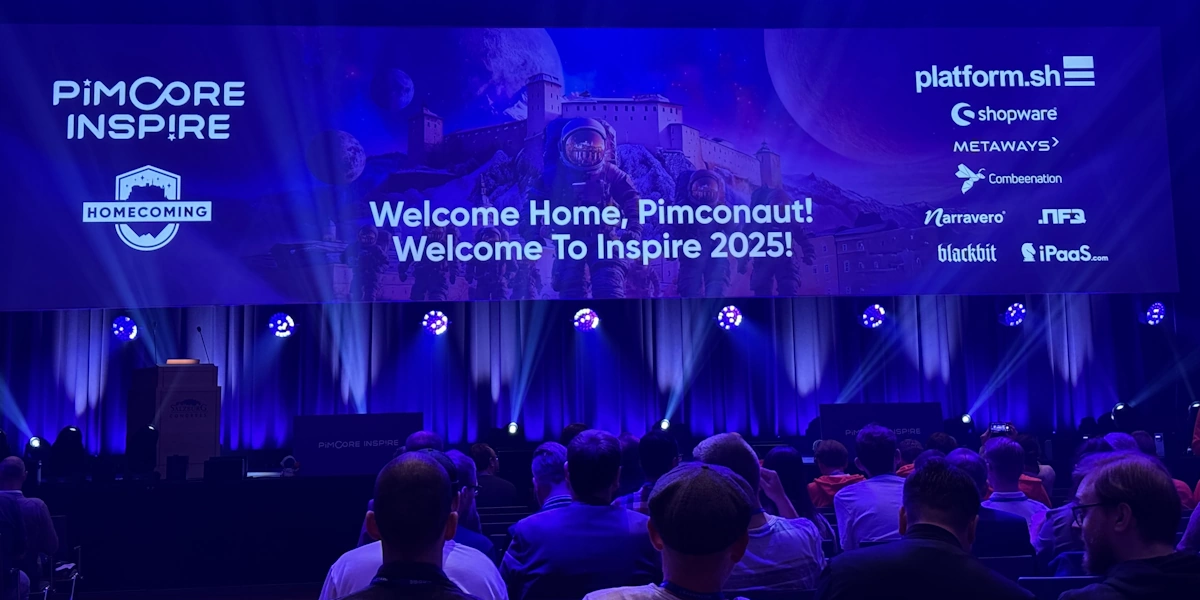
 To celebrate its 15th anniversary, Pimcore returns to Salzburg and unveils its roadmap for the coming years. From its technological vision to product repositioning and business model evolution, DATASOLUTION— Pimcore’s long-standing partner in France—breaks down the key takeaways.
The 2025 edition provided an opportunity to announce several major developments, which we will analyze in detail in a series of upcoming articles:
- Pimcore Studio: New Interface, New Uses
- Pimcore 2025.1: What’s New in the Latest Version
- Pimcore POCL: Understanding the New Open Core License
Table of Contents
- Pimcore: From a Modular Platform to a Unified PXM Suite
- Opening Keynote: Orchestrating, Rather Than Following
- Gartner Takes the Stage: PXM Is No Longer a Niche
- A day packed with product launches (Pimcore Studio, Pimcore Copilot…)
- Pimcore Announces Its New License: Pimcore Open Core License (POCL)
- What This Means (or Will Mean) for Businesses
On April 29, 2025, more than 400 participants gathered to attend Pimcore Inspire, the Austrian software company’s flagship event.
Fifteen years after the platform’s launch, this conference was not just a return to its roots. It marked a turning point: a shift in strategic direction, both in terms of the product offering and the way Pimcore now engages with businesses.
Pimcore: From a Modular Platform to a Unified PXM Suite
At the heart of the announcements: a clarification of the company’s positioning. Pimcore now fully embraces its role as a PXM (Product Experience Management) platform. It’s no longer just about structuring product data or managing media: the goal isto orchestrate the entire product experience in a centralized, open, and high-performance manner.
This repositioning is supported by a comprehensive suite of features:
- PIM and MDM for Structured Product Data
- DAM for Digital Assets
- DXP for creating personalized journeys
- CDP for Customer Data Consolidation
- And native interoperability with e-commerce environments
Need a refresher on the basics? Check out our how-to guides on
The message is clear: Pimcore aims to be the single platform that replaces fragmented tech stacks. And analysts agree:
- Inclusion in the Gartner DXP Magic Quadrant
- Positioning as a PIM/PXM leader at IDC and ISG
In a landscape where companies are seeking to streamline their tools, automate their processes, and personalize their customer journeys, Pimcore positions itself as a comprehensive and cost-effective alternative.
Opening Keynote: Orchestrating, Rather Than Following
The conference kicked off with a keynote address rich in strategic insight. Pimcore no longer merely asserts its ability to support businesses; the company now positions itself asan active orchestrator of their transformation.
This vision is structured around three pillars:
- The integration of artificial intelligence, via Pimcore Copilot, is designed to assist users with data management, workflow optimization, and content generation
- A completely redesigned user experience, featuring Pimcore Studio—a modern, modular interface designed for specific business roles
- A technical architecture that is fully compatible with composable and MACH approaches
The vocabulary used (orchestration, convergence, experience) is no accident. It reflects a profound shift in direction: Pimcore no longer wants to be just a flexible toolkit. The ambition is now to offer an integrated platform that manages product data from the back office to the omnichannel front end.
Gartner Takes the Stage: PXM Is No Longer a Niche
A highlight of the day was the presentation by Mike Lowndes, VP Analyst at Gartner, which helped put Pimcore into a broader context. A few years ago, PXM was still viewed as an optional add-on to PIM. Today, it has become a fundamental requirement.
According to Gartner, successful brands are those that have a firm grasp of their product repositories while orchestrating their activation at scale, within a composable, data-driven model. PXM represents the convergence of these needs.
And that’s exactly where Pimcore aims to make its mark.
The “best-of-suite” model, which until now has been seen as a competitor to “best-of-breed” approaches, is reimagined here: rather than being a compromise, it becomes a driver of simplification and strategic alignment.
A day packed with product launches (Pimcore Studio, Pimcore Copilot…)
The day featured a series of live demonstrations and product launches, with three highlights:
- Pimcore Studio: a redesigned interface focused on business use cases, fast navigation, and customizable dashboards (comprehensive analysis coming soon)
- Pimcore Copilot: an AI implementation embedded at the core of the platform to assist users and automate certain critical tasks
- A more modular technical foundation: a new extension model, improved API compatibility, and support for cloud-native scenarios
Each of these building blocks will be explored in detail in our series of articles, but the key takeaway here is the overall coherence: Pimcore is accelerating its transformation into a platform driven by business performance and user experience.
Pimcore announces its new license: the Pimcore Open Core License (POCL).
Latest key announcement: Pimcore’s transition to a new licensing model, the Pimcore Open Core License (POCL).
The GPLv3 license, which Pimcore has historically used, imposed several limitations on cloud integrators and companies with stringent legal compliance requirements. POCL provides clarification:
- The platform’s core remains open source
- Advanced modules (analytics, AI, premium connectors) are available under a commercial license
- The whole thing becomes more readable, stable, and suitable for professional environments
This development does not call into question the platform’s open-source DNA, but it reflects a clear commitment to ensuring the product’s growth amid widespread adoption.
What This Means (or Will Mean) for Businesses
What Pimcore Inspire 2025 ultimately reveals is that the platform is moving beyond a “technical” cycle and entering a phase of ecosystem-based structuring. Pimcore is becoming a unified and streamlined environment for leveraging product and customer data.
For organizations, this means:
- A need to rethink their reference architecture
- An opportunityto accelerate the automation of business processes
- The Need toSupport Users Through Change
Pimcore Inspire 2025 marks a clear turning point: the beginning of a new phase of product maturity. More than just a flexible open-source platform, Pimcore is establishing itself as a comprehensive strategic solution for companies that want to regain control of their product experience at every level.
At DATASOLUTION, we are closely monitoring this trend and developing the appropriate content, methods, and tools to support our clients in this new era.
To receive our upcoming articles on Pimcore Studio, version 2025.1, and the POCL, or to ask our teams questions
Related articles
Visit the blog
ChatGPT Ads on Shopify and HubSpot: What This Means for E-commerce Businesses and Marketing Teams in France
02/10/2026
Fine-tuning LLMs in the Enterprise: Better Than a Frontier Model?
28/09/2026

OroMomentum: AI for B2B efficiency
22/09/2026

AI: The 5 Top Stories of Summer 2026
17/09/2026

Content management on Magento: how to give marketing teams back control with Hyvä CMS
17/08/2026