CRM & ERP Agency for unified customer relationship management
Customer relationship management no longer relies on a single tool: it depends on data quality, the efficiency of business processes, and the integration between CRM, ERP, e-commerce, and line-of-business tools.
DATASOLUTION supports you in selecting, integrating, and optimizing your CRM and ERP solutions to create a more reliable, transparent, and high-performing ecosystem.
Some figures
What are the customer challenges?
Many companies already have a CRM, an ERP, an e-commerce tool, invoicing software, a customer service system, and sales files. The problem, therefore, does not always stem from a lack of tools, but rather from their lack of integration.
The customer relationship management deteriorates when teams don’t share the same information: a sales rep can’t see the latest orders, customer service doesn’t know the billing history, marketing segments based on incomplete data, and sales administration has to re-enter information into another software system. Over time, these friction points lead to errors, slow down sales, and undermine the customer experience.
The most common issues are clear:
-
#01
Customer data scattered across CRM, ERP, e-commerce, support, marketing automation, and internal files.
-
#02
Business processes difficult to understand, with poorly defined workflows for sales, quotes, orders, and follow-ups.
-
#03
Re-entry and duplicates, which cause errors and slow down teams.
-
#04
Lack of a 360° customer view, particularly in B2B, retail, distribution, and e-commerce.
-
#05
Underutilized sales management software, poorly integrated with the CRM, or too far removed from business needs.
-
#06
Difficulty managing performance due to a lack of reliable metrics on the sales cycle, opportunities, margins, orders, or customer satisfaction.
A CRM & ERP project must therefore address a key question: How can we create a system in which customer, sales, and operational data flows seamlessly?
Solutions and services
We accompaniedyou with e-commerce projects from start to finish, from strategic planning to ongoing operations. Our goal: to design a platform tailored to your business model, your organization, your IT constraints, and your growth ambitions.
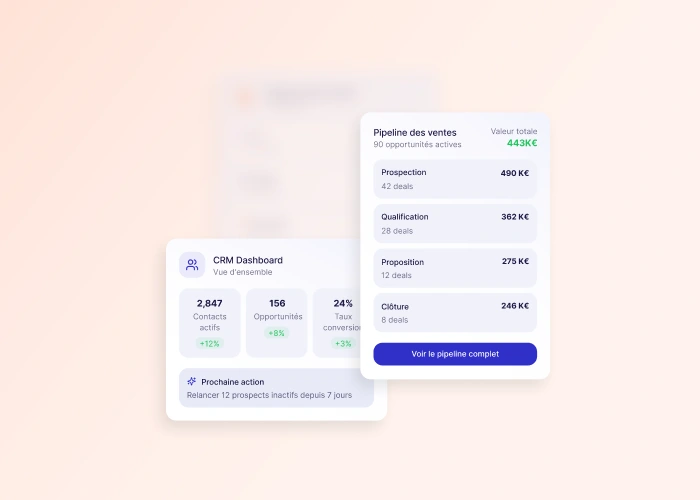
CRM: Centralizing customer relationships
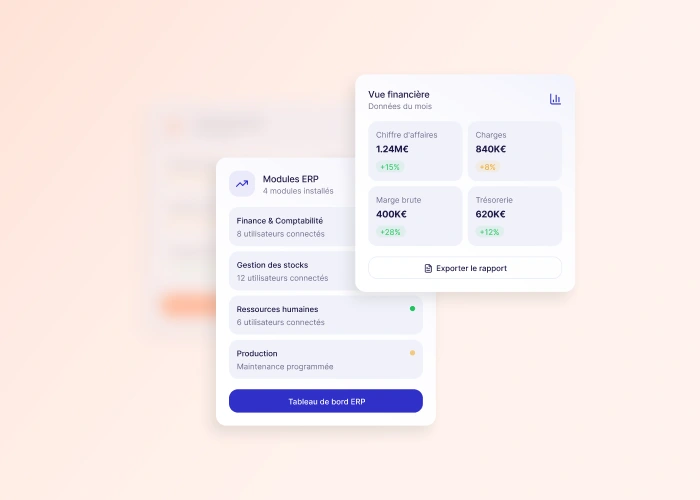
ERP: Structuring sales and operations management
Why should you choose us for your sales management software?
Contact a CRM & ERP Expert
A CRM, Data, and IT Approach
DATASOLUTION treats customer relations as a cross-functional priority, linking data, sales, marketing, customer service, finance, and e-commerce.

CRM expertise enhanced by HubSpot
As a HubSpot partner agency, DATASOLUTION combines CRM, data, and AI to transform your marketing and sales ecosystems into drivers of performance.

A Practical and Scalable ERP Vision
Using Odoo, DATASOLUTION supports sales management, e-commerce, accounting, inventory, and CRM in a way that is both operational and scalable.
The Methodological Approach
Context: Understanding Your Journey and Your Pain Points
We analyze your customer journeys, business processes, existing tools, data flows, and pain points. This step identifies priorities: CRM, ERP, integration, migration, automation, or governance.
Design: Defining the Target Model
We organize the key objects: accounts, contacts, leads, opportunities, orders, quotes, invoices, products, tickets, user roles, and performance metrics.
Integration: Connecting Business Tools
We set up integrations between CRM, ERP, e-commerce, PIM, marketing automation, billing tools, customer support, and reportingsystems.
Adoption: Empowering Teams
A CRM or ERP system rarely fails because of the technology alone. Usage patterns, training, business rules, and team buy-in determine the project’s success.
Optimization: Improving Over Time
Once the platform is deployed, we optimize workflows, dashboards, automations, quality rules, and operational scenarios.
Our CRM and ERP Partners
Our selection of partner solutions is based on our experience in the digital sector. Our vendor-neutral approach allows us to identify and recommend the best solutions on the market.
FAQ: your questions about CRM and ERP
CRM manages customer relationships: prospects, accounts, opportunities, interactions, marketing, and service. ERP manages operational processes: orders, inventory, billing, purchasing, accounting, and production.
It all depends on the top priority. If your teams are losing leads or failing to follow up with customers, start with the CRM. If your ordering, inventory, or billing processes are causing errors, the ERP becomes the priority.
Not really. Sales management software organizes sales, quotes, orders, and invoices. CRM manages the customer relationship before, during, and after the sale.
To eliminate duplicate data entry, ensure the accuracy of customer information, align teams, and provide a comprehensive view of the sales cycle.
The duration depends on the scope, the number of tools to be connected, the data to be migrated, and the level of customization. A scoping exercise helps define a realistic timeline.
Contact an expert
Latest articles
Visit the blog
ChatGPT Ads on Shopify and HubSpot: What This Means for E-commerce Businesses and Marketing Teams in France
02/10/2026
Fine-tuning LLMs in the Enterprise: Better Than a Frontier Model?
28/09/2026

OroMomentum: AI for B2B efficiency
22/09/2026
AI: The 5 Top Stories of Summer 2026
17/09/2026

Content management on Magento: how to give marketing teams back control with Hyvä CMS
17/08/2026