Agent-Based AI & RAG: Designing AI agents connected to your data
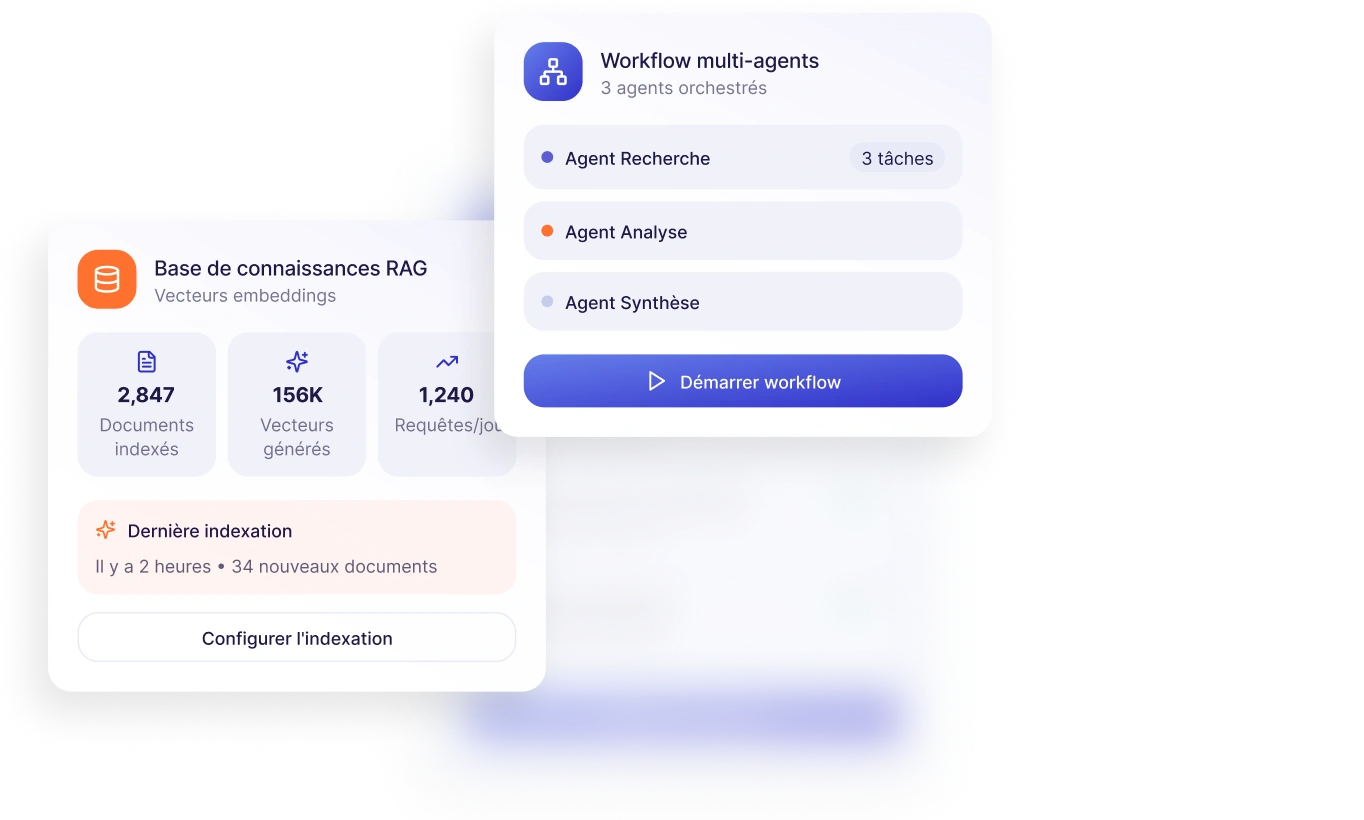
An AI agent becomes truly useful when it understands your business context, queries the right sources, and provides a actionable response. That is the whole point of RAG andagent-based AI: connecting AI models to your content, knowledge bases, and internal tools to produce answers that are more reliable, traceable, and tailored to your needs.
We support companies in the design, scoping, and scaling of solutions that combine RAG (retrieval-augmented generation), agent orchestration, semantic search, embeddings, and human oversight when the level of risk requires it.
What are the capabilities of agent-based AI combined with RAG?
RAG addresses a simple need: to enable AI to draw on internal information rather than relying solely on its general knowledge.Agent-based AI goes a step further: it can chain together multiple actions, call upon different tools, compare sources, and follow a task-based logic.
In practical terms, this approach makes it possible to create:
- Assistants capable of searching a document database, a PIM, a CRM, or an intranet
- Agents specialized by function: customer support, sales support, product research, document analysis, and support for business teams
- Systems capable of processing structured and unstructured data
- Workflows with human-in-the-loop validation to maintain control over sensitive decisions
When should you consider an agent-based AI project?
An RAG or agent-based project becomes relevant when your teams are wasting time searching for, cross-referencing, or rephrasing information.
Several factors make this a priority:
-
#01
Domain knowledge is scattered across documents, tickets, internal tools, and databases
-
#02
Support, sales, and product teams often answer the same questions
-
#03
Internal search engines return too many results that are of little use
-
#04
Your content exists, but it remains difficult to use in the right contexts
-
#05
Do you want to automate certain tasks without losing business control?
-
#06
Your AI use cases require well-sourced, verifiable, and contextualized answers
Our Agent-Based AI & RAG Solutions
We approach each project as a complete value chain, from defining the use case to deployment. Our goal: to create useful, robust, and measurable agents tailored to your business requirements.
Tell us about your AI project-
- Analysis of Business Needs, Operational Pain Points, and Expected Benefits
- Identifying available data sources: documents, FAQs, product databases, CRM, ERP, support tickets, web content
- Prioritizing use cases based on their value, feasibility, and level of risk
-
- Document pipeline design: ingestion, cleaning, segmentation, indexing
- Implementation of embedding to match user queries with relevant content
- Defining search rules and scoring and source display
-
- Development of agents capable of utilizing multiple tools as needed
- Orchestration between document search, API calls, internal databases, and business operations
- Can be integrated with suitable , including Spring AI, depending on the technical environment
-
- Definition of safeguards: access rights, authorized sources, scope of responses
- Implementation of human oversight for critical decisions
- Tracking errors, poor responses, and areas needing improvement
-
- Tests for relevance, response quality, latency, and robustness
- Monitoring of usage, logs, user feedback, and resolution rates
- Continuous optimization of prompts, indexes, embeddings and orchestration rules
Why should you entrust your agent-based AI & RAG project to us?
Contact an expert
A business-first approach
A high-performing AI agent isn’t limited to a single model. It relies on a solid understanding of processes, data, users, and the decisions it is designed to support.

Architectures Designed for Business
We build solutions that can integrate with your IT system, respect your access rights, and manage multiple sources of information without compromising your existing infrastructure.

Useful agents, not demonstrators
Each use case is evaluated based on specific criteria: quality of responses, time saved, adoption by teams, reduction in repetitive tasks, and scalability.
Our Agent-Based AI & RAG Methodology
Scoping: Turning an AI Idea into a Workable Use Case
We start with business needs: who uses the agent, for what task, with what data sources, and with what level of autonomy and human oversight. This phase helps us distinguish between simple use cases, high-potential scenarios, and those that require enhanced safeguards.
Build: Connect the agent to the correct data
We are building the technical foundation: document ingestion, processing of structured data and unstructured data, vector index, logic ofagent search, prompts, connectors, and orchestration rules. The goal remains clear: to provide a useful, contextualized, and verifiable response.
Validation: Testing Relevance Before Mass Production
An AI agent must be evaluated using real-world cases. We test the responses, the sources used, the agent’s limitations, the risk of error, and the need for validation human in the loop. User feedback drives these adjustments.
Deployment: Moving from Prototype to Business Use
We support deployment, monitoring, and continuous improvement. The agent evolves alongside your content, your business rules, and your feedback from the field.
FAQ: Your questions about agentic AI and RAG
RAG enables an AI model to search for information in your sources before responding. Agent-based AI adds decision-making logic: the agent can decide which steps to take, which tools to use, and how to sequence multiple tasks.
A RAG project can utilize PDF documents, web pages, product databases, support tickets, CRM content, tables, FAQs, or business data. The task involves preparing this content so that it is searchable, reliable, and accurately presented.
Not always. Having a human in the loop becomes essential when an agent is handling sensitive decisions, critical data, or actions that impact business operations. For tasks such as assistance or document research, spot checks may be sufficient.
Contact an expert
Latest articles
Visit the blog
ChatGPT Ads on Shopify and HubSpot: What This Means for E-commerce Businesses and Marketing Teams in France
02/10/2026
Fine-tuning LLMs in the Enterprise: Better Than a Frontier Model?
28/09/2026

OroMomentum: AI for B2B efficiency
22/09/2026
AI: The 5 Top Stories of Summer 2026
17/09/2026

Content management on Magento: how to give marketing teams back control with Hyvä CMS
17/08/2026