Move to Cloud: how to successfully migrate to the cloud
Infrastructure that is difficult to scale, high operating costs, a lack of visibility into security, aging applications, and the need for greater availability: the move to the cloud is becoming a key driver for modernizing your information system.
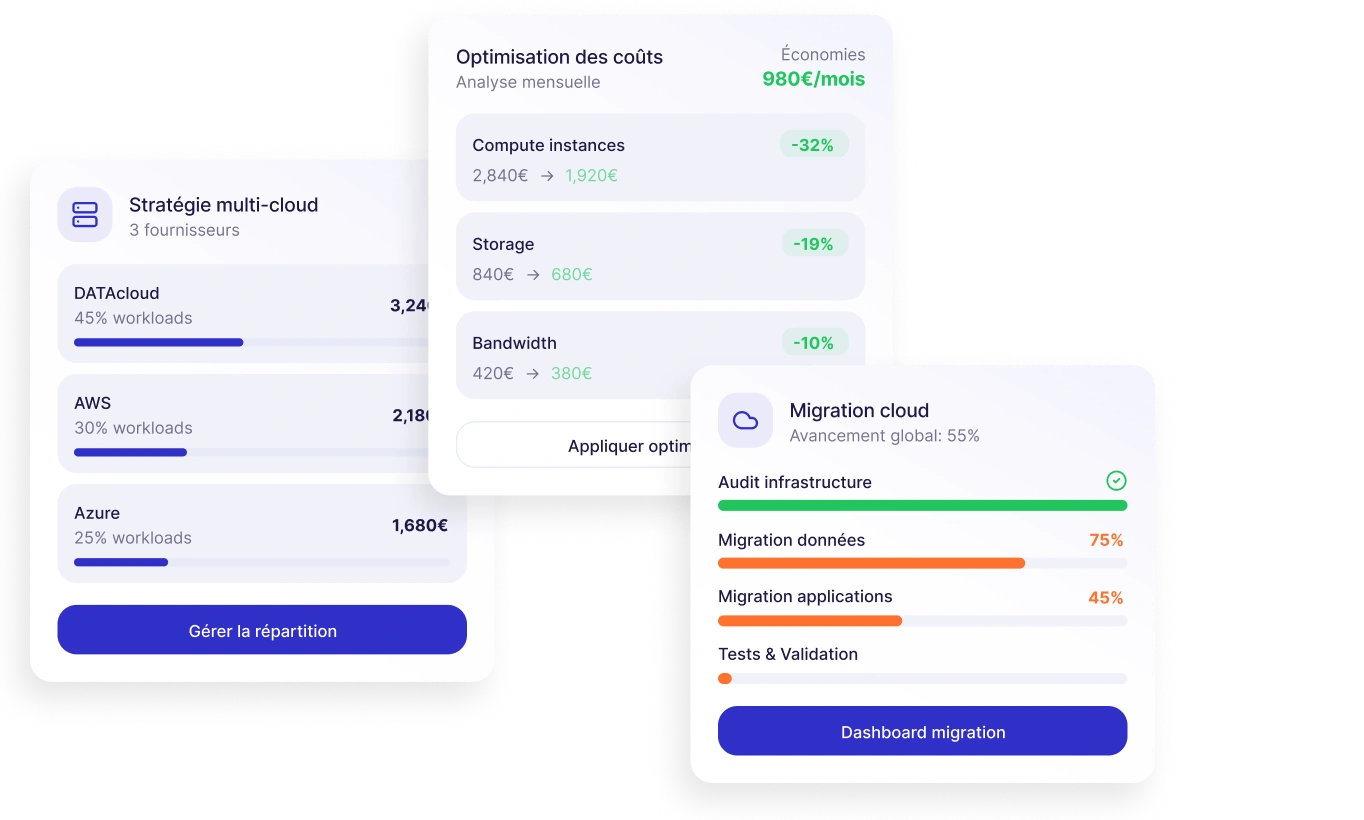
We support companies in their migration to the cloud, from auditing their current infrastructure to the day-to-day operation of their environment. The goal: to build a more flexible architecture that is better managed and aligned with your business needs.
When should you consider migrating to the cloud?
A migration to the cloud becomes a viable option when the current infrastructure hinders projects or increases operational risks.
There are several warning signs to watch for:
-
#01
Internal or outsourced servers reaching the end of their lifecycle
-
#02
Costly maintenance that adds little value for the teams
-
#03
Performance or availability issues with mission-critical applications
-
#04
Difficulty integrating business systems: ERP, CRM, PIM, WMS, e-commerce platform
-
#05
Backups, disaster recovery plans, or business continuity plans that are not robust enough
-
#06
A need for more flexible hosting to support growth
-
#07
A desire to centralize operations using acloud hosting and managed services
The cloud offers flexibility, but it requires a solid framework. A poorly planned migration can result in additional costs, service interruptions, or an architecture that is too complex to maintain.
Our "Move to Cloud" Offering
We treat every cloud project as a gradual transformation, not just a technical migration. Our support covers auditing, target architecture, migration, security, and operations.
-
- Analysis of the current infrastructure, servers, applications, workflows, and dependencies
- Identification of workloads eligible for the cloud, to be retained, rearchitected, or decommissioned
- Risk Assessment: Availability, Security, Performance, Technical Debt, Hidden Costs
-
- Help with choosing cloud hosting based on your needs: public, private, hybrid, or sovereign
- Definition of the target architecture: network, security, storage, backups, monitoring
- Recommendation between private cloud hosting, public cloud, or cloud hosted in France, depending on your data, compliance, and business criticality requirements
-
- Phased migration plan by application, environment, or business unit
- Pre-production testing, performance validation, and data security
- Controlled switching with rollback procedures when the situation requires it
-
- Implementation of a enterprise cloud hosting solution tailored to mission-critical applications
- Monitoring, maintenance, backups, updates, and incident tracking
- Ongoing monitoring of costs, performance, and availability
Why should you entrust your move to the cloud to DATASOLUTION?
Contact one of our cloud experts
A business-oriented cloud approach
We start with your actual usage patterns: mission-critical applications, data volumes, IT constraints, business dependencies, peak activity periods, and security requirements. The cloud should support your organization, not add another layer of complexity.

A well-managed migration, without a tunnel effect
Each step is documented: audit, target architecture, migration plan, testing, acceptance testing, cutover, and operations. You maintain visibility into technical decisions, priorities, and risks.

Cloud hosting managed over the long term
Once the migration is complete, the focus shifts to operations. With an approach that combines cloud hosting and managed services, your environments remain monitored, maintained, and adjusted as your business evolves.
Our "Move to Cloud" Methodology
Scope: Understanding Best Practices Before Migrating
We analyze your existing technical and business infrastructure: applications, data, dependencies, security constraints, expected availability levels, and current costs. This phase allows us to prioritize migrations and avoid unnecessary switchover.
Design: Designing a Reliable Cloud Architecture
We define a target architecture tailored to your organization: cloud hosting in France, private cloud, public cloud, or a hybrid model. The design incorporates networking, backup, security, monitoring, and business continuity.
Migration: Transition Gradually and Manage Risks
The migration is carried out in batches, including testing, acceptance testing, and performance validation. Critical applications are handled with special care to minimize disruptions and ensure data security.
Run: Operate, Monitor, and Optimize
Once the environments are in production, we provide operational support, including monitoring, managed services, cost optimization, updates, backups, and support for internal teams.
FAQ : your questions about move to cloud
A “move to cloud” project involves transferring part or all of an information system to a cloud infrastructure. This may include applications, databases, servers, e-commerce environments, business tools, or internal solutions. The goal is to gain flexibility, security, and scalability.
When choosing a cloud hosting solution, you need to compare several criteria: application criticality, data location, expected security level, budget, performance, monitoring, backups, managed services needs, and regulatory constraints. Cloud hosting in France or private cloud hosting may be appropriate when issues of sovereignty, confidentiality, or control are of high importance.
Cloud hosting refers to the infrastructure that hosts your applications and data. Managed services cover day-to-day operations: monitoring, maintenance, updates, backups, security, and support. Combining cloud hosting with managed services ensures that you have a cloud environment that is monitored, maintained, and optimized over the long term.
Contact an expert
Latest articles
Visit the blog
ChatGPT Ads on Shopify and HubSpot: What This Means for E-commerce Businesses and Marketing Teams in France
02/10/2026
Fine-tuning LLMs in the Enterprise: Better Than a Frontier Model?
28/09/2026

OroMomentum: AI for B2B efficiency
22/09/2026

AI: The 5 Top Stories of Summer 2026
17/09/2026

Content management on Magento: how to give marketing teams back control with Hyvä CMS
17/08/2026