Digital Sovereignty consulting agency
Sensitive data, reliance on non-European suppliers, the cloud, cybersecurity, compliance, business continuity: digital sovereignty is becoming a strategic issue for businesses and public organizations.
We support business, IT, security, and procurement departments in charting a more controlled digital path: infrastructure selection, data governance, trusted cloud solutions, application architecture, cybersecurity, and reducing critical dependencies.
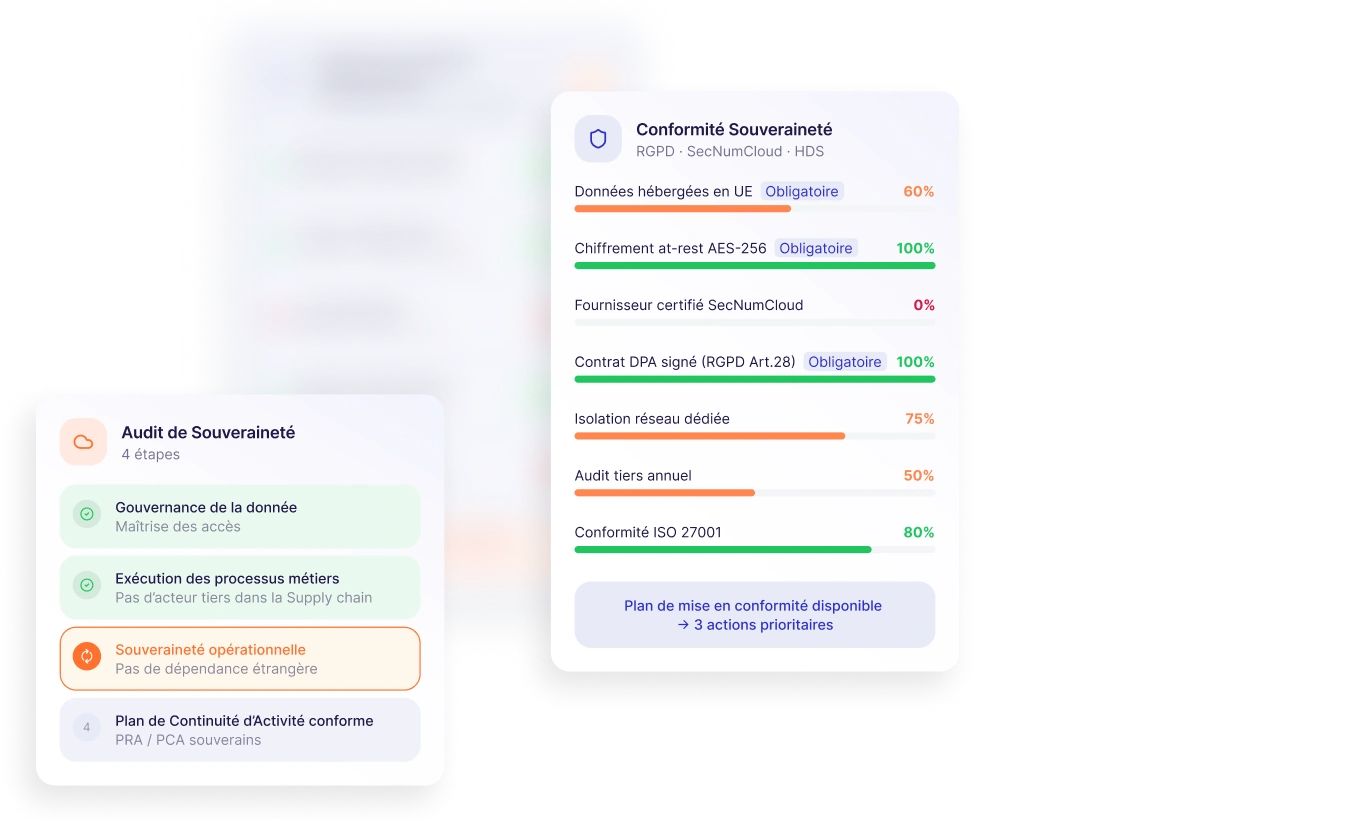
What does digital sovereignty really entail?
Digital sovereignty does not mean doing everything in-house or rejecting international solutions.
Its primary goal is to maintain control over its technology choices, data, infrastructure, and dependencies.
It covers several aspects:
- Data location and protection, particularly when the data is sensitive, strategic, or subject to regulation
- The selection of cloud, SaaS, and managed service providers, with a focus on legal, technical, and contractual dependencies
- Reversibility, to prevent an organization from becoming stuck with a service provider it cannot leave
- Cybersecurity, because digital proficiency also depends on the ability to prevent, detect, and respond
- Interoperability: Connecting Tools Without Trapping the Company in a Closed Ecosystem
Some Statistics on Digital Sovereignty
When should a digital sovereignty strategy be developed?
This issue becomes a priority as soon as an organization becomes heavily reliant on tools, hosting providers, or platforms that support critical operations.
There are several warning signs to watch for:
-
#01
Customer, HR, financial, or industrial data hosted without a clear understanding of the risks.
-
#02
Proliferation of SaaS tools with little oversight from the IT department.
-
#03
Heavy reliance on a single cloud provider.
-
#04
Difficulty retrieving, migrating, or utilizing your own data.
-
#05
Contracts that lack clarity regarding location, access, or reversibility.
-
#06
AI or data roadmaps requiring better data governance.
Our support for Digital Sovereignty
We approach digital sovereignty as a gradual process. The goal is not to replace all tools, but to prioritize risks, secure key decisions, and chart a realistic course.
-
- Mapping of cloud, SaaS, hosting, data, AI, and cybersecurity solutions
- Analysis of critical suppliers, contracts, data flows, and dependency levels
- Risk Identification: Data Access, Reversibility, Compliance, Business Continuity
-
- Evaluation of Scenarios: Public Cloud, Private Cloud, Hybrid Cloud, Trusted Cloud
- Recommendations Based on Data Sensitivity and Business Constraints
- Defining a clear target architecture that is compatible with your current and future needs
-
- Classification of Data by Criticality
- Definition of rules governing access, storage, transfer, and retention
- Alignment with data, AI, CRM, ERP, PIM, and e-commerce projects
-
- Supplier Lock-in Risk Analysis
- Establishment of open and documented architectural principles
- Preparing plans for exit, migration, or a change in service provider
-
- Incorporating Security Requirements from the Scoping Phase Onward
- Review of Backups, Access, Monitoring, and Disaster Recovery Plans
- Alignment with the operational constraints of IT and business teams
Why should you entrust us for your digital sovereignty strategy?
Contact one of our experts
A business-oriented approach, not just a technical one
Digital sovereignty isn’t limited to choosing a hosting provider. We analyze your actual usage patterns, data flows, tools, and business constraints to develop a practical roadmap.

Clear trade-offs between risk, cost, and performance
Each recommendation must be clear and actionable: what is critical, what can wait, and what needs to be secured as a priority. You maintain a clear understanding of the technical, budgetary, and organizational impacts.

A path that aligns with your digital initiatives
E-commerce overhauls, cloud migration, data projects, AI, ERP, CRM, PIM: We integrate digital sovereignty into your existing projects without creating a theoretical roadmap that’s disconnected from reality.
Our Approach to Digital Sovereignty
Scope: Understanding Risks and Priorities
We begin by aligning the teams around the key issues: sensitive data, critical applications, supplier dependencies, regulatory constraints, and business objectives. This phase allows us to establish a shared understanding of the situation and avoid decisions based solely on technical considerations.
Mapping: Making Dependencies Visible
We analyze tools, infrastructure, contracts, data flows, and integrations. This mapping exercise highlights areas of vulnerability: single vendors, mislocated data, low reversibility, insufficient documentation, and fragmented governance.
Roadmap: Prioritize Effective Actions
The roadmap distinguishes between immediate actions, structural initiatives, and long-term trade-offs. The goal: to reduce risks without stifling innovationor slow down digital projects already underway.
Deployment: Supporting Teams
We support the implementation process: selecting solutions, defining project scope, governance, documentation, and knowledge transfer. Digital sovereignty becomes a lasting habit, not a one-time audit.
FAQ : yours questions about digital sovereignty
Digital sovereignty refers to an organization’s ability to maintain control over its data, infrastructure, software, suppliers, and technology choices. It aims to limit critical dependencies and strengthen security, reversibility, and business continuity.
No. The point is not to reject any international solution, but to make an informed choice. Depending on the specific circumstances, a European, French, open-source, hybrid, or international solution may be appropriate, provided that the risks are identified and managed.
The most useful starting point is still mapping: sensitive data, critical suppliers, cloud solutions, contracts, integrations, and dependencies. This overview then makes it possible to prioritize actions: security, reversibility, governance, migration, or architectural changes.
Contact an expert
Latest articles
Visit the blog
ChatGPT Ads on Shopify and HubSpot: What This Means for E-commerce Businesses and Marketing Teams in France
02/10/2026
Fine-tuning LLMs in the Enterprise: Better Than a Frontier Model?
28/09/2026

OroMomentum: AI for B2B efficiency
22/09/2026

AI: The 5 Top Stories of Summer 2026
17/09/2026

Content management on Magento: how to give marketing teams back control with Hyvä CMS
17/08/2026