13 January 2025
MDM, PIM, DAM… What does each one do?
 Today, industry experts agree that we’re at the peak of the data era. But often, even with a basic understanding, making sense of all this information isn’t easy! Especially when there are various IT solutions in use, some more user-friendly than others… You know this all too well, don’t you? And even though the data and information flowing through a company are considered the new black gold, knowing how to manage them to reap the benefits is no easy task!
MDM, PIM, DAM, CMS… All these terms are acronyms that pop up everywhere when it comes to managing business data. But it can be hard to make sense of them all. So, between Master Data Management (MDM), Product Information Management (PIM), and Digital Asset Management (DAM)… What does each one do, and what challenges do they address?
MDM: Your Partner in Finally Breaking Down Data Silos
What is Master Data Management (MDM)?
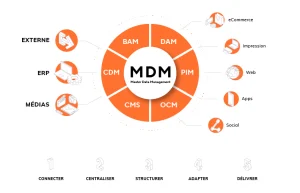
Master Data Management (MDM), as applied to Martech, is a marketing data management system that brings together all the elements required to execute your marketing efforts. This solution enables you to define, store, and distribute all master data at the core of the business. While historically DAM (Digital Asset Management) and later PIM (Product Information Management) were the most widely used or well-known systems, MDM breaks down the various silos to manage, correct, and share your data within a single database.
An MDM allows you to connect, manage, and share data from all of your company's departments. This gives you a 360° view of your information. The data is up-to-date, consistent, and free of duplicates.
Why use Master Data Management (MDM)?
By using an MDM, you can eliminate the multitude of information silos and centralize them into a single, authoritative solution. Through this optimization, you can increase the efficiency of internal tasks and improve collaboration across departments. You can also streamline and automate data processing workflows, which enhances the customer experience and reduces regulatory risks (such as those related to the GDPR).
Who needs Master Data Management (MDM)?
While the structure of very large companies may justify separate solutions and siloed data management, mid-sized companies and small and medium-sized enterprises (SMEs) have every reason to centralize their data. All the different types of data, consolidated in the DAM and PIM, are centralized in the MDM and enriched with other types of data. For example, customer information for personalized marketing, or logistical or technical information… In any case, a single tool for all the data you need to produce your marketing materials.
A major competitive advantage, Master Data Management (MDM) streamlines the entire business process chain so that you can focus on what really matters: improving performance.
What types of data are managed in a Master Data Management (MDM) system?
For mid-sized companies, using separate tools is unnecessary and can even be counterproductive. By definition, MDM manages all of the company’s master data that is widely shared, such as customers, products, suppliers, employees, locations, organizations, etc.
Although MDM aggregates PIM and DAM data in addition to other data, it’s important to note that it systematically manages all types of data. By incorporating these two concepts, MDM aggregates product information for the storage and management of images intended for print, web, and social media channels.
More broadly speaking, MDM—as a solution directly linked to Martech (Marketing Technologies)—is in fact THE concept of the future for data management in marketing and corporate communications, given its ability to centralize, simplify, and improve data governance.
PIM: Take Care of Your Product Information
What is a PIM?
PIM, which stands for Product Information Management (or Gestion de l’Information Produit, or GIP, for French speakers), is one of the types of data involved in managing and distributing product information content to sales channels: e-commerce sites, printed product catalogs, websites, and more. This ensures that the content is always up to date and, most importantly, optimized for search engine optimization (SEO).
Simply put, the PIM centralizes and standardizes all of your product descriptive information—SKUs, descriptions, translations, images, technical data, dimensions, and more. Once this data is centralized, structured, and validated, it can be distributed across all the channels you wish to target.
Why use a PIM?
A company’s success depends on its ability to respond quickly to a competitive market. In other words, your team members must provide a significant amount of information across various distribution channels. The solution is, quite simply, high-quality and consistent product data—everywhere. The idea is to stop wasting time searching for the right data and instead consolidate it all into a single system: the PIM. Say goodbye to those endless Excel files that ruin your data!
A fully optimized PIM ensures that your product information is disseminated more effectively to your consumers, distributors, and various intermediaries. The primary goal is to reduce both dissemination times and costs.
Who needs a PIM?
Whether you’re a marketer, an IT manager, an e-commerce manager, or a buyer… If you’re committed to ensuring consistent data across all your channels and strengthening your relationships with suppliers and customers, then PIM is right for you. The quality of the products listed on an e-commerce site or featured in a catalog will inevitably have a positive impact on sales.
Ultimately, PIM is useful for the vast majority of businesses (retail, B2B and B2C, e-commerce, export, etc.). No matter what industry you’re in, if your goal isto achieve a significant and rapid ROI, you need to manage your product information from start to finish.
The advantage of PIM is that it is accessible to all your employees, across all departments in your company. It will be an invaluable solution for optimizing your performance.
What data is managed in a PIM?
Marketing data, media files, design data, technical data, user data… In short, a PIM essentially manages the data and information related to your products and product catalogs. Overall,e-commerce has made the types of information required —such as descriptions, photos, and videos—more complex. But that’s not the only reason. The multitude of marketplaces also contributes to this wealth of information. These factors have changed significantly since companies began shifting toward a new digital dimension, moving away from catalog-based mail-order sales in favor of direct sales.
 DAM: Keep Your Digital Assets Safe and Secure
What is a DAM?
Digital Asset Management is designed to manage and store a company’s digital assets. This terminology (Digital Asset Management or Digital Asset Management) originates from the banking sector, where asset management is one of the fundamental concepts. Consequently, when it came time to conceptualize how the company should carry out its digital transformation in this area, the same terminology was adopted. With the goal of improving employees’ working conditions, DAM brings all your visual content (photos, videos, music, presentations, projects, etc.) together in one place.
This solution offers enhanced security (compared to on-premises storage) and helps prevent data loss or theft.
Why use a DAM?
A DAM is useful for organizational purposes within a company, particularly in reducing the time it takes for various departments (such as marketing and design) to search for digital resources (files such as images, videos, audio, logos, PDFs, etc.). Thanks to advanced search tools, users can categorize and organize content according to defined criteria: keywords, format, type, etc.
Distributing and sharing resources on a website or on social media is significantly easier. Digital channels are multiplying and require an ever-increasing number of visuals, which contributes to the exponential growth in the number of graphic files that need to be produced. With features each more powerful than the last, DAM has proven to be one of the most popular solutions today. Indexing, metadata management, the use of tags and keywords, and powerful, dynamic search capabilities —DAM makes your day-to-day work easier and offers an exceptional user experience.
Who needs a DAM?
A DAM is useful for companies that publish and share large amounts of content. Take, for example, communications agencies, advertising agencies, and marketing departments. In other words, virtually all companies need a DAM solution.
What types of data are managed in a DAM?
Once again, it's nothing complicated! It simply refers to all of a company's digital resources and files, such as photos, videos, audio files, text files, and so on. In short, it's about quickly storing, searching, enriching, organizing, and sharing thousands of them.
Need help defining the scope of your project? Call on our experts!
Related articles
Visit the blog
ChatGPT Ads on Shopify and HubSpot: What This Means for E-commerce Businesses and Marketing Teams in France
02/10/2026
Fine-tuning LLMs in the Enterprise: Better Than a Frontier Model?
28/09/2026

OroMomentum: AI for B2B efficiency
22/09/2026

AI: The 5 Top Stories of Summer 2026
17/09/2026

Content management on Magento: how to give marketing teams back control with Hyvä CMS
17/08/2026