MDM Agency: ensuring the reliability of your Master Data
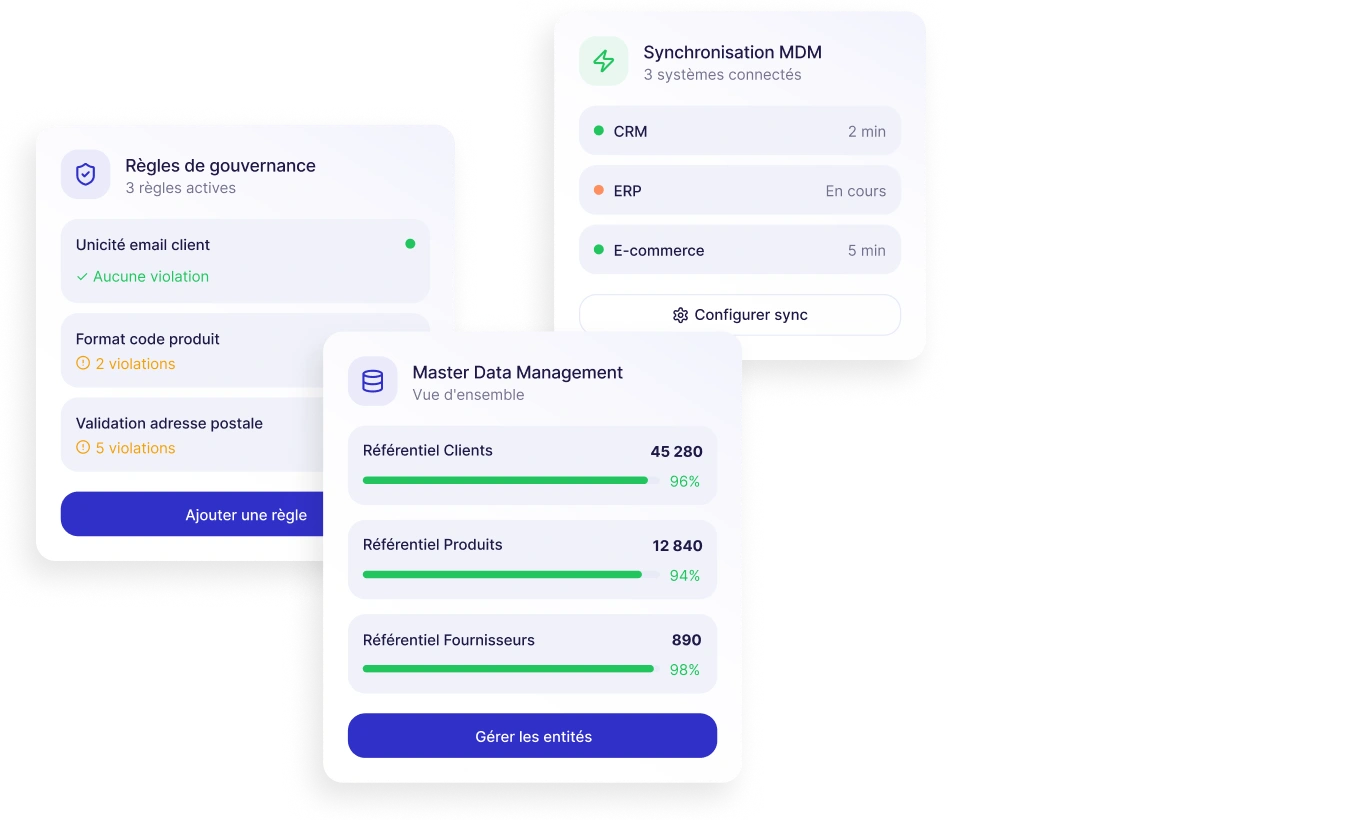
Products, customers, suppliers, organizations, points of sale, bills of materials: MDM structures your critical data to create a reliable, shared source.
DATASOLUTION supports you in implementing an MDM data repository connected to your IT system, your business teams, and your growth objectives.






What does the market say about MDM solutions?
When should you consider implementing an MDM solution in your company?
As the company grows, critical data becomes fragmented. A single supplier may appear under multiple names. A customer may be duplicated in the CRM and ERP systems. A product SKU may have different statuses depending on the system. A country may apply its own rules. Data flows, but it no longer always means the same thing.
MDM addresses a specific challenge: creating a single source of truth for master data. While PIM focuses on managing product information intended for various channels, MDM governs the company’s foundational data.
Common challenges faced by businesses
-
#01
Inconsistent master data across ERP, CRM, PIM, e-commerce, BI, and line-of-business tools.
-
#02
Duplicates and conflicting definitions for customers, suppliers, products, or organizations.
-
#03
Processes slowed down by manual approvals or repeated corrections.
-
#04
Reporting is unreliable when indicators are based on non-harmonized data.
-
#05
Difficulty in scaling AI, personalization, or omnichannel initiatives without a governed data foundation.
An MDM is not limited to a database repository. It defines the rules of truth, responsibilities, quality, and synchronization of critical data.
Why should you entrust us with your MDM implementation?
For more than 10 years, DATASOLUTION has been helping companies manage their master data

A Business Perspective on MDM
MDM should not remain just an IT project. It must solve real-world problems: data source reliability, sales performance, omnichannel consistency, operational efficiency, and reporting quality.

Expertise integrated with PIM, DAM, ERP, and e-commerce
We integrate MDM into a comprehensive data repository ecosystem, drawing on our expertise in PIM, DAM, RCU, ERP, and more…

A method designed to minimize risks
MDM projects often fail when they are too broad, too technical, or poorly aligned with business needs. Our approach focuses on scoping, prioritization, business adoption, and measuring results.
What is our methodology for integrating your MDM?
Context: Aligning the MDM with Business Objectives
We identify priority use cases: product quality, supplier database, customer view, reporting, international governance, ERP/CRM synchronization, and AI readiness.
Assessment: Mapping Sources and Discrepancies
We identify source systems, duplicates, inconsistencies, existing rules, and areas of risk.
Concept: Establishing the Rules of Truth
We are building the target model, quality rules, workflows, roles, and synchronization principles.
Implementation: Phase in Gradually
Deployment can be carried out by domain, by country, by tool, or by use case. This approach reduces risks and facilitates adoption.
Performance Management: Measuring and Improving
We define the relevant metrics: duplicate rate, completeness, errors, validation times, synchronization quality, and adoption by teams.
Technologies & Partners
Our selection of partner solutions is based on our experience in PIM, MDM, DAM, and digital technology. Our vendor-neutral approach allows us to identify and recommend the best solutions on the market.
Some of our projects




FAQ: Your questions about MDM
MDM, or Master Data Management, centralizes and governs a company’s master data to ensure consistency across multiple systems.
PIM manages product information for distribution channels. MDM governs broader master data: products, customers, suppliers, organizations, and internal repositories.
When duplicates, inconsistencies, reporting discrepancies, or conflicts between systems slow down operations and erode confidence in the data.
No. It’s best to start with a high-impact priority area and then gradually expand the scope.
By starting with business use cases, limiting the initial scope, defining responsibilities, and measuring data quality from the moment of deployment.
Contact an expert
Latest articles
Visit the blog
ChatGPT Ads on Shopify and HubSpot: What This Means for E-commerce Businesses and Marketing Teams in France
02/10/2026
Fine-tuning LLMs in the Enterprise: Better Than a Frontier Model?
28/09/2026

OroMomentum: AI for B2B efficiency
22/09/2026

AI: The 5 Top Stories of Summer 2026
17/09/2026

Content management on Magento: how to give marketing teams back control with Hyvä CMS
17/08/2026