B2C e‑commerce Website Development & Omnichannel Strategy
Your customers no longer shop through a single channel: they switch from mobile to in-store, from the website to the app, and expect the same experience at every step.
We design B2C e-commerce sites designed for omnichannel, offering a unified experience across your online store, brick-and-mortar locations, and mobile channels.
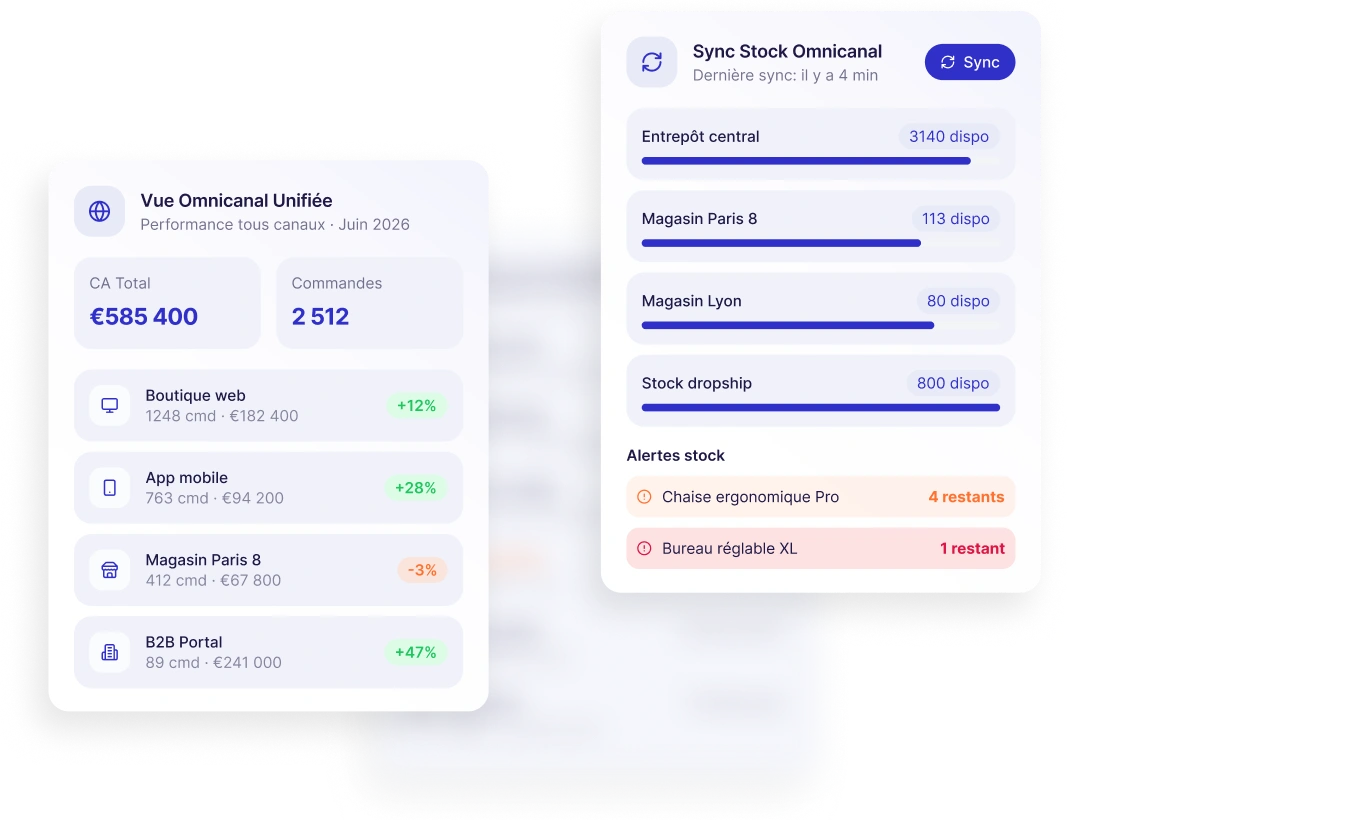













Some Statistics on the Power of an Omnichannel Strategy
A single channel is no longer enough. An omnichannel experience is no longer a competitive advantage—it’s a basic expectation of your B2C customers.
What are the challenges of a non-omnichannel B2C website?
When your e-commerce site and your brick-and-mortar stores operate in silos, the customer experience becomes fragmented, and conversion rates suffer as a result.
-
#01
Your in-store inventory and your online inventory aren’t synchronized, which frustrates your customers and hinders your cross-selling efforts.
-
#02
Your customer cannot pick up in-store what they purchased online (BOPIS: Buy Online, Pick Up In-Store) or return to the store what they ordered online.
-
#03
Your loyalty program works differently depending on the channel, leading to lost points, frustration, and a loss of loyalty.
-
#04
Your store staff do not have access to the customer’s web history, and vice versa.
-
#05
Your product catalog is not consistent across the website, mobile site, app, and in-store product pages.
Your marketing is promoting offers that are inconsistent across channels, which undermines brand perception.
Our Omnichannel B2C E-commerce Website Solution
We treat omnichannel as a customer experience initiative, not as a technical patchwork. Our scope covers the entire chain, from the user journey to IT integration.
-
- Mapping Omnichannel Purchase Journeys: Search, Comparison, Purchase, Delivery, Returns, Loyalty
- UX/UI Workshop with Your Marketing, E-commerce, and Retail Teams to Align Experiences
- Defining key switching points between channels (web => store, app => web, store => web)
-
- Mobile-first design, optimized checkout process, high-performing product pages
- Personalization and dynamic recommendations based on customer profile and history
- Native integration of the loyalty program, reviews, and UGC
-
- Implementation of click-and-collect, BOPIS (Buy Online, Pickup In-Store), and curbside pickup
- A unified, real-time view of inventory across the web and stores
- Cross-Channel Returns Management (Online to Store and Vice Versa)
-
- Integration with your ERP, OMS, WMS, PIM, and store POS system
- Customer Data Platform (CDP) to unify customer insights across all channels
- Real-time synchronization of inventory, prices, promotions, and content
-
- Omnichannel tracking: multi-touch attribution, measuring the impact of digital channels on in-store sales (ROPO)
- Unified dashboards for managing online and in-store performance together
- Consistent marketing efforts across all channels (CRM, retail media, paid)
Why Choose DATASOLUTION for Your B2C Omnichannel Project ?
Contact an e-commerce expert
Proven B2C and omnichannel expertise
For over 20 years, we have been supporting B2C brands that need to integrate e-commerce, retail locations, business systems, and the customer experience.
A customer journey-centered approach
Our teams of experts design the project based on real-world use cases: online shopping, in-store pickup, loyalty programs, personalization, product search, mobile, and international operations.

An end-to-end integrated team
Architects, developers, UX/UI specialists, data analysts, SEO experts, and e-commerce specialists work together to design a robust, scalable platform that aligns with your omnichannel roadmap.
Our Methodology for Creating Omnichannel B2C Websites
Framework: Aligning Business Strategy with the Omnichannel Customer Journey
We start by conducting an audit of your current customer journey: pain points, gaps between channels, and unmet expectations. Building on this foundation, we work together to a target vision (journey, features, IT integrations) prioritized by business value. Deliverables: a shared set of specifications and a delivery in batches.
UX/UI Design: Ensuring Consistency Across All Channels
The web experience cannot be viewed in isolation: we design user journeys by integrating pathways to the store, the mobile app, and customer service. This phase produces the screens, data schemas, and API contracts that will guide development.
Build: Develop in sprints with incremental releases
We prefer a phased rollout approach: the first version delivers the core functionality (catalog, shopping cart, payment, unified inventory), while subsequent versions add advanced omnichannel features (BOPIS, unified loyalty program, cross-channel returns). This allows us to deliver value right from the start.
Deployment and Activation
Secure migration, training for your in-store and e-commerce teams, and enhanced monitoring after go-live. We support the marketing launch and gradual ramp-up.
A Methodology Enhanced with AI
AI accelerates several critical phases: product catalog enrichment, personalized recommendations, automated test generation, and documentation. We’ve seen productivity gains of 30 to 70 percent in certain key phases.
Technologies & Partners
Our selection of partner solutions is based on our experience in e-commerce and digital technology. Our vendor-neutral approach allows us to identify and recommend the best solutions on the market.
Discover our B2C & omnichannel projects
FAQ: Your questions about creating an Omnichannel B2C Website
The budget depends on the size of your product catalog, the number of stores to be integrated, the level of customization, and the complexity of the IT integrations (point-of-sale, ERP, OMS). An omnichannel B2C project for a retailer with 50 to 200 stores represents an investment of several hundred thousand euros, with a measurable ROI in terms of average order value, customer loyalty, and drive-to-store traffic.
Allow 4 to 9 months from scoping to the launch of an initial version that delivers core functionality (catalog, purchasing, unified inventory). Advanced omnichannel features (BOPIS, unified loyalty, cross-channel returns) are rolled out in successive releases over an additional 6 to 12 months.
Click & Collect refers to the option to order online and pick up in-store. BOPIS (Buy Online, Pick Up In-Store) is the most advanced version of this model: the product is physically set aside in the store. Drive-through is a variation where customers pick up their orders outside without entering the store. The choice depends on your store type, average order value, and the customer experience you’re aiming for. We’ll help you decide which option is best and guide you through the implementation process.
This is achieved through an Order Management System (OMS) that aggregates inventory from all retail locations and displays it on your website in real time. Off-the-shelf solutions (OneStock, Manhattan, Fluent Commerce) or custom-built systems can be implemented depending on your IT maturity and sales volumes.
Not always. Depending on the quality of your current platform, it’s possible to add omnichannel components (OMS, CDP, BOPIS) as an overlay without completely redesigning the entire site. A preliminary audit helps determine whether to opt for a complete redesign, partial replatforming, or gradual enhancement.
Contact an expert
Latest articles
Visit the blog
ChatGPT Ads on Shopify and HubSpot: What This Means for E-commerce Businesses and Marketing Teams in France
02/10/2026
Fine-tuning LLMs in the Enterprise: Better Than a Frontier Model?
28/09/2026

OroMomentum: AI for B2B efficiency
22/09/2026
AI: The 5 Top Stories of Summer 2026
17/09/2026
Content management on Magento: how to give marketing teams back control with Hyvä CMS
17/08/2026