AI training & governance
Artificial intelligence is already transforming jobs, tools, and decision-making. But without a clear framework, it also creates risks: exposure of sensitive data, uncontrolled use, poorly evaluated models, uncertain compliance, and dependence on generative tools.
Our approach combines AI training, AI governance, AI strategy, and regulatory compliance to help your teams understand, use, and manage AI in a systematic way.
The goal: to move from isolated experiments to reliable, well-documented use cases that align with your business objectives.
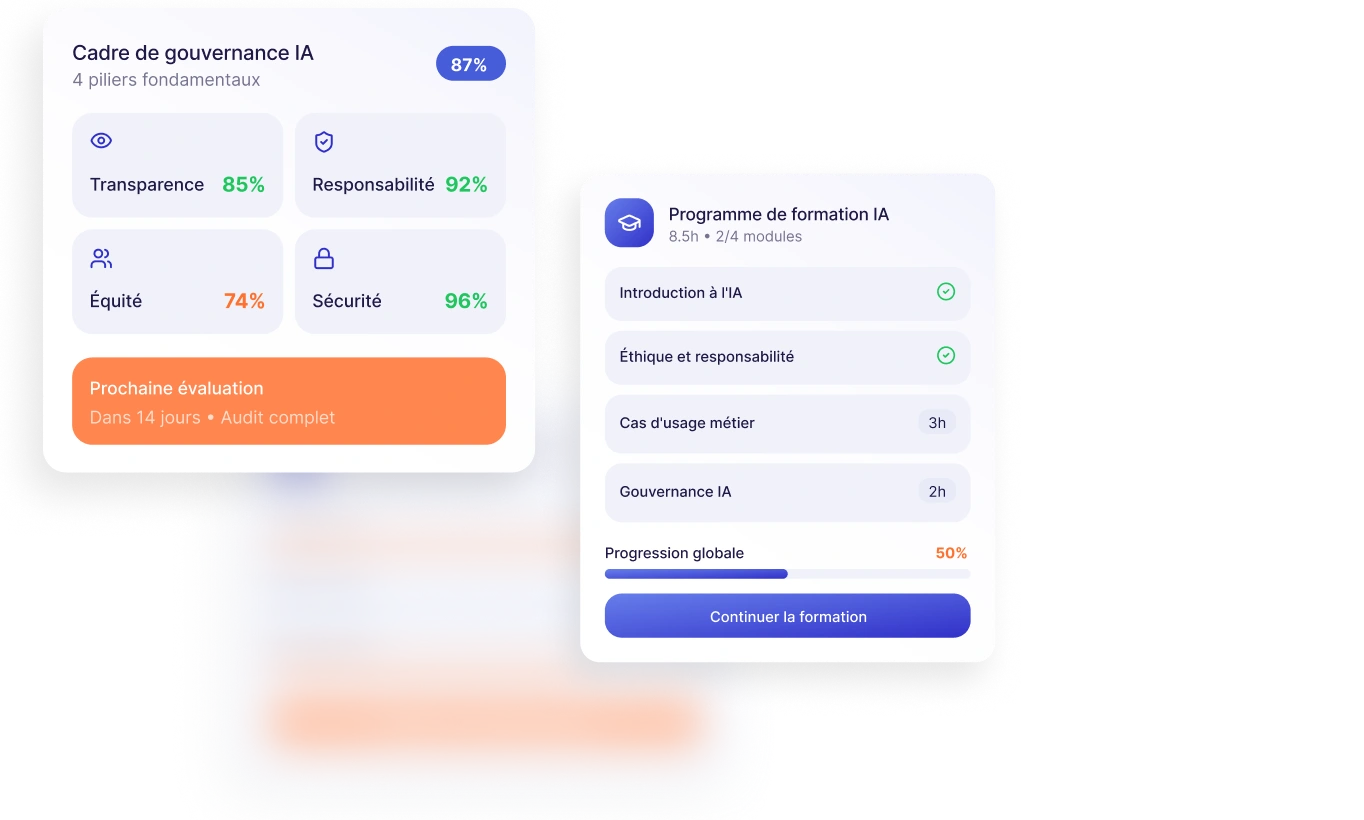
What is AI governance?
The adoption of AI is accelerating, but the level of maturity among organizations remains highly varied.
Many teams are already using generative AI tools without a common framework, validation rules, or a clear understanding of the impacts on the data.
- The AI Act is gradually imposing new obligations on entities that develop, deploy, or use AI systems.
- The use of AI involving personal data must remain compliant with the GDPR.
- Companies must now document their AI practices, train their teams, and establish AI governance tailored to their level of risk.
When should an AI and governance training program be structured?
An AI strategy becomes a priority as soon as use cases multiply without a shared framework.
There are several warning signs to watch for:
-
#01
Are your teams using ChatGPT, Copilot, Gemini, or other tools without specific guidelines.
-
#02
Customer, HR, sales, or internal data can be copied to external tools.
-
#03
Your AI projects are moving forward without a framework for assessing risks, biases, or the quality of results.
-
#04
Your organization needs to prepare for theAI Act, the GDPR, or internal audits.
-
#05
Business units want to increase productivity, but lack the criteria to distinguish valid use cases from false positives.
-
#06
Your management team would like to define an clear, realistic, and actionable AI strategy that is clear, realistic, and manageable.
Our AI & Governance Training Offerings
We support organizations that want to train their teams, establish guidelines for AI use, and build a sustainable governance framework. AI training isn’t just about learning how to write prompts—it must also cover security guidelines, data quality, and the responsibilities and limitations of AI models.
Tell us about your project-
- Understanding how generative AI works and its limitations.
- Identify useful use cases by business function: marketing, sales, support, data, IT, HR, and legal.
- Learn how to formulate, test, and verify the results produced by AI.
- Develop the right habits when it comes to confidential data, sources, and human validation.
-
- Establishing internal rules for the use of AI.
- Mapping of tools, uses, and the populations involved.
- Implementation of policies, approval processes, and authorization levels.
- Alignment among business, IT, data, legal, and DPO departments.
-
- Raising Awareness of Obligations Related to theAI Act.
- Compliance with the GDPR in data processing operations involving personal data.
- Best Practices foranonymization, minimization, and access control.
- Documentation of uses, purposes, risks, and control measures.
-
- Review of the AI tools used within the organization.
- Identification of risks related to data, bias, security, and vendor lock-in.
- Prioritizing actions based on their level of criticality.
- Operational recommendations for transitioning from opportunistic use to controlled management.
Why should you entrust us with your AI training and governance?
Contact an expert
A Vision for Business, Data, and Compliance
We align AI applications with real business challenges: productivity, quality, customer experience, operational performance, compliance, and security. AI governance becomes a driver of deployment, not an obstacle.

Practical and actionable training programs
Each session is based on your teams’ use cases. Participants leave with practical methods they can apply: decision trees, best practices for prompting, verification rules, GDPR best practices, and examples of permitted and prohibited uses.

Governance Tailored to Your Level of Maturity
Not all organizations need the same level of framework. We are developing a phased approach: awareness-raising, AI charter, mapping, AI audit, committee structure, metrics, and validation processes.
Our AI & Governance Training Methodology
Scope: Understanding Your Usage and Risks
We begin by identifying the teams involved, the tools already in use, the data being handled, and the expected objectives. This phase helps us distinguish between simple use cases, sensitive situations, and projects requiring enhanced oversight.
Training: Building Teams' Skills
The modules are tailored to the participants’ skill level: an introduction to AI, business applications, prompting, data security, GDPR, AI Act, data governance, response quality control. The goal: to create a shared, clear, and actionable AI culture.
Governance: Formalizing Rules and Responsibilities
We define usage policies, roles, approval workflows, risk criteria, and reference documents. This provides your organization with a clear framework for deploying AI without leaving it up to individual teams to decide on their own.
Continuous Improvement: Managing Usage Over Time
AI governance evolves alongside tools, regulations, and internal practices. We help your teams track metrics, update policies, enhance training, and prepare for future audits.
FAQ: Your questions about AI training and governance
An AI training program is designed for business leaders and teams in marketing, data, IT, legal, HR, sales, and support who are already using AI or wish to integrate it into their practices. The content varies depending on the level of maturity: awareness, business use cases, compliance, governance, or AI auditing.
The AI Act regulates AI systems based on their level of risk, while the GDPR applies whenever personal data is processed. AI governance serves to link these requirements to practical applications: internal policies, documentation, responsibilities, data oversight, anonymization, and human validation.
While AI is still used only to a limited extent, AI training helps establish a common foundation. If AI tools are already widely used, an AI audit helps map out current practices, identify risks, and prioritize actions. The two approaches are often complementary.
Contact an expert
Latest articles
Visit the blog
ChatGPT Ads on Shopify and HubSpot: What This Means for E-commerce Businesses and Marketing Teams in France
02/10/2026

Fine-tuning LLMs in the Enterprise: Better Than a Frontier Model?
28/09/2026

OroMomentum: AI for B2B efficiency
22/09/2026

AI: The 5 Top Stories of Summer 2026
17/09/2026

Content management on Magento: how to give marketing teams back control with Hyvä CMS
17/08/2026