iOS and Android mobile app development agency
Your customers spend 94% of their time on mobile devices using apps, not in a browser.
So do your employees.
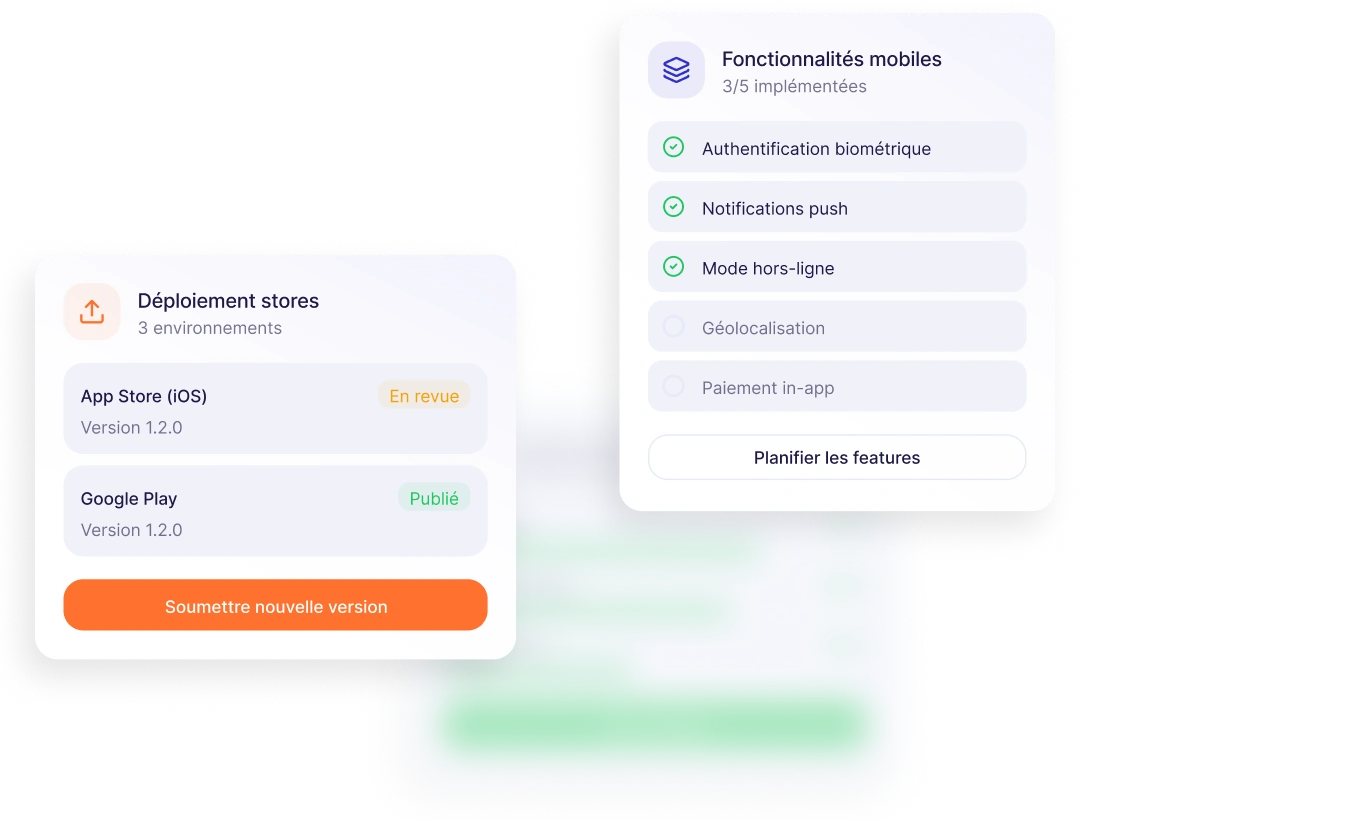
We design and develop iOS, Android, hybrid, and PWA mobile appsfor both your B2C audiences (customer acquisition, loyalty, e-commerce) and your internal needs (productivity, field mobility, security).
Some statistics on the rise of mobile apps
The performance gap between a dedicated app and a mobile website is massive. If your audience is mobile and returns frequently, an app isn’t just a supplement—it’s a channel in its own right.
The problems that a mobile app solves
A mobile app isn’t the right choice for every use case. But when the need arises, the difference in performance compared to a mobile website is massive.
-
#01
Your audience is a returning one: they come back every week or every month, and you want to engage them outside of your website.
-
#02
Your mobile web conversion rate is stagnating despite site optimization.
-
#03
You want to enable direct channels: push notifications, geolocation, biometrics, and integrated payments.
-
#04
Your employees need a mobile interface for their jobs (field work, delivery, sales, service calls).
-
#05
Your feature relies on the phone’s capabilities: camera, scanner, GPS, NFC, Bluetooth, sensors.
-
#06
You want to work offline or with an intermittent connection.
-
#07
You want to build a direct engagement channel.
Our mobile app development services
Our scope covers all mobile development approaches, from native iOS and Android to PWAs and hybrid frameworks. We choose the approach based on your target audience, your constraints, and your roadmap—not on technical preference.
Contact an expert-
- Defining Target Use Cases (B2C, Internal B2B, Field Operations, Connected World)
- Choosing between native, hybrid, and PWA based on your constraints (performance, hardware capabilities, distribution, cost)
- Scenario-Based Modeling of TCO and Time-to-Market
-
- Swift / SwiftUI for iOS, Kotlin / Jetpack Compose for Android
- High-performance apps with full access to the phone’s features (camera, sensors, NFC, biometrics)
- Ideal for consumer apps where user experience is critical or that require native performance
-
- A single codebase for iOS and Android, with performance close to that of native apps
- React Native (Meta) and Flutter (Google), depending on your teams’ skills and the scope of the project
- Ideal for internal B2B apps or B2C apps where time-to-market and TCO are key priorities
-
- A web application that installs like an app, works offline, and sends notifications
- No need to submit to app stores, immediate deployment, audience accessible via a browser
- Ideal for B2C use cases where the download rate for a native app would be too low
-
- Native integration with your existing back end (REST API, GraphQL)
- Integration with your third-party services: authentication (SSO, OAuth), payment (Stripe, Apple Pay, Google Pay), analytics, push notifications (Firebase, OneSignal)
- API-first and event-driven architecture to synchronize the app, website, and store
-
- Submission to the App Store and Google Play, certificate management, compliance with publisher guidelines
- Performance monitoring (crash analytics, sessions, conversion), continuous monitoring
- MCO and developments: new versions, OS updates, A/B testing, continuous optimization
Why should you entrust us for the development of your mobile apps?
Contact one of our experts
Dual Expertise: Native and Hybrid
We develop high-performance mobile apps—either native Swift/Kotlin apps or cross-platform React Native/Flutter apps—depending on your specific needs.

A User-Centric and Conversion-Focused Approach
Our teams take a holistic approach to app design that goes beyond development: mobile-first UX, retention, conversion, customer loyalty, express payment, and business value.

An end-to-end integrated team
Designers, developers, architects, UX/UI specialists, data experts, and SEO/GEO experts work together to take your app from concept to launch.
Our mobile app development methodology
Scoping: Assess the Feasibility and Choose the Approach
Before writing any code, we assess whether an app is the right fit for your use case: target audience, expected frequency of use, unique features, and estimated ROI. Then we determine the best approach (native, hybrid, PWA) based on the constraints. Deliverable: a scoping document with recommendations, scope, and a budget estimate.
Mobile-First UX/UI Design
Mobile has its own rules: tap touch zones, thumb navigation, screen constraints, native gestures. We design the user experience using an interactive prototype validated with real users before development begins. This step helps avoid the costs of late-stage redesigns.
Build: Develop in sprints with releases to the store
Iterative development with regular demos on actual devices (not just in a simulator). Automated testing, continuous integration, build of distributed test to your team via TestFlight and Google Play Console.
Proposal Submission, Launch, and Support
Submission to the App Store and Google Play (review process, certificate management, compliance), support with launch strategy (user acquisition, ASO, push notifications), and training for your teams on analytics and support tools.
A Methodology Enhanced with AI
AI accelerates several phases: UI variation generation, test automation, multilingual translation, accessibility, and in-app content generation. Measured gains of 30 to 70% have been observed in certain phases of the delivery.
FAQ : your questions about mobile app development
From a few tens of thousands of euros for a targeted MVP to several hundred thousand euros for a complex B2C app with IT integrations and a dedicated back end. Three main factors determine the cost: the functional scope, the choice between native and hybrid (for the same set of features, native is 1.5 to 2 times more expensive because it involves two code bases), and the complexity of integration with the enterprise system. The initial scoping phase provides precise cost estimates.
Allow 4 to 9 months from scoping to public launch, depending on the complexity. A targeted MVP can be released in 3 months. A full-featured B2C app with onboarding, payment, loyalty, and IT integrations often takes more than 6 months. We prefer incremental approaches with phased launches.
Native (Swift / Kotlin) if performance, access to the phone’s capabilities, and a flawless user experience are critical (high-volume consumer-facing B2C apps, apps that make heavy use of sensors). Hybrid (React Native, Flutter) if you want to optimize TCO and time-to-market while delivering an experience close to native (internal B2B apps, standard B2C apps). PWA if you want to bypass app stores and reach a broad audience via the web. We’ll determine the best approach during the scoping phase.
A PWA (Progressive Web Application) is a web application that installs like a regular app: it has an icon on the home screen, works offline, and sends push notifications (with limited functionality on iOS). It eliminates the need to submit to app stores and download the app. This is useful when your audience has a low app download rate (emerging B2C markets, older audiences, occasional users) or when you want to test a concept quickly.
The submission process involves several steps: creating developer accounts (Apple Developer Program at $99/year, Google Play Console at a one-time fee of $25), complying with editorial guidelines (UX, security, content), conducting compliance tests, submitting the app, and awaiting approval from Apple or Google (which can take anywhere from a few hours to several days). We handle the entire process for our clients.
Three areas: (1) OS updates—Apple and Google release a new version of iOS and Android every year, which must be tested and adapted; (2) functional enhancements based on user feedback and new requirements; (3) continuous monitoring (crashes, performance, conversion). We structure all of this into a mobile maintenance contract tailored to the specific challenges involved.
Contact an expert
Latest articles
Visit the blog
ChatGPT Ads on Shopify and HubSpot: What This Means for E-commerce Businesses and Marketing Teams in France
02/10/2026
Fine-tuning LLMs in the Enterprise: Better Than a Frontier Model?
28/09/2026

OroMomentum: AI for B2B efficiency
22/09/2026
AI: The 5 Top Stories of Summer 2026
17/09/2026
Content management on Magento: how to give marketing teams back control with Hyvä CMS
17/08/2026