DAM Agency for Digital Asset Management
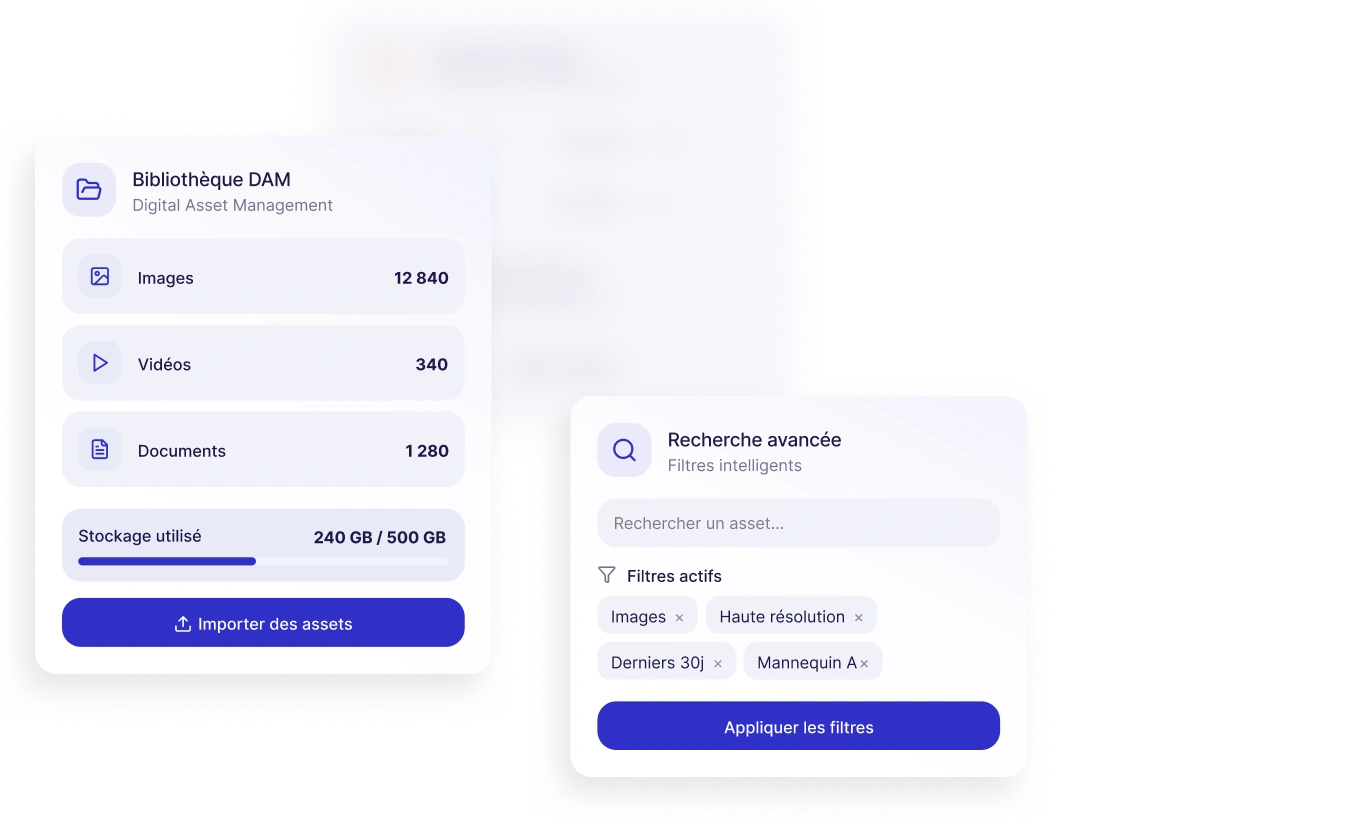
Product images, videos, manuals, documents, source files, and branded content: Your DAM becomes the media data repository that secures and accelerates the distribution of your content.
Our experts will guide you through the scoping, integration, and optimization of your DAM solution.





What does the market say about DAM in the enterprise?
When should you consider implementing a DAM solution in your company?
Digital content has become essential to sales performance. A product listing without a reliable image converts less effectively. A marketplace sometimes rejects images in the wrong format. A sales team uses an outdated brochure. A country releases an unapproved version. A marketing department wastes time searching for the right file.
Without a DAM, assets are often scattered across cloud storage services, servers, creative tools, e-commerce platforms, external agencies, or local folders. This disorganized structure slows teams down and undermines brand consistency.
Common Issues
-
#01
Scattered media: images, videos, PDFs, product shots, manuals, and source files are not centralized.
-
#02
Uncontrolled versions: Teams sometimes use content that is outdated or has not been approved.
-
#03
Slow searches: the files exist, but no one can find them quickly.
-
#04
Unsuitable formats for specific channels: e-commerce, marketplaces, print, social media, and B2B portals each require their own specific formats.
-
#05
Rights and compliance difficult to track: licenses, expiration dates, and country- or usage-based restrictions are not always visible.
DAM complements PIM: PIM structures the product database, while DAM organizes the media assets that bring the product experience to life. Together, they enhance product information management and omnichannel consistency.
Why should you entrust us with the implementation of your DAM?
For more than 10 years, DATASOLUTION has been helping companies manage their digital assets and distribute them across all channels.

A vision focused on the product experience
A DAM isn’t just a marketing tool. It affects product listings, e-commerce customer journeys, sales materials, catalogs, print materials, and brand consistency.

Expertise Integrated with PIM and MDM
DATASOLUTION structures DAM projects around a comprehensive data repository framework: media, product data, master data, channels, business tools, and information systems.

A Practical Approach to Workflows
The DAM should simplify day-to-day operations: find content faster, approve it more clearly, distribute it without errors, reduce duplication, and ensure usage rights are protected.
What is our methodology for integrating your DAM?
Scope: Understanding Your Content and Channels
We identify the contributing teams, asset types, priority use cases, and channels to populate.
Organization: Building a Useful Taxonomy
We organize metadata, statuses, categories, naming conventions, and access rights to facilitate search and dissemination.
Migration: Cleaning and Qualifying Media
We prepare the files for import, remove unnecessary duplicates, identify priority content, and secure the associated rights.
Connectivity: Integrating DAM, PIM, and the Digital Ecosystem
We set up the necessary workflows to distribute media to the right tools, without the need for re-entry or loss of control.
Adoption: Establishing Good Habits
Teams must know how to upload, retrieve, validate, edit, and distribute the correct files. Change management helps prevent a return to old practices.
Technologies & Partners
Our selection of partner solutions is based on our experience in PIM, MDM, DAM, and digital technology. Our vendor-neutral approach allows us to identify and recommend the best solutions on the market.
Some of our projects



FAQ: Your questions about DAM
A DAM centralizes, organizes, secures, and distributes digital assets: images, videos, documents, source files, metadata, and marketing content.
PIM manages product data. DAM manages the associated media. The two solutions work together to create comprehensive and consistent product listings.
Yes, if the files become numerous, sensitive, difficult to locate, or used across multiple channels. A DAM adds metadata, access rights, workflows, and distribution formats.
You need to prioritize useful content, define metadata, remove duplicates, secure rights, and train teams on new practices.
Yes. When connected to the PIM or CMS, the DAM can deliver the right media to product pages, catalogs, marketplaces, or sales materials.
Contact an expert
Latest articles
Visit the blog
ChatGPT Ads on Shopify and HubSpot: What This Means for E-commerce Businesses and Marketing Teams in France
02/10/2026
Fine-tuning LLMs in the Enterprise: Better Than a Frontier Model?
28/09/2026

OroMomentum: AI for B2B efficiency
22/09/2026

AI: The 5 Top Stories of Summer 2026
17/09/2026

Content management on Magento: how to give marketing teams back control with Hyvä CMS
17/08/2026