26 May 2025
Pimcore POCL: Understanding the New Open Core License

 In 2025, Pimcore will move away from the GPLv3 to adopt a new licensing model: the Pimcore Open Core License (POCL). This is a major change for the ecosystem, raising legitimate questions about the platform’s open-source future. DATASOLUTION, a long-standing Pimcore partner in France, is here to help you make sense of it all.
This article is part of a series of in-depth analyses provided by DATASOLUTION following Pimcore Inspire 2025:
- Pimcore Inspire 2025: AI, Studio, POCL License
- Pimcore Studio: New Interface, New Uses
- Pimcore 2025.1: What’s New in the Latest Version
Table of Contents
- Why is Pimcore changing its license now?
- What is POCL?
- How this differs from GPLv3
- Is this still an open-source platform?
- What are the implications for businesses?
- DATASOLUTION’s Perspective
Why is Pimcore changing its license?
Since its inception, Pimcore has been based on the GPLv3 license. While this license ensured that the code was completely open, it also imposed several limitations, particularly for cloud integrators or companies subject to stricter compliance requirements.
As Pimcore has gained traction in the international market, the Austrian software company has had to rethink its business model:
- To ensure the legal compliance of its deployments in SaaS and cloud environments
- To support the functional upgrade of its platform
- To build an ecosystem centered on premium components and services
The transition to POCL provides a clear solution to these challenges without compromising the project’s open-source foundations.
What is POCL?
The POCL, short for Pimcore Open Core License, is a specific license developed by Pimcore. It follows a model that has become common among open-source software vendors targeting professional users (GitLab, Elastic, MongoDB, etc.).
It is based on a simple distinction:
- The Pimcore core remains free, open source, and accessible without restriction
- Advanced modules, on the other hand, are subject to commercial use terms and conditions
These modules include:
- Native connectors for certain third-party tools
- Advanced Analytics Features
- The first AI components integrated into the platform
- Certain cloud integration or monitoring tools
The POCL is accompanied by clear documentation that explains what is open source and what is covered by the licensing model.
How this differs from GPLv3
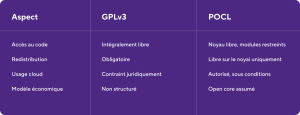
GPLv3 required the full redistribution of modifications, which limited certain indirect commercial uses, particularly in cloud environments.
In comparison, the POCL offers:
Is this still an open-source platform?
It’s a valid question. The answer is yes, within an open-core model.
Pimcore remains:
- Free and customizable at its core
- Can be used in production at no cost if the commercial modules are not needed
- Backed by an active community, with a vibrant GitHub repository and public documentation
The main difference: some modules are now offered for a fee, as is the case with most mature open-source PIM/MDM platforms.
This is therefore not a reversal, but rather an alignment with industry standards.
Need a refresher on the basics? Check out our how-to guides on MDM, PIM, and DAM:
What are the implications for businesses?
For companies already using Pimcore, the transition to POCL is relatively seamless.
There is no requirement to make immediate changes, and projects that have already been deployed can continue to operate without any impact, as long as they do not use modules affected by the POCL.
For projects currently in the planning stages, this new framework provides:
- Greater legal clarity, particularly for IT and legal departments
- Greater compatibility with the security and compliance policies of large organizations
- The ability to use Pimcore in hybrid or cloud architectures without any legal uncertainty
For integrators and hosting providers, the POCL clarifies the terms for marketing packaged Pimcore solutions, which could open the door to new business models.
DATASOLUTION’s Perspective
We have been closely following this development since it was first announced.
We believe the transition to POCL is consistent with the platform’s increasing maturity.
We see three concrete benefits for businesses:
- Enhanced Security for Cloud Deployments
- A clearer organization of the functional features
- Greater transparency regarding the product roadmap
Our experts are available to assist our clients in understanding the terms of the POCL, analyzing the relevant modules, and planning their medium-term strategy for using Pimcore.
In a market torn between innovation, scalability, and compliance, this new license streamlines the platform’s openness while enabling the software vendor to build sustainable growth.
For companies that use Pimcore or are considering it, this development presents an opportunity: the chance to benefit from a robust open-source foundation, backed by a model that is now transparent and sustainable.
Do you have a question about how this license might affect your project or your technical environment?
Related articles
Visit the blog
ChatGPT Ads on Shopify and HubSpot: What This Means for E-commerce Businesses and Marketing Teams in France
02/10/2026
Fine-tuning LLMs in the Enterprise: Better Than a Frontier Model?
28/09/2026

OroMomentum: AI for B2B efficiency
22/09/2026

AI: The 5 Top Stories of Summer 2026
17/09/2026

Content management on Magento: how to give marketing teams back control with Hyvä CMS
17/08/2026