2 January 2025
What is a DAM?
 Today, corporate communication relies primarily on visual design and digital media. In this context, new challenges are emerging, particularly in networked organizations that must manage thousands of images, videos, and other resources.
With Digital Asset Management, you can control your marketing data from start to finish—like an invisible glue that connects all your systems together.
Click here to learn more about our DAM expertise
Definition of Digital Asset Management
The term " Digital Asset Management" (DAM) translates to "Gestion des Données Numériques" in French. It refers to software solutions that enable a company to store, organize, and share its digital assets in a centralized manner.
What began as simple software for storing a company's multimedia content has evolved into a full-fledged collaborative platform for managing digital content.
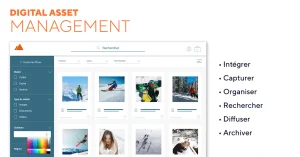
A DAM is particularly useful for quickly and securely sharing digital assets within a company (images, videos, audio files, etc.). It provides marketing, sales, and graphic design teams with convenient and controlled access to all of the company’s digital content.
The DAM manages the adaptation of media content for multiple channels. The image is stored just once in high definition on the platform and is then automatically adapted based on the specific needs and the channel on which it will be used.
And if you're still unsure about the role of each data management tool, we invite you to read this article: MDM, PIM, DAM... What Does Each One Do?
 Why Choose a Digital Asset Management Solution?
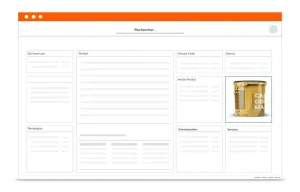
Faced with an abundance of digital content, companies find themselves having to manage a large volume of files, which are often scattered across multiple servers. Digital Asset Management primarily addresses the classic challenges companies face with digital resources:
 What are the benefits of a digital asset management solution?
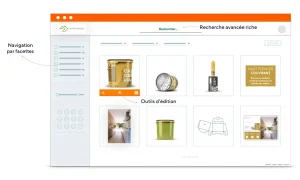
If you’re in charge of your network’s communication campaigns, you know that managing resources is a time-consuming task. Searching for, editing, and requesting file shares can take up a lot of your time. Digital Asset Management solutions offer many benefits.
Centralize content and prevent file loss
A DAM allows you to centralize marketing information on a single platform. As a result, this solution offers enhanced security and, in particular, helps prevent duplicate files and data loss. With a DAM solution, the company’s various departments can classify and organize content according to defined criteria: keywords, format, type, etc. A DAM solution also makes it possible to track media usage and maintain full control over how it is used.
Reduce time-to-market
Enterprise DAM gives marketers easy access to various digital resources. It is similar to a media library and contains all approved digital assets that are available for use. With Digital Asset Management, you can easily add metadata that makes it easier to index and search for content. Users can quickly find the resources they need, which speeds up the production of product pages and the creation of marketing campaigns. Content creation is accelerated through faster workflows.
Ensure brand oversight and security
Some companies have multiple brands and subsidiaries and work with several partners or agencies. As a result, it can sometimes be difficult to maintain brand consistency. Marketing departments must constantly ensure that digital content is up to date. A DAM solution creates a single data repository where the company’s digital content is stored. As a result, the data complies with brand guidelines and includes all relevant information. This ensures that marketing teams can be confident the message communicated across all channels is consistent.
Enable the automation of document approval workflows
More and more companies are working with external service providers, such as freelancers or external agencies. These providers are often geographically distant, making it difficult to properly manage the various stages of a project. With a DAM solution, you can share files online and also access files uploaded by other team members.
Improving Return on Investment
A DAM solution can also distribute marketing content. It allows you to personalize content, resulting in more engaging marketing campaigns. It therefore provides a unique experience for each user. In addition, this solution collects data, allowing you to evaluate and measure content performance. This makes it possible to adjust strategies based on the results, thereby increasing the company’s return on investment.
Improving the Dissemination and Sharing of Resources
Digital channels are multiplying over time and require ever-increasing amounts of content. With a DAM solution, distributing and sharing digital assets on a website or social media is significantly more convenient. A DAM solution brings your teams together around a collaborative and user-friendly tool. It allows you to find the right file at the right time and convert media formats to suit your needs. By integrating with various company systems, the DAM provides teams with a centralized view of all digital content. You can then quickly publish your media to social media and third-party applications.
What are the business challenges of Digital Asset Management?
Digital Asset Management addresses major challenges for businesses. In fact, marketing teams face numerous challenges on a daily basis. They must ensure consistent communication about the brand’s products, while also guaranteeing content distribution and delivering a high-quality customer experience.
Maintaining the brand image
When a company operates across multiple networks, in particular, the growing number of members means that a certain degree of autonomy must be allowed in managing communication. Tailoring communication to different networks is essential, but it must remain consistent with the brand image. That is why it must be guided by central teams, with the goal of ensuring consistent communication across the entire region. DAM software allows files to be stored in one place and shared with stakeholders across different companies.
Time savings
Digital Asset Management must be part of an approach aimed at optimizing work time. Having all media assets consolidated on a single platform should enable users to manage their campaigns quickly and easily. As such, DAM tools should free teams from time-consuming tasks.
Personnalisation
A digital asset management (DAM) solution must integrate seamlessly into the company’s day-to-day processes. That is why it is essential for the DAM to be customizable and capable of integrating with other tools. In other words, for the system to be effective, connections with the other tools used by the company must be fully operational.
 Who needs a DAM solution?
The primary role of Digital Asset Management is to simplify the management and use of marketing data. DAM is therefore particularly useful for companies that produce and use large amounts of media and marketing materials. The starting point for a DAM project is often the need to organize photos, videos, and other media within the company. But then, who exactly needs a DAM?
A DAM solution is primarily intended for:
Any company that publishes and shares a large amount of content needs a solution that allows its employees to easily and quickly take ownership of their digital resources.
- Do you represent a communications company—a mid-sized business or an SME—that produces marketing materials?
- Does your company sell products online and/or through a network of brick-and-mortar stores (B2B, B2B2C)?
- Do you offer a broad and deep range of products, both in France and internationally?
- Are you facing challenges related to digital transformation and rising customer expectations?
- Are you looking for a rangeof communication tools for an omnichannel experience?
- Are you looking for a fast and responsive solution that will give you the autonomy to make your own decisions?
So, like most companies that are currently experiencing a significant influx of digital files, you certainly need a DAM solution!
Finally, it includes data—the numerical information that is collected and helps to understand and analyze the company’s results. It can sometimes be challenging to connect these people, processes, and data within a company.
That is why the DAM was designed: it integrates seamlessly into the company’s software ecosystem. By centralizing data and connecting to various systems, the DAM ensures that all stakeholders have access to it, and it is regarded as the single source of truth.
Request your personalized audit
Where does DAM fit into the content value chain?
Digital Asset Management is a critical link in the content value chain.
Today, the DAM is structured as follows:
Production → Storage & Organization → Localization & Customization → Distribution
More than just a storage repository, a DAM serves as a collaborative platform that centralizes and secures your data. It integrates easily with various enterprise systems, such as a CMS (Content Management System) and a brand portal, and provides all stakeholders with a comprehensive overview of multimedia resources.
Some of you will choose to integrate DAM with a similar technology, such as PIM (Product Information Management). Indeed, these solutions are complementary, particularly in projects involving the digitization of the product portfolio.
Note: DAM and PIM solutions can also work together in a complementary manner, but within a larger framework. This is known as MDM (Master Data Management), which is always aimed at optimizing marketing data.
Do you need help defining the scope of your DAM project?
Related articles
Visit the blog
ChatGPT Ads on Shopify and HubSpot: What This Means for E-commerce Businesses and Marketing Teams in France
02/10/2026
Fine-tuning LLMs in the Enterprise: Better Than a Frontier Model?
28/09/2026

OroMomentum: AI for B2B efficiency
22/09/2026

AI: The 5 Top Stories of Summer 2026
17/09/2026

Content management on Magento: how to give marketing teams back control with Hyvä CMS
17/08/2026