ERP Agency : structure your sales management and operations
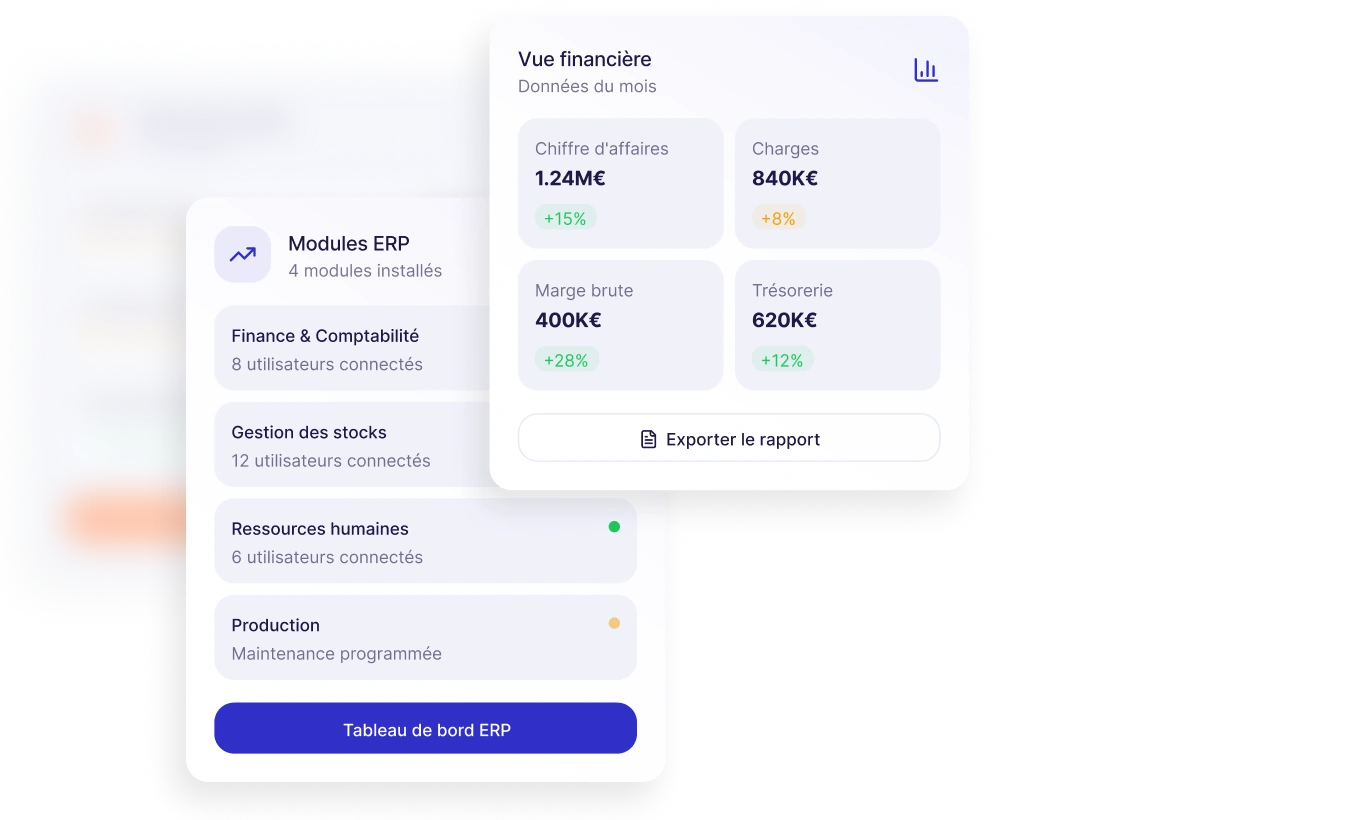
A ERP centralizes key business processes: sales, orders, inventory, purchasing, billing, accounting, production, HR, and e-commerce.
Our experts will guide you through the selection, implementation, and evolution of your ERP software to make your business management more reliable and integrate your operations with your customer relationships.
What does the market say about ERP systems?
ERP software remains a foundational pillar for companies seeking to modernize their processes and data.
When should you consider an ERP system?
When business and operational processes rely on multiple unconnected tools, the company gradually loses visibility. Teams end up re-entering the same information, inventory levels aren’t always up to date, quotes are sent via email, invoicing depends on manual approvals, and customer data differs between the CRM system and the sales management software.
These issues become critical as the business grows: new sales channels, e-commerce growth, an increasing number of product SKUs, international expansion, accounting constraints, logistical complexity, or the need for more reliable reporting.
The most common issues are as follows:
-
#01
Outdated sales management software that is difficult to upgrade or integrate.
-
#02
Re-entering data between tools: a source of errors and wasted time.
-
#03
Lack of visibility into orders, inventory, invoices, or profit margins.
-
#04
Sales and sales administration processes that are too labor-intensive.
-
#05
Inconsistent data across ERP, CRM, e-commerce, PIM, and accounting systems.
-
#06
Difficulty in accommodating growth, particularly in B2B, retail, distribution, and e-commerce.
-
#07
Insufficient reporting, because the information is scattered or not reliable enough.
An ERP project is not just about switching to a new system. It helps structure processes, clarify responsibilities, automate repetitive tasks, and create a reliable foundation for managing the business.
The ERP solutions and services offered by the agency
-
We analyze your current processes: quotes, orders, invoicing, purchasing, inventory, production, accounting, customer service, e-commerce, or reporting. The goal is to identify gaps, duplications, and tasks that can be automated.
-
Choosing an ERP software depends on your business, your volume, your organizational structure, your accounting requirements, your integration needs, and your budget. We positionposition Odoo as a scalable suite that allows you to add applications as your business needs them.
-
Odoo covers core ERP functions such as order tracking, accounting, inventory, CRM, website management, project management, and point of sale. DATASOLUTION provides support for configuration, workflows, permissions, modules, and the necessary integrations.
-
An ERP system creates more value when it integrates with your CRM, e-commerce platform, PIM, MDM, or logistics tools. Keep in mind that the ERP interacts with the PIM/MDM for products and suppliers, as well as with the e-commerce platform for prices, contacts, customers, and orders.
-
We are preparing for data migration, ensuring the quality of imports, conducting tests, developing business scenarios, and providing user training. Adoption is essential to prevent teams from recreating parallel files.
Why choose us as your ERP integrator?
Contact an ERP expert
An ERP agency with a digital focus
We work with e-commerce, data, CRM, PIM/MDM, and cloud ecosystems. This approach allows us to treat the ERP as an operational foundation connected to commerce, customer relations, and data.

Odoo Expertise Focused on Real-World Applications
Finance, CRM, sales management, inventory, or e-commerce: Odoo lets you bring all your tools together on a single, scalable platform.

A method that secures critical data flows
ERP workflows involve orders, invoices, inventory, pricing, accounts receivable, and financial data. We structure projects to minimize disruptions, test key scenarios, and support users.
What is our methodology for ERP implementation?
Scope: Identify Priority Processes
We identify the business challenges: sales, inventory, billing, accounting, CRM, e-commerce, production, or reporting.
Design: Modeling the Target Organization
We define roles, management rules, statuses, workflows, user permissions, and the data to be synchronized.
Implementation: Configuring the ERP Software
We configure modules, automations, dashboards, connectors, and business scenarios.
Migration: Retrieving Useful Data
We clean, organize, and import the necessary data: customers, products, suppliers, orders, historical data, and bills of materials.
Deployment: Train and Stabilize
We support teams, monitor post-launch issues, and adjust processes to improve actual usage.
Our ERP Partners
Our selection of partner solutions is based on our experience in the digital sector. Our vendor-neutral approach allows us to identify and recommend the best solutions on the market.
FAQ: your questions about ERP
An ERP is an integrated management system that centralizes operational processes: sales, purchasing, inventory, billing, accounting, production, HR, and reporting.
Sales management software often handles quotes, orders, invoices, and sometimes inventory. An ERP system goes a step further by integrating multiple business processes into a single system.
Odoo offers a modular suite that covers a wide range of business needs: CRM, sales, accounting, inventory, e-commerce, projects, point of sale, and marketing. However, your choice should be based on your specific processes and constraints.
Yes. The ERP/CRM integration allows you to synchronize customer information, orders, invoices, statuses, purchase histories, and sales data.
The duration depends on the number of modules, the volume of data, integrations, business-specific requirements, and the level of change management support.
Contact an expert
Latest articles
Visit the blog
ChatGPT Ads on Shopify and HubSpot: What This Means for E-commerce Businesses and Marketing Teams in France
02/10/2026
Fine-tuning LLMs in the Enterprise: Better Than a Frontier Model?
28/09/2026

OroMomentum: AI for B2B efficiency
22/09/2026

AI: The 5 Top Stories of Summer 2026
17/09/2026

Content management on Magento: how to give marketing teams back control with Hyvä CMS
17/08/2026