B2B Website Development & E-Procurement Solutions
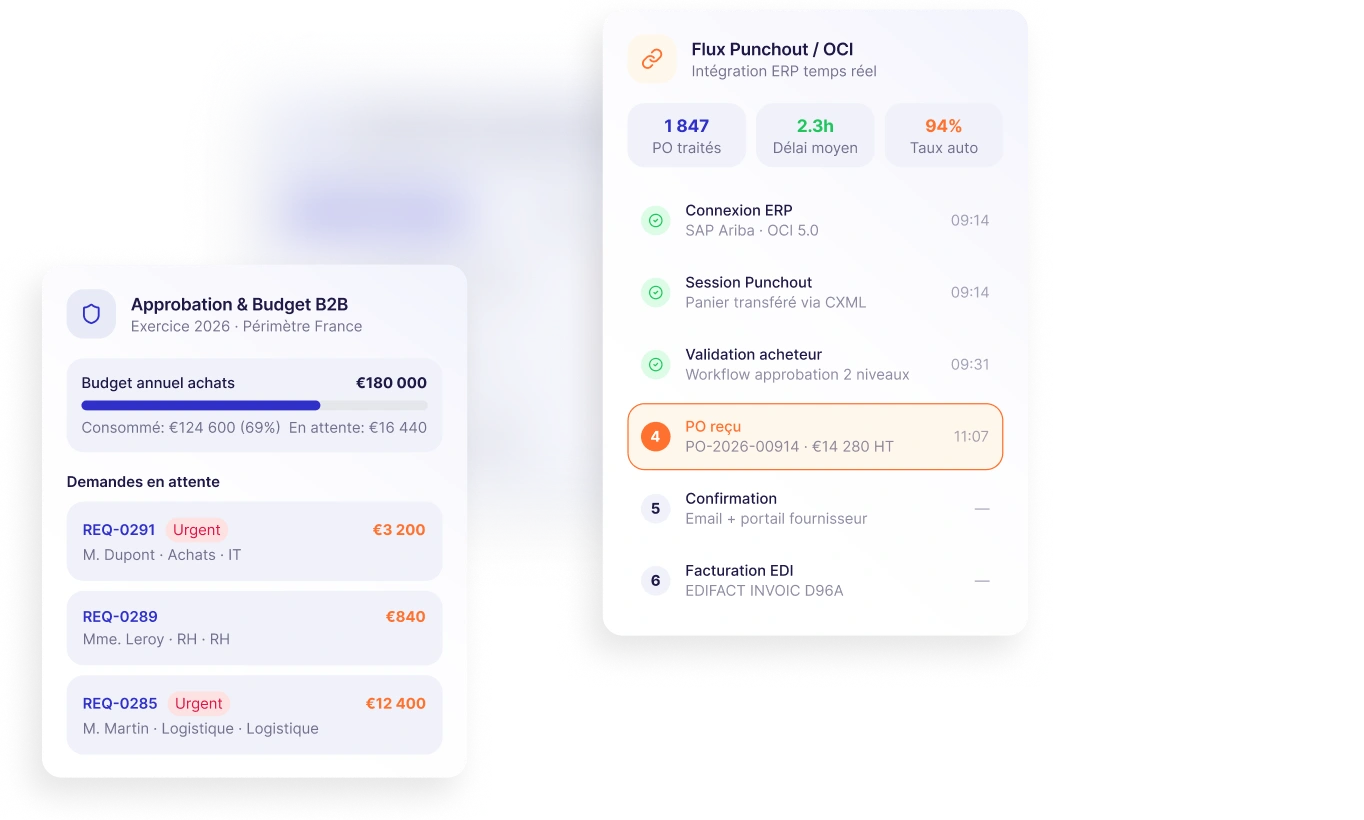
Selling to businesses involves managing prices and catalogs on a per-customer basis, quotes, specific account structures, negotiated payment terms, approval workflows, and direct connections to your customers’ procurement systems (e-procurement, PunchOut).
We design B2B e-commerce platforms tailored to these specific needs, with the self-service functionality that professional buyers expect.














Some Statistics on B2B E-commerce and E-Procurement
The B2B sector is undergoing its own digital transformation. Your buyers have gone self-service, and your platform needs to keep up.
What are the challenges of a poorly designed B2B e-commerce site?
A B2B website is not just a B2C website with a login feature. The specific requirements of B2B are not optional: if they are not handled properly, the buyer will revert to the phone or email, and your website will become a useless showcase.
-
#01
Your customers cannot view the negotiated prices and contract terms specific to their account
-
#02
Your internal approval workflows (buyer > manager > purchasing department) have not been modeled
-
#03
Quotes are managed manually via email, outside the platform, and cannot be tracked or automated
-
#04
Your hierarchical customer accounts (headquarters, subsidiaries, branches) are not natively supported
-
#05
No integration is possible with your key accounts’ e-procurement systems (SAP Ariba, Coupa, Oracle Procurement)
-
#06
Your punchout catalogs do not exist, which excludes you from large companies’ requests for proposal
-
#07
Your payment terms (Net 30, Net 60, bank transfer, promissory note) are not supported
Our B2B E-commerce Platform Offering
Our scope covers the entire B2B value chain, from the purchasing journey to sales management, including integration with your customers’ e-procurement systems.
-
- Architecture selection (Adobe Commerce B2B, OroCommerce, Intershop, Shopify Plus B2B, custom-built) based on your volume, IT integrations, and roadmap
- Modeling hierarchical accounts (headquarters, subsidiaries, branches, multiple users)
- Negotiated prices, account-specific price lists, customized contract terms
-
- Request a quote from the catalog, track status, negotiate, and approve online
- Automated Conversion of Quotes to Orders
- History of quotes and negotiated terms, accessible to sales representatives and customers
-
- Multi-level workflows (request → manager → purchasing department) that can be configured per account
- Budgets and Purchase Limits by User and by Cost Center
- Catalog Filtering by Profile (Product Managers, Access Rights, Restricted Lists)
-
- Integration with leading e-procurement platforms: SAP Ariba, Coupa, Oracle Procurement, Jaggaer, Basware
- PunchOut catalogs (cXML, OCI) to enable your key accounts to place orders through their own IT systems
- Implementation of account-specific catalogs and synchronization of negotiated prices
-
- Payment terms: Net 30/60/90, bank transfer, promissory note, outstanding balances, and credit limits
- Automated invoice generation, accounting integration, payment tracking
- Access to Financing Solutions (B2B BNPL, Factoring)
Why should you entrust your B2B project to us?
Contact an e-commerce expert
Proven expertise in B2B and e-procurement
Since B2B has long been one of DATASOLUTION’s areas of expertise, we have been supporting complex B2B e-commerce projects for over 20 years, leveraging our expertise in specialized platforms and procurement integrations.

An approach focused on business processes
Our teams tailor the project based on actual usage scenarios: customer accounts, approval workflows, negotiated rates, payment, punchout, or integration with procurement tools.

An integrated team for complex projects
Architects, developers, UX/UI designers, data specialists, and SEO experts work together to design a robust, scalable platform tailored to your business growth.
Our B2B Website Development Methodology
Scope: Aligning Business Strategy and Customer Journey
We start by conducting an audit of your current customer journey: pain points, unmet expectations, and delays. Building on this foundation, we collaboratively develop a target vision (journey, features, IT integrations) prioritized by business value. Deliverables: a shared set of specifications and a delivery in batches.
UX/UI Design: An Optimal Experience
It’s important to remember that a B2B buyer is also a B2C buyer. We design user flows and specific screens with this principle in mind to provide your customers with the most seamless website experience possible, despite the potential complexity of certain screens. This phase produces the screens, data schemas, and API contracts that will guide the development process.
Build: Develop in sprints with incremental releases
We prefer an approach based on successive releases: the first version delivers the core functionality (catalog, shopping cart, payment, inventory, and pricing), while subsequent releases add advanced B2B features (order workflow, roles, customer-specific catalogs, etc.). This allows us to deliver value right from the start, rather than waiting for a “big bang.”
Deployment and Activation
Secure migration, training for your e-commerce and sales teams, and enhanced monitoring after go-live. We support the marketing rollout and gradual ramp-up.
A Methodology Enhanced with AI
AI accelerates several critical phases: product catalog enrichment, personalized recommendations, automated test generation, and documentation. We’ve seen productivity gains of 30 to 70 percent in certain key phases.
Technologies & Partners for Your B2B E-Commerce Projects
Our selection of partner solutions is based on our experience in e-commerce and digital technology. Our vendor-neutral approach allows us to identify and recommend the best solutions on the market.
Discover our B2B projects
See our projectsFAQ: Your Questions About Creating a B2B Website
A B2B platform must natively support hierarchical accounts, customer-specific negotiated prices, quotes, internal approval workflows, deferred payment terms (Net 30/60), and integration with your customers’ e-procurement systems. A B2C site with basic authentication isn’t enough – you’ll lose business buyers, who will revert to using the phone or email.
A punchout catalog allows a professional buyer to access your catalog from their own e-procurement solution (SAP Ariba, Coupa, Oracle, etc.) without leaving their usual purchasing interface. This is often a requirement for large accounts; without punchout, you may be excluded from their listings. The standard protocols are cXML and OCI.
Between 6 and 18 months, depending on the complexity (data volume, number of accounts, e-procurement integrations, and IT systems). We prefer an incremental release approach to deliver value from the very first months and spread out the risks
Integration is achieved through a punchout catalog in cXML or OCI format, hosted on your platform. The customer logs in from Ariba or Coupa, browses your catalog, selects products, and the shopping cart is automatically sent to their purchasing system for approval. We manage the integration from start to finish.
The budget depends on the number of accounts to be managed, the complexity of the workflows, the scope of functionality (quotes, B2B BNPL, multi-country operations), and IT integrations. A B2B project involving punchout catalogs and ERP integrations represents an investment of several hundred thousand euros, with a measurable ROI in terms of sales productivity and market share among key accounts.
Yes, some platforms (Adobe Commerce, Shopify Plus, OroCommerce) natively support multi-store setups with separate B2B and B2C workflows. The choice depends on your business strategy, the overlap in your product catalog, and your IT maturity. We evaluate this option during the scoping phase.
Contact an expert
Latest articles
Visit the blog
ChatGPT Ads on Shopify and HubSpot: What This Means for E-commerce Businesses and Marketing Teams in France
02/10/2026
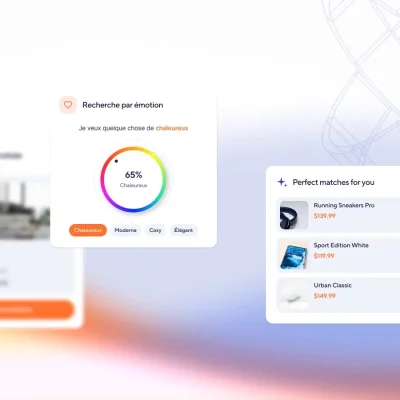
Fine-tuning LLMs in the Enterprise: Better Than a Frontier Model?
28/09/2026

OroMomentum: AI for B2B efficiency
22/09/2026

AI: The 5 Top Stories of Summer 2026
17/09/2026
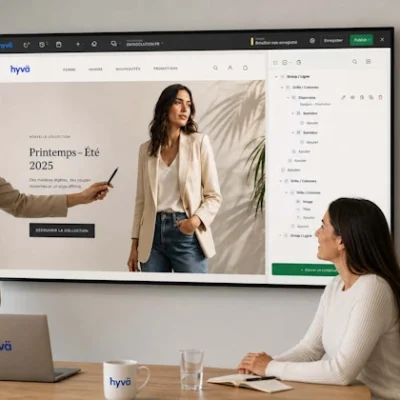
Content management on Magento: how to give marketing teams back control with Hyvä CMS
17/08/2026