Custom cloud solutions for your business
Rigid infrastructure, applications that are difficult to scale, opaque hosting costs, and security that needs to be strengthened: the cloud is becoming a key driver for modernizing your information system.
We help companies select, design, migrate, and optimize their cloud environments using a pragmatic approach: performance, security, scalability, and cost control.








What does cloud computing actually enable?
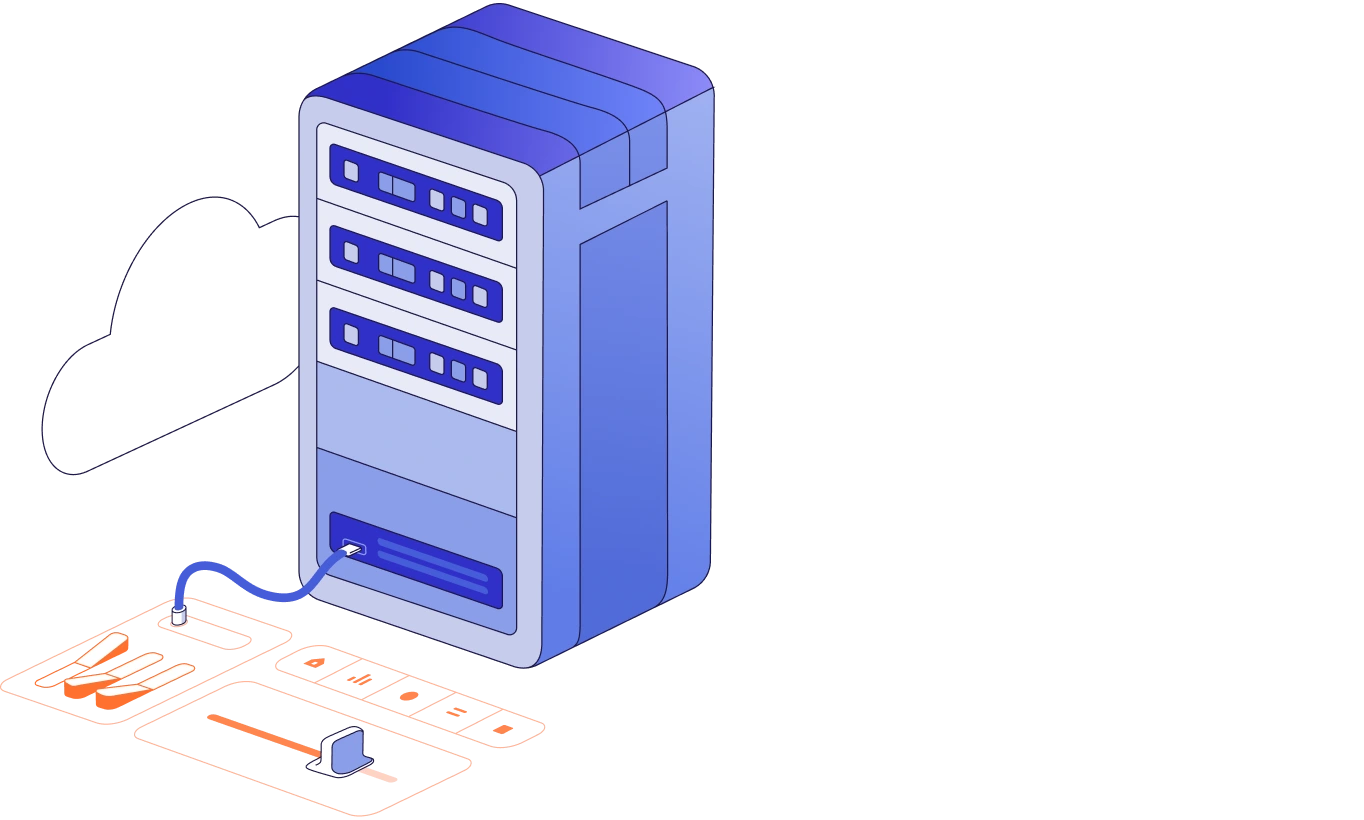
A cloud computing solution allows you to host, run, and scale your applications, data, and services without relying solely on an internal physical infrastructure.
The cloud addresses several business challenges: absorbing traffic spikes without oversizing the infrastructure, reducing reliance on aging servers, accelerate application deployments, secure data and access, andmore easily connect ERP, CRM, PIM, e-commerce, data, and business tools.
When should you consider a cloud strategy?
The transition to the cloud becomes a priority when existing systems hinder growth, service quality, or innovation.
There are several warning signs to watch for:
-
#01
Hosting costs that are difficult to manage.
-
#02
An infrastructure that lacks flexibility during peak periods.
-
#03
Excessively long deployment times
-
#04
Technical debt that hinders progress.
-
#05
More demanding security, backup, or compliance requirements.
-
#06
Trouble connecting your business tools or leveraging your data.
The cloud is about more than just “moving servers.” It’s about building an architecture capable of supporting your business, your workflows, your applications, and your future digital needs.
Our Cloud offerings
We treat every cloud project as an architecture and transformation initiative, not just a technical migration. The goal: to choose the right model, ensure a smooth transition, and make the environment sustainable in the long term.
-
- Analysis of your current infrastructure, applications, and technical dependencies.
- Identification of critical loads, risks, hidden costs, and safety constraints.
- Prioritizing environments to migrate, modernize, or retain.
-
Choosing a cloud computing provider depends on your specific context: data volume, data location, application architecture, compliance requirements, internal expertise, and availability goals.
We compare the possible scenarios: public cloud, private cloud, hybrid cloud, multicloud, or managed architecture. The final choice must be based on your actual usage, not on market trends.
-
- Preparing the target environments.
- Phased migration of critical applications, databases, and services.
- Testing, monitoring, and securing the switchover.
- Modernization when the application warrants a redesign rather than simply being migrated.
-
A high-performance cloud environment relies on clear governance: access control, backups, monitoring, encryption, network segmentation, cost oversight, and documentation.
We incorporate these elements from the design phase onward to avoid architectures that are unstable, costly, or difficult to maintain.
Our Cloud Solutions and Services
We help companies with the selection, design, migration, and day-to-day management of their cloud environment and infrastructure.
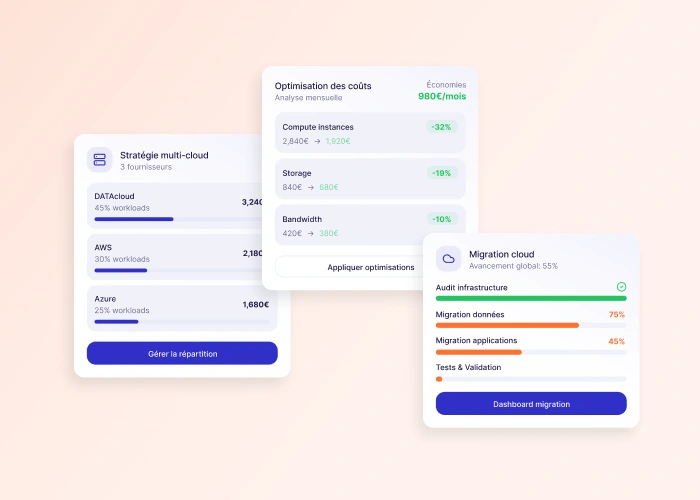
Move to the Cloud
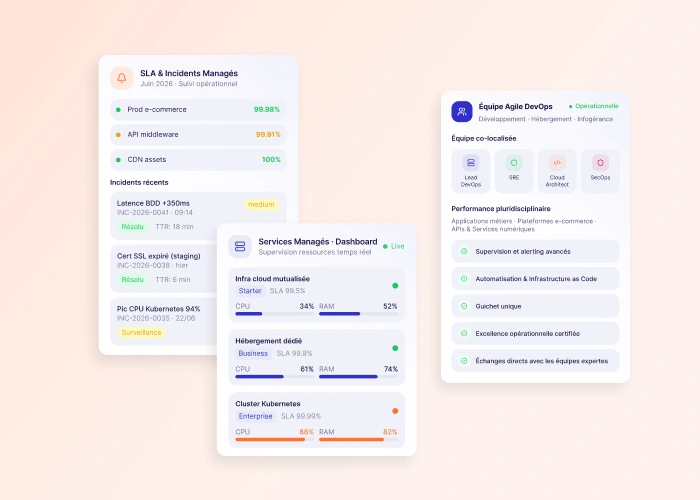
IT Outsourcing
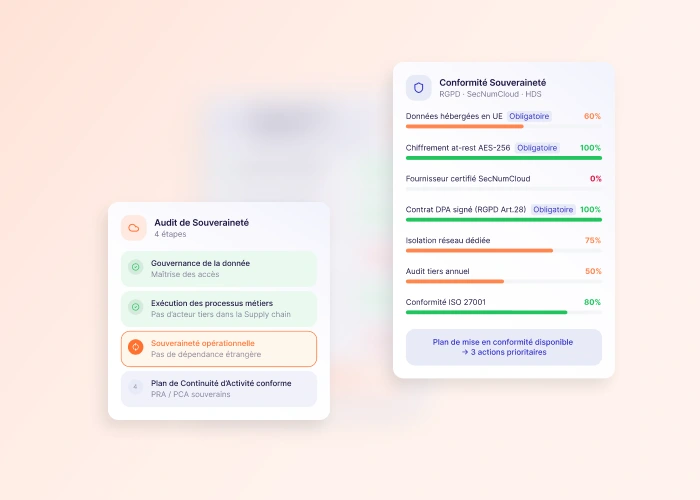
Digital Sovereignty
Why should you entrust your cloud project to us?
Contact one of our experts
A business-oriented approach
We start with your specific needs: critical applications, IT workflows, operational constraints, seasonality, and internal teams. Cloud technology should support your business—not add another layer of complexity.

Architecture Designed to Last
Every technical decision must remain transparent: hosting, networking, security, monitoring, backup, and costs. You maintain a clear overview of your environment and its potential for growth.

A Secure Migration
We prioritize a phased approach: audit, scoping, testing, batch migration, and enhanced monitoring. This method minimizes disruptions, regressions, and decisions made too late.
Our Cloud Methodology
Scope Definition: Understanding Your Challenges and Constraints
We identify the project’s objectives: reducing technical debt, improving performance, enhancing security, ensuring scalability, modernizing applications, or optimizing costs. This phase allows us to define a clear and realistic roadmap.
Architecture: Designing the Target Environment
We design your cloud architecture around your applications, workflows, and levels of criticality. The goal: to avoid environments that are oversized, poorly secured, or difficult to manage.
Migration: Moving Forward in Controlled Steps
The migration is carried out in batches, with testing, validation, and checkpoints. Critical applications are handled with special care, taking into account dependencies, data, security, performance, and service continuity.
Optimization: Long-Term Management
Once the environment is in production, we monitor performance, costs, availability, and alerts. The cloud requires ongoing management to remain efficient, secure, and cost-effective.
Our Cloud Partners
Our selection of partner solutions is based on our experience in e-commerce and digital technology. Our vendor-neutral approach allows us to identify and recommend the best solutions on the market.
FAQ: Your questions about cloud
The right choice depends on your applications, data volumes, security requirements, budget, and technical maturity. An analysis of your current environment allows you to compare different scenarios before selecting the most suitable architecture.
The public cloud relies on shared resources provided by a vendor. The private cloud offers a dedicated environment. The hybrid cloud combines several models to meet different needs: security, performance, flexibility, or data location.
Cost control relies on proper sizing, monitoring, decommissioning unnecessary resources, overseeing usage, and clear governance. A cloud environment must be monitored regularly to avoid hidden costs.
Contact an expert
Latest articles
Visit the blog
ChatGPT Ads on Shopify and HubSpot: What This Means for E-commerce Businesses and Marketing Teams in France
02/10/2026
Fine-tuning LLMs in the Enterprise: Better Than a Frontier Model?
28/09/2026

OroMomentum: AI for B2B efficiency
22/09/2026

AI: The 5 Top Stories of Summer 2026
17/09/2026
Content management on Magento: how to give marketing teams back control with Hyvä CMS
17/08/2026