Headless CMS: Architecture, solution selection and deployment
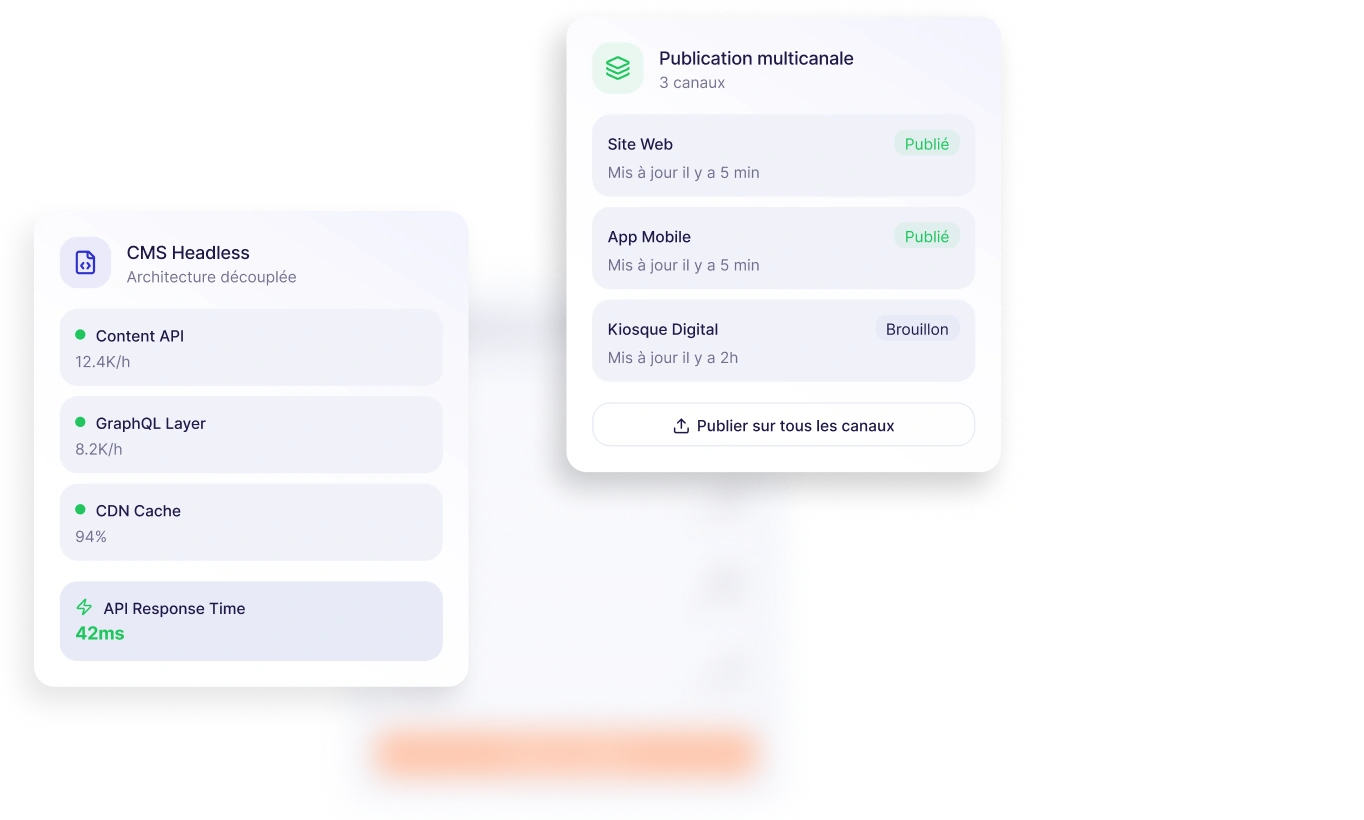
A headless CMS separates content management (back office) from content delivery (front end).
This decoupled architecture allows the same content to be delivered across multiple channels (web, mobile, apps, IoT, stores, marketplaces) without duplication or re-entry.
We design, select, and deploy headless architectures tailored to your IT maturity and your omnichannel strategy.





Some Statistics on the Adoption of Headless CMSs
The “headless” is no longer a topic ofbefore–cutting-edge technology, but is now the standard for mature companies addressing their omnichannel challenges.
Headless CMS: What exactly is it?
A traditional CMS (WordPress, classic Drupal) handles both content creation and display: a single application, a single HTML output. A headless CMS, on the other hand, handles only the back-office functions (content creation, structuring, and storage) and exposes that content via APIs (REST, GraphQL). It’s then up to you to choose how and where to display it: website, mobile app, in-store display, smartwatch…
The Building Blocks of Headless Architecture
- A content management back-end (the “headless” system, without a rendering engine)
- An API to make content available to consumer applications
- One or more front-end interfaces: website (Next.js, Nuxt, Astro…), mobile app (React Native, Swift, Kotlin), in-store kiosk, etc.
- A DAM (Digital Asset Management) system for media management, often integrated
When should we talk about composable / MACH?
Headless is one of the building blocks of a broader architecture known as composable, or MACH (Microservices, API-first, Cloud-native, Headless). We refer to MACH when the entire information system (CMS, e-commerce, search, payment, PIM, loyalty programs, etc.) is composed of “best-of-breed” components connected via APIs, rather than a single monolith. The headless CMS is a natural gateway to composable architecture.
The Challenges a Headless CMS Solves
An architecture Headless is not merely an aesthetic luxury: it addresses the practical limitations of traditional CMSs.
-
#01
You publish (or want to publish) the same content across multiple channels: website, mobile app, store, marketplace, partners
-
#02
Your site is slow, and your CMS is preventing Core Web Vitals optimization Vitals
-
#03
Your editorial and technical teams are stepping on each other’s toes: a design change requires a complete overhaul of the CMS
-
#04
Your current CMS cannot handle your volume of content or traffic
-
#05
Your front-end updates (React, Vue, Next.js, Nuxt) are limited by the constraints of your CMS’s rendering engine
-
#06
Do you want to improve your time-to-market for front-end updates without affecting the back end
-
#07
Do you want to avoid the vendor lock-in associated with a proprietary monolithic CMS
Our Headless CMS offering
Our scope covers the entire process: from selecting the solution to ongoing operations, including designing the content model and integrating it with your ecosystem.
Contact an expert-
- Mapping your current and future distribution channels (web, mobile, app, IoT, in-store)
- Evaluation of Headless CMS Solutions on the Market (Contentful, Strapi, Sanity, Storyblok, Prismic, Hygraph, Directus, Kontent.ai…)
- Scenario-Based Modeling of TCO and Time-to-Market, with Supported Recommendations
-
- Modeling content types, attributes, and relationships (taxonomy)
- Definition of editorial workflows (drafting, approval, publication, expiration)
- Multilingual, multi-market, and multi-brand governance, as applicable
-
- Modern websites (Next.js, Nuxt, Astro, Svelte) with SSR / SSG / ISR for performance
- Native or hybrid mobile apps connected to the same back-office system
- Third-party interfaces: in-store kiosks, digital displays, IoT applications
-
- Integration with your e-commerce platform (Adobe Commerce, Shopify Plus, commercetools, etc.)
- Integration with your PIM, DAM, CDP, and CRM
- Implementation of a BFF (Backend for Frontend) when appropriate
-
- Secure deployment, monitoring of APIs and the back office
- Training Your Editorial Teams on the New Workflows
- Developments and Continuous Optimization Under a Maintenance, Repair, and Overhaul (MRO) Contract
Why should you entrust us for your Headless CMS project?
Contact one of our experts
Headless & Composable Expertise
We design robust, decoupled architectures, leveraging our expertise in leading headless CMS platforms and MACH environments.

A Value-Driven Approach
Our teams recommend a headless approach only when it aligns with clear business objectives, taking into account use cases, KPIs, and TCO.

A team connected to the entire ecosystem
Architects, developers, UX/UI specialists, and other experts work together to integrate headless technology into a cohesive digital architecture.

Our own accelerator
We have developed DATAFRONT, a collection of high-performance, secure, ready-to-use components that are compatible with industry-standard back-ends.
Our Methodology for Implementing a Headless CMS
Scope Definition: Aligning Business Needs with Technology Choices
We begin by identifying your current and future distribution channels, your editorial workflows, and your technical constraints. This phase results in a functional requirements document, a solution evaluation matrix, and a well-reasoned recommendation.
Modeling: Establishing a Sustainable Content Model
The content model (types, attributes, relationships) determines the quality of the entire system. Poor modeling comes at a high cost in terms of refactoring later on. We work together this phase together with your editorial and technical teams.
Build: Developing Front Ends and Integrations
Sprint-based development of front-end interfaces (website, app), integrations with your ecosystem (e-commerce, PIM, DAM, CRM), and the BFF layer when necessary. Incremental releases to deliver value early.
Migration: Retrieving Content History
The migration of existing content to the new CMS is often underestimated. We organize a secure migration process: mapping of content legacy, migration scripts, manual validation of strategic content, and preservation of URLs and SEO history.
Operation and Development
Once in production, the headless CMS evolves alongside your strategy. We support your gradual expansion—including new channels, new markets, and new features—as part of a maintenance and support contract.
FAQ : your questions about Headless CMS
A traditional CMS manages both the content and its display within a single application (the front end is linked to the back end). A headless CMS manages only the content and exposes it via an API; the front end is completely independent. You gain flexibility (you choose your front-end stack and publish to multiple channels), but this comes at the cost of having to develop the front end separately.
Yes, WordPress offers a REST API and a GraphQL API (via the WPGraphQL plugin) that allow you to use it in headless mode with a front end built with Next.js, Nuxt, or another framework. This is a practical approach if you already have WordPress and want to keep its editorial ecosystem. For a project starting from scratch with strong headless requirements, CMS platforms designed natively for headless use (Contentful, Strapi, Sanity) are often a better fit.
The choice depends on your needs: content volume, teams (technical vs. editorial), preferred pricing model (open source vs. SaaS), required integrations, multilingual support, etc. Contentful and Storyblok are robust SaaS solutions. Strapi is the leading open-source platform. Sanity appeals to developers with its flexibility. Prismic is popular with marketing teams. We evaluate solutions based on your specific context.
Three main components: the CMS license (ranging from €0 for open-source solutions to tens of thousands of euros per year for enterprise SaaS), front-end development (which varies depending on the number of channels and complexity), and integration with your ecosystem (e-commerce, PIM, CRM). A targeted project typically starts at around 50–100 k€, while a complete IT overhaul can cost several hundred thousand euros.
Three main factors: (1) greater technical complexity, which requires modern front-end skills, (2) a higher initial investment than a turnkey CMS, (3) a reliance on the proper functioning of multiple components. A headless architecture is cost-effective when your multichannel, performance, or flexibility needs justify it—not for a single-channel showcase site.
No, but it helps. A well-optimized monolithic site can be fast. However, a headless CMS combined with a modern framework (Next.js, Astro) using static rendering (SSG) or hybrid rendering (ISR) offers better performance than virtually all traditional CMSs, particularly when it comes to Core Web Vitals.
Contact an expert
Latest articles
Visit the blog
ChatGPT Ads on Shopify and HubSpot: What This Means for E-commerce Businesses and Marketing Teams in France
02/10/2026
Fine-tuning LLMs in the Enterprise: Better Than a Frontier Model?
28/09/2026

OroMomentum: AI for B2B efficiency
22/09/2026

AI: The 5 Top Stories of Summer 2026
17/09/2026
Content management on Magento: how to give marketing teams back control with Hyvä CMS
17/08/2026