1 August 2024
What is an MDM?
 A true pioneer in digital transformation and data-driven strategies, the Master’s in Data Management is the cornerstone of organizational development and a forward-looking concept in data management.
But what exactly is Master Data Management? Why is it so beneficial to implement it in your company? What types of data can be managed through MDM?
Click here to learn more about our MDM expertise
Definition of Master Data Management
By definition, Master Data Management (MDM) is the set of tools used to store, manage, and distribute master data within an organization. This suite of tools ensures that reference data is correctly identified, safe to use, error-free, and of high quality.
More specifically, Master Data Management centralizes data in a single master repository to streamline the company’s operations. This approach facilitates secure data sharing among employees and across departments.
Simply put, the primary role of MDM is to ensure data consistency. In other words, MDM ensures that all data is linked within a single, unified repository. But that’s not all. This solution offers enhanced security, maintains data quality and governance, and ensures data traceability.
The Problem of Data Silos
In fact, many companies today are still grappling with “silos”—a term that refers to isolated, disconnected information and applications. In other words, data is scattered throughout the company, and business applications do not communicate with one another. As a result, the lack of consistency and streamlining of information hinders the smooth operation of an organization.
This issue affects both the people involved and the company’s strategy. Whether it involves customer, employee, supplier, or product data—all data must be usable, secure, scalable, and reusable. Poor-quality data poses a significant risk to your company. Beyond generating significant costs, incorrect and outdated data can also distort customer insights. As a result, the actions taken within the company based on this low-quality data are skewed.
The Solution Provided by Master Data Management
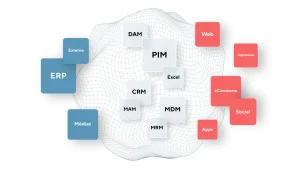
Data quality remains a key priority within your company. Master Data Management solutions address these challenges by covering all of the company’s systems. As a result, data is consolidated, cleaned, categorized, secured, and kept up to date.
Instead of having data scattered across multiple files, MDM centralizes it, removes duplicates, and combines incomplete data to create a “golden record,” which serves as a single source of truth, thereby connecting the company’s various systems.
Most of the time, a company’s reference data is scattered across multiple systems. With Master Data Management, all data is centralized in a master database. This solution also encompasses the following concepts:
- DAM (Digital Asset Management), for organizing and distributing digital assets (Learn more about DAM).
- PIM (Product Information Management), to coordinate and distribute product information (Learn more about PIM).
- RCU (Single Customer Repository): the entire set of customer data, including both core and behavioral data.
Since data is shared in real time across departments, all teams have access to accurate information. This makes it an excellent tool for marketing departments, as it allows them to understand customer purchasing habits and better target consumers based on their interests and past purchase history. It also enables teams to optimize the customer experience through system integration. As a result, this solution saves a considerable amount of time and allows the company to adapt its products to meet consumer needs.
What are the benefits of a Master Data Management solution?
Master Data Management offers numerous benefits to companies that prioritize their data.
Indeed, as businesses become increasingly digital, data management has taken on paramount importance. But what are the real benefits of MDM for the enterprise ecosystem?
As you can see, a Master Data Management solution is essential today for leveraging the vast amount of information generated by companies every day.
There are many benefits to be gained from this. On the one hand, teams save time because they can easily find their files, allowing them to focus more readily on their regular tasks. On the other hand, decision-makers can implement appropriate strategies thanks to the accurate information provided.
The Business Challenges of MDM
MDM should provide a strategic and structured view of all of the company’s data in order to improve operational efficiency. Implementing this data management system therefore presents significant challenges.
Optimizing IT Infrastructure
Optimizing IT infrastructure is undoubtedly the main challenge of Master Data Management. Indeed, as mentioned earlier, for years companies have built their architectures around data silos. Today, it is important to move away from this segmented organizational structure if we want to improve the company’s overall operations. To do so, you need to turn to data management platforms tailored to your needs.
Company Performance
Master Data Management is a significant driver of growth for the company. Data guides stakeholders in their decision-making and actions. Master data management tools thus enable a company’s managers and decision-makers to anticipate the best courses of action to take.
Data Security
Data security has always been a crucial issue for businesses. As such, one of the key objectives of MDM is to ensure the confidentiality and security of data within the company.

Who needs an MDM solution?
MDM proves to be particularly valuable for companies with a large number of IT departments and applications. It is also very useful when a merger takes place.
For companies that place digital transformation at the heart of their strategy, Master Data Management (MDM) is an essential data management solution. MDM is often of interest to complex or large-scale companies that manage large volumes of data. However, mid-sized companies and small and medium-sized enterprises (SMEs) also have much to gain from centralizing their data.
Even if your information system contains only a few applications and appears to be under control, MDM is a forward-looking concept that is worth incorporating into any marketing strategy, with a long-term perspective. The reason for this is that you are not immune to the effects of more or less uncontrolled developments in your information system as your business expands.
When you’re looking to develop a comprehensive ecosystem, data must not be scattered. Otherwise, your data may be difficult to leverage, which will have a direct impact on the company’s results.
In this sense, Master Data Management is a discipline that applies to all businesses, regardless of their size: communications agencies, advertising agencies, e-commerce stores, retail businesses, manufacturers, and so on.
 Where does MDM fit into the enterprise ecosystem?
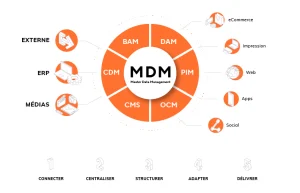
To date, there are several business applications and data management tools necessary for the company to operate smoothly. Among the best known are:
- ERP (Enterprise Resource Planning) software or PGI (Integrated Management Software)
- CRM (Customer Relationship Management) Software
- PLM (Product Lifecycle Management) Software
- WMS (Warehouse Management System) Software Packages
With an MDM solution, all applications are interconnected. This means that data related to a particular tool can easily be used to enrich the data in the repository. For example, the WMS can add product-related data, and the CRM can provide statistics on that same product.
Master Data Management is ultimately the fuel that must flow throughout the entire corporate ecosystem to ensure its healthy growth. This process integrates seamlessly with business applications, enabling the import of data from various sources. This allows data to be shared seamlessly across different departments. With an MDM solution, the entire corporate ecosystem is involved: IT, marketing, communications, sales, customer service, delivery, and more.
What features do Master Data Management solutions offer?
Data scattered throughout the information system makes it difficult to gain a clear overview of the information. Master Data Management tools therefore include several features, such as:
- Product Data Consolidation
- Data Cleaning
- Enrichment, Classification, and Translation
- Data Quality Control and Maintenance
- Workflows and business processes (validation, collaborative completeness checks, etc.)
- Supplier Management
- Cross-Reference Management
- Lifecycle Management
- Multichannel Distribution
- Bulk Deletion of Relationships
Choosing an MDM Solution
While implementing a Master Data Management system can sometimes be time-consuming and costly, it is nonetheless essential for a company because it addresses specific needs related to traceability, quality, validation, and data access.
However, each MDM solution is designed for a specific purpose. The key, then, is to clearly define your needs. These needs will determine the best MDM solution for you. In fact, depending on the objectives you want to achieve, the technological choices may vary. To choose a suitable MDM solution, several key considerations must be taken into account:
- The ability to interface with other applications in the current and future information systems
- Data Mapping and Quality Assurance
- The Lifecycle of Reference Data
- Regulatory Requirements
Making Your MDM Project a Success
A project of this type requires the creation of a comprehensive roadmap to best define the specific functional requirements. Outlining the identified needs and the various development phases relies on a precise understanding of the fundamentals of your “data and process” architecture. To ensure the success of your Master Data Management project, you must therefore assess the following:
- The structure of your current internal processes
- The business challenges that drive you to invest
- The channels through which the information will be broadcast
- Upstream product information collection processes
- Your budget for this project
- The nature of the schedule designed to provide a framework for the project
- The qualitative and quantitative objectives of this investment
Master Data Management significantly improves operational efficiency by freeing up resources to add value in other areas. Implementing a Master Data Management solution revolutionizes data utilization, as it enables near real-time operations and thus allows companies to offer products or services that align with consumer expectations. In conclusion, managing, controlling, and disseminating the right information at the right time is a real challenge for businesses on a daily basis. However, one thing is certain: those that capitalize on their data are highly successful.
MDM solutions are therefore specifically designed to meet the demands of today’s world. Is your company undergoing a digital transformation? Do you need to centralize your data because you have a large volume of files? Now is surely the time for you to invest in a new data management strategy.
Do you need help defining the scope of your MDM project?
Related articles
Visit the blog
ChatGPT Ads on Shopify and HubSpot: What This Means for E-commerce Businesses and Marketing Teams in France
02/10/2026
Fine-tuning LLMs in the Enterprise: Better Than a Frontier Model?
28/09/2026

OroMomentum: AI for B2B efficiency
22/09/2026

AI: The 5 Top Stories of Summer 2026
17/09/2026

Content management on Magento: how to give marketing teams back control with Hyvä CMS
17/08/2026