Data engineering agency to organize, ensure the reliability of, and maximize the value of your data
Scattered data, unstable pipelines, unreliable reporting, and AI projects slowed down by poor data quality: data engineering is becoming a strategic lever for transforming your data into actionable assets.
We help companies design, modernize, and scale their data architectures: data lakes, data warehouses, data lakehouses, pipelines, governance, AI preparation, and business-use-case-oriented models.
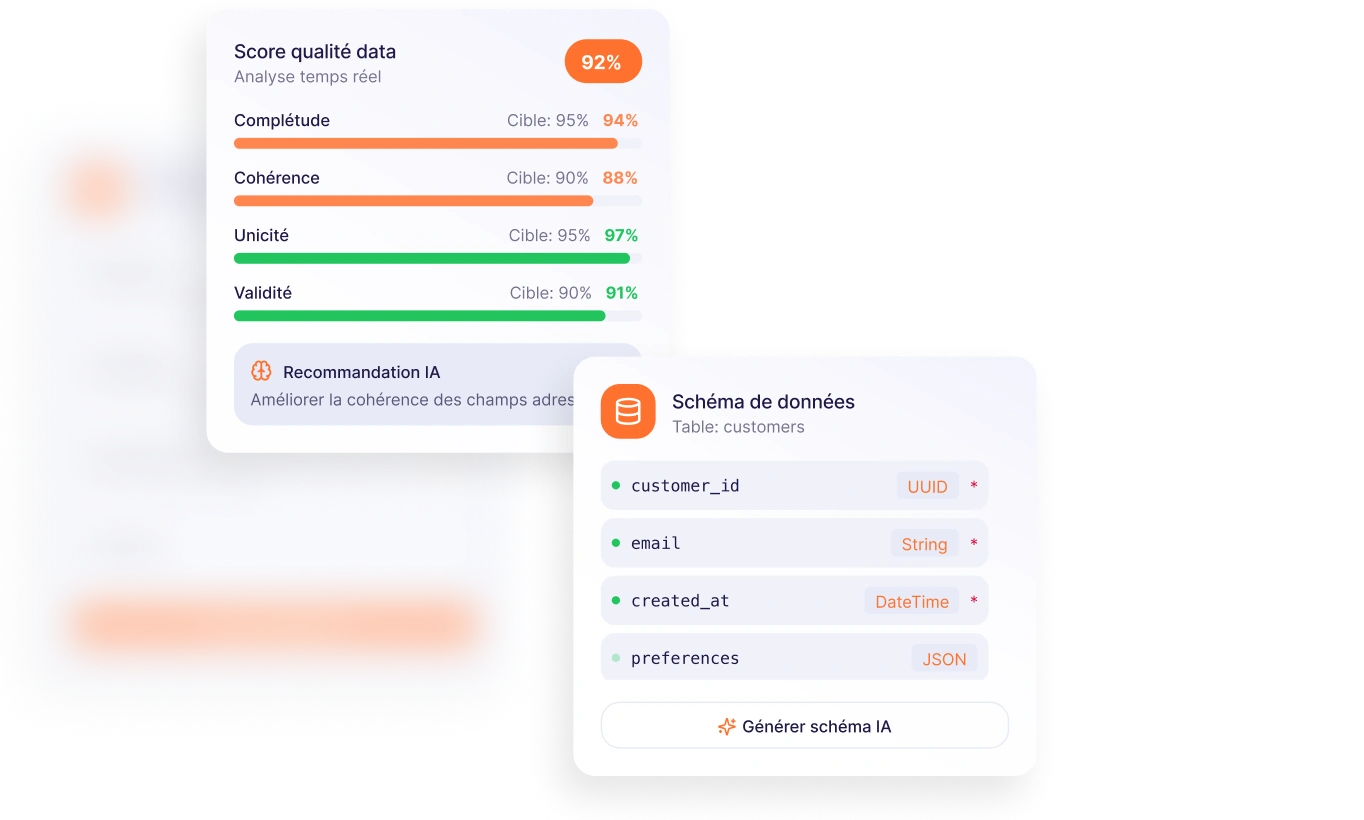
What is data structuring (or data engineering)?
The data engineering encompasses all the practices that enable us to collect, transform, organize, secure, and make data available to business, analytics, AI, and IT teams.
In practical terms, this discipline addresses three key challenges: ensuring the reliability of data flows, making data understandable, and accelerating its use in decision-making tools, business applications, and artificial intelligence models.
- Data Pipeline: ingestion, transformation, orchestration, and monitoring of data flows
- Data Modeling : structuring tables, data repositories, dimensions, and metrics
- Data Governance : quality standards, cataloging, ownership, traceability, and compliance
Some statistics on the importance of structured data
When should you restructure or modernize your data foundation?
A data architecture quickly reaches its limits when use cases multiply without a shared framework.
There are several warning signs to watch for:
-
#01
Teams no longer trust the numbers used in reports.
-
#02
Manual processing takes too much time and leads to errors.
-
#03
Data is duplicated across CRM, ERP, e-commerce, PIM, and BI tools.
-
#04
Pipelines frequently break or lack supervision.
-
#05
AI projects are stalled due to a lack of clean, historical, or well-documented data.
-
#06
The choice between ETL, data lake, data warehouse, or data lakehouse is unclear
-
#07
Data governance remains theoretical, with no operational rules or designated responsible parties.
Our data engineering services
We approach data engineering as a business foundation, not merely as a technical project. The goal is to build a reliable, scalable foundation that can be leveraged by teams that make decisions, automate processes, or develop AI use cases.
Contact an expert-
- Mapping of Sources, Flows, Tools, Processing Steps, and Critical Dependencies
- Analysis of data quality, duplicates, schema breaks, and inconsistencies
- Identifying business pain points: slowness, lack of trust, rework, silos
-
- Recommendation between datalake, data warehouse, data lakehouse, data hub or hybrid architecture
- Definition of data zones, including themedallion architecture when appropriate: bronze, silver, gold
- Developing a roadmap aligned with your BI, AI, business, and real-time needs
-
- Implementation of robust, tested, and monitored pipelines
- A Clear Distinction Between ETL vs. ELT based on your data volumes, tools, and constraints
- Industrialization of data cleaning, standardization, and enrichment
-
- Implementation of data governance that are concrete and enforceable
- Role Definitions: data owner, data steward, IT teams, business teams, analytics
- Monitoring of indicators related to quality, freshness, completeness, traceability, and usage
-
- Preparing Reliable Datasets for BI and reporting and analyticsanalytics engineering
- Structuring of data products that can be reused by business domain
- Data Preparation for AI: embedding, AI vectorization, semantic search, RAG, and vector databases
Why should you entrust your data engineering to DATASOLUTION?
Contact an expert
A user-centered approach
We start with real-world use cases: sales management, e-commerce performance, supply chain, customer insights, business process automation, and AI. The data foundation serves a clear purpose—not just a theoretical architecture.

Scalable architectures, not static ones
Your organization can move forward in stages: modernizing a critical data flow, redesigning a data warehouse, creating a data lake, transitioning to a data lakehouse, or deploying a domain-based data mesh model.

Actionable and Governed Data
A data project is successful when teams understand the data, trust it, and know how to use it. We incorporate data governance, documentation, and quality right from the design phase.
Our data engineering methodology
Scope Definition: Aligning Business, Data, and IT Objectives
We identify priority use cases, critical data sources, security constraints, data volumes, IT dependencies, and expected metrics. This phase allows us to define a realistic goal, with clear trade-offs between speed, robustness, and scalability.
Build: Standardizing Workflows and Models
Pipelines are built in batches, with testing, documentation, oversight, and quality standards. Transformations become traceable, data models become readable, and dependencies are managed. Teams can track what’s happening, make corrections more quickly, and evolve the processing without having to start from scratch.
Governance: Ensuring Data Reliability Over Time
We establish naming conventions, cataloging procedures, quality controls, responsibilities, and approval workflows. Governance is not just a document—it becomes part of our day-to-day operations, serving the needs of our users.
AI Acceleration: Preparing Data for New Applications
AI use cases require clean, contextualized, and well-structured data. We prepare content, historical data, and reference data for applications such as vectorization, embeddings, augmented search, and business assistants.
FAQ: your questions about data engineering
Data engineering lays the groundwork: ingestion, storage, pipelines, quality, security, and governance. Analytics engineering focuses more on analytical modeling, metrics, business transformation layers, and BI applications.
The choice depends on your use cases. A data warehouse is suitable for structured data and reporting. A data lake accommodates varied volumes and heterogeneous formats. A data lakehouse combines both approaches to bring together flexible storage, analytical performance, and governance.
Quality is based on specific rules: ingestion checks, duplicate detection, standardization, freshness monitoring, field documentation, clear ownership, and alerts in the event of anomalies. Data cleansing must be automated within pipelines, not handled manually on an ad hoc basis.
Contact an expert
Latest articles
Visit the blog
ChatGPT Ads on Shopify and HubSpot: What This Means for E-commerce Businesses and Marketing Teams in France
02/10/2026
Fine-tuning LLMs in the Enterprise: Better Than a Frontier Model?
28/09/2026

OroMomentum: AI for B2B efficiency
22/09/2026

AI: The 5 Top Stories of Summer 2026
17/09/2026

Content management on Magento: how to give marketing teams back control with Hyvä CMS
17/08/2026