Custom e‑commerce Website Development
When your e-commerce project exceeds the capabilities of standard CMS platforms—whether due to complex business workflows, deep IT integrations, or high transaction volumes—a custom-built solution becomes a strategic investment.
We design and develop high-performance, scalable platforms that are aligned with your information system. Our experts work on both B2B projects and B2C websites that cannot be accommodated by a standard off-the-shelf solution.








Some Numbers: The Hidden Cost of a Website That Doesn't Meet Your Needs
When your e-commerce platform isn’t aligned with your business, it’s not just a technical issue—it’s a measurable loss of revenue, both in terms of conversion and customer retention.
What are the issues with an e-commerce site that doesn't meet your needs?
As long as your catalog, workflows, and customer base remain within industry standards, a CMS “off-the-shelf” will do the job just fine. Beyond that, however, limitations quickly become apparent, and their effects compound.
-
#01
Your business processes don’t fit within the framework imposed by your platform: multi-level validation, B2B quotes, negotiated accounts, product configurators, and hybrid subscription models.
-
#02
Your third-party extensions and apps are piling up, leading to rising costs, increased maintenance complexity, and overall instability with every update.
-
#03
Your performance declines as your catalog or traffic grows, without any means for in-depth optimization.
-
#04
Your IT integrations (ERP, CRM, PIM, WMS, OMS) rely on fragile connectors rather than native, event-driven data flows.
-
#05
Your strategic direction depends on your software vendor’s roadmap, not your own.
-
#06
Your business teams are bringing forward requests that the platform simply cannot model.
Our Custom Development Services for E-commerce Websites
Custom development is not an end in itself: it is a means to an end, chosen when a standard CMS cannot meet your business or performance needs. Our scope covers the entire process, from requirements definition to operation.
-
- Discovery workshop with your business, IT, and marketing teams to map out your actual processes
- Mapping of workflows, business rules, and target user journeys
- A well-reasoned architecture recommendation (full-custom, headless, composable MACH, hybrid)
-
- Architecture choices tailored to your scalability, performance, security, and integration requirements
- Headless or composable approach: when separating front-end and back-end makes sense
- Clean, well-documented, maintainable code that is independent of external vendors’ choices
-
- Product configurators, calculators, automated quote generation
- Advanced B2B Workflows: Approval, Negotiation, Hierarchical Accounts, E-Procurement, Punchout
- Industry-Specific Modules (Manufacturing, Retail, Healthcare, Services, Subscriptions)
-
- Two-way integration between ERP, CRM, PIM, WMS, OMS, and marketing automation
- API-first and event-driven architecture for real-time data streams
- Adoption of existing business rules without disrupting current processes
-
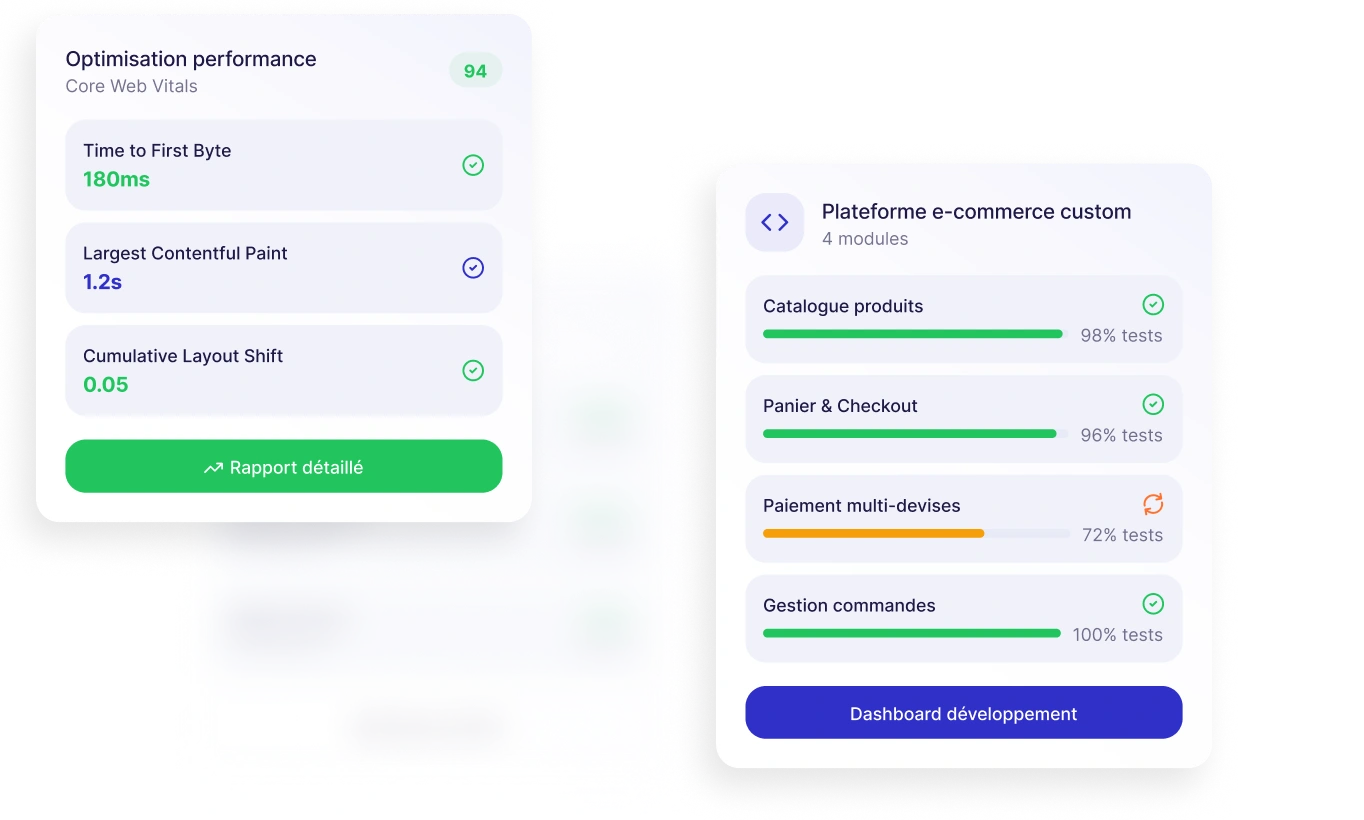
- Optimization Core Web Vitals starting with the design phase
- Automated testing, continuous integration, non-regression testing
- Architecture designed to handle traffic spikes and catalog growth
Why should you entrust your project to us to us?
Contact an e-commerce expert
Proven expertise in 100% customized solutions
For over 20 years, we have been designing specialized and customized platforms, ranging from custom development to headless or composable architectures.

An Industrial and Secure Approach
Our experienced teams structure each project using a robust methodology: scoping, sprints, testing, continuous integration, documentation, and controlled releases.

An end-to-end integrated team
Architects, developers, UX/UI specialists, data analysts, and SEO experts work together to deliver a reliable, scalable solution that is perfectly aligned with both your operational and business objectives.
A proven methodology for designing your custom website
Scope Definition: Defining the Project's Foundations and Objectives
Every successful project begins with a thorough understanding of your environment. We analyze your business processes, technical constraints, strategic challenges, and performance metrics to develop a coherent vision for the project. This collaborative effort enables us to establish prioritized project specifications, a clear roadmap, and a secure framework for the budget, timeline, and scope.
Functional and Technical Design: Structuring the Future Platform
This phase aims to translate the identified needs into concrete specifications. We define user flows, organize data, map business processes, and design interfaces as well as system-to-system exchanges. These elements form the foundation of the development process and minimize the risk of costly adjustments at the end of the project.
Agile Development: Sprints and Continuous Monitoring
TThe solution is developed using an iterative approach, organized into successive sprints. EEach cycle includes regular demonstrations to validate progress and adjust priorities as needed. Continuous integration practices and and automated testing ensure reliability, maintainability, and overall quality.
Deployment and Operation
The production deployment is prepared and secured using a representative , validated rollback procedures, and enhanced monitoring capabilities. We support the post-go-live stabilization phase and establish the maintenance during operational service (MCO) to ensure long-term performance.
A Methodology Enhanced with AI
AI speeds up and helps optimize certain key tasks of delivery : analysis of the existing system, code and test generation, and technical documentation. We’ve seen productivity gains of 30 to 70% in certain key phases, without compromising on quality or control over the delivered code.
Technologies & Partners for Your Custom Projects
Our selection of partner solutions is based on our experience in e-commerce and digital technology. Our vendor-neutral approach allows us to identify and recommend the best solutions on the market.
FAQ: Your Questions About a Custom E-Commerce Site
The budget depends on the functional complexity, the number of IT integrations, the performance requirements, and the scope of the project. A B2B website with complex workflows and ERP/PIM integrations typically represents an investment of several hundred thousand euros. A more focused project can be completed within a significantly lower budget. The initial scoping phase allows us to establish a reliable budget and structure the delivery in phases to ensure a positive ROI.
On average, allow 6 to 18 months from scoping to go-live, depending on the complexity of the scope, the number of IT integrations, and the delivery model. We prefer an incremental release approach to deliver value from the very first months, rather than a “big bang” at the end of the project.
A standard CMS remains a viable option as long as your business processes, data volume, and integrations fall within the vendor’s standards. Custom development becomes justified when apps and connectors pile up, performance deteriorates, or your business roadmap depends on features that fall outside the CMS’s scope. A scoping audit allows you to make an objective decision, free from commercial bias.
Three key factors: well-documented source code that complies with industry standards (recognized frameworks, no proprietary stack); a modular architecture that allows components to be replaced independently; and comprehensive technical documentation delivered at the end of the project. We always prioritize the client’s autonomy, including the option to take over the application maintenance in-house or switch to a different service provider.
“Full-custom” means that the entire platform is developed from scratch, without relying on a commercial CMS, and is suited for projects where no off-the-shelf solution meets the requirements. A headless approach uses an off-the-shelf e-commerce engine in the back office (Shopify, commercetools, etc.) with a custom-developed front end. A composable approach (MACH architecture) combines several best-of-breed components connected via APIs. The choice depends on the expected return on investment, not on a technological preference.
Yes, provided that we first conduct an audit of the code, architecture, and existing documentation. This audit allows us to assess the quality of the deliverable, identify areas of technical debt, and estimate the cost of the takeover. Depending on the situation, we may take over the existing codebase, refactor certain parts, or recommend a partial rebuild.
Contact an expert
Latest articles
Visit the blog
ChatGPT Ads on Shopify and HubSpot: What This Means for E-commerce Businesses and Marketing Teams in France
02/10/2026
Fine-tuning LLMs in the Enterprise: Better Than a Frontier Model?
28/09/2026

OroMomentum: AI for B2B efficiency
22/09/2026

AI: The 5 Top Stories of Summer 2026
17/09/2026
Content management on Magento: how to give marketing teams back control with Hyvä CMS
17/08/2026