5 August 2026
What is the ETIM standard, and what is it used for?
 What is ETIM?
ETIM (Electro-Technical Information Model ) is an international model for classifying and characterizing“rich” technical data for building products, particularly electrical and HVAC products.
Producing high-quality data is a major challenge for the construction industry, given end customers’ growing demand for transparency.
The international ETIM (Electro-Technical Information Model) standard was thus designed to classify technical product data in the building supply sector. It enables the FAB-DIS data exchange format to function optimally.
ETIM helps organize the vast amount of data, making it possible to look up any item and describe it unambiguously using relevant characteristics. Products are thus described in a uniform and consistent manner, regardless of the manufacturer, medium, or language.
Manufacturers can integrate product data into their PIM (Product Information Management) system. Retailers, for their part, benefit from optimal product listing across various distribution channels: the Web, stores, catalogs, and apps.
The History of the ETIM Standard
The ETIM product classification standard was developed to structure the flow of information between professionals, manufacturers, and distributors in the construction sector. ETIM was designed to meet the construction industry’s growing demand for clear and structured information on technical products.
The ETIM model was first used by manufacturers and distributors in the electrical engineering sector, but it quickly gained traction in other fields and countries around the world.
A model that is updated regularly
Today, this classification model (or taxonomy) is available in 17 languages. It is supported by no fewer than twenty member organizations, representing 21 countries. It is updated regularly.
To date, international versions of ETIM are released every two years. The current version of the ETIM model is V 8.0. The French version has been available to all members since March 2021. The next version, 9.0, is currently in development and will be available in late 2022. Manufacturers must have these updates.
There is also a dynamic version of the model, which allows all changes to be incorporated in real time.
Do you have an idea or a project?
Request your personalized audit
What is a data exchange format?
Previously, retailers did not require suppliers and manufacturers to use specific data formats when submitting product data.
However, the wide variety of formats in which the data was received made it difficult to analyze. While some providers supplied complete and detailed data, others provided files that were sparse and difficult to analyze.
Standardized data exchange formats were developed to address these issues, with the goal of ensuring everyone speaks the same language. In some cases, multiple formats coexist depending on the industry.
More and more retailers are asking their suppliers for standardized formats.
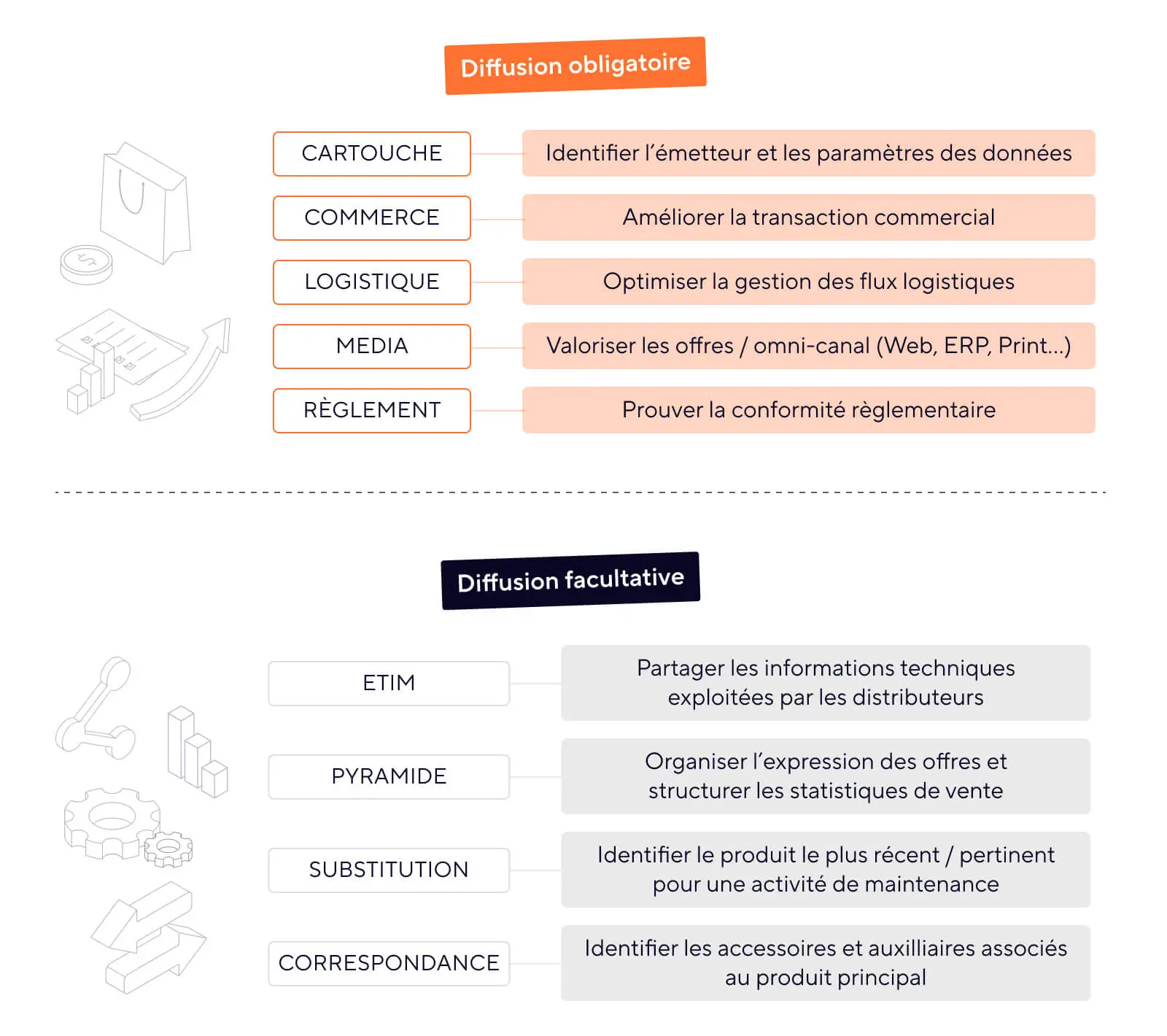
Adopting FAB-DIS means boosting productivity by eliminating the time-consuming task of managing multiple proprietary formats. No special hardware or investment is required.
The result: up to a 40% time savings on your data cataloging tasks. FAB-DIS lets you focus your time on enriching and improving data quality, rather than on duplicating it.
By default, the FAB-DIS file is filled out manually. DATASOLUTION integrates the ETIM model into the marketing production platforms it deploys for its clients, particularly in PIM (Product Information Management).
Once this data has been entered into the PIM solution, it is then automatically processed for various formats and purposes. This data can be imported into marketplaces, e-commerce sites, etc.
A PIM (Product Information Management) system facilitates the enrichment and maintenance of data through a graphical interface and a tailored data model. For manufacturers and distributors who wish to use the ETIM model, it is therefore preferable to use a PIM solution.
There are many business challenges associated with using a standardized and unified data format, such as ETIM:
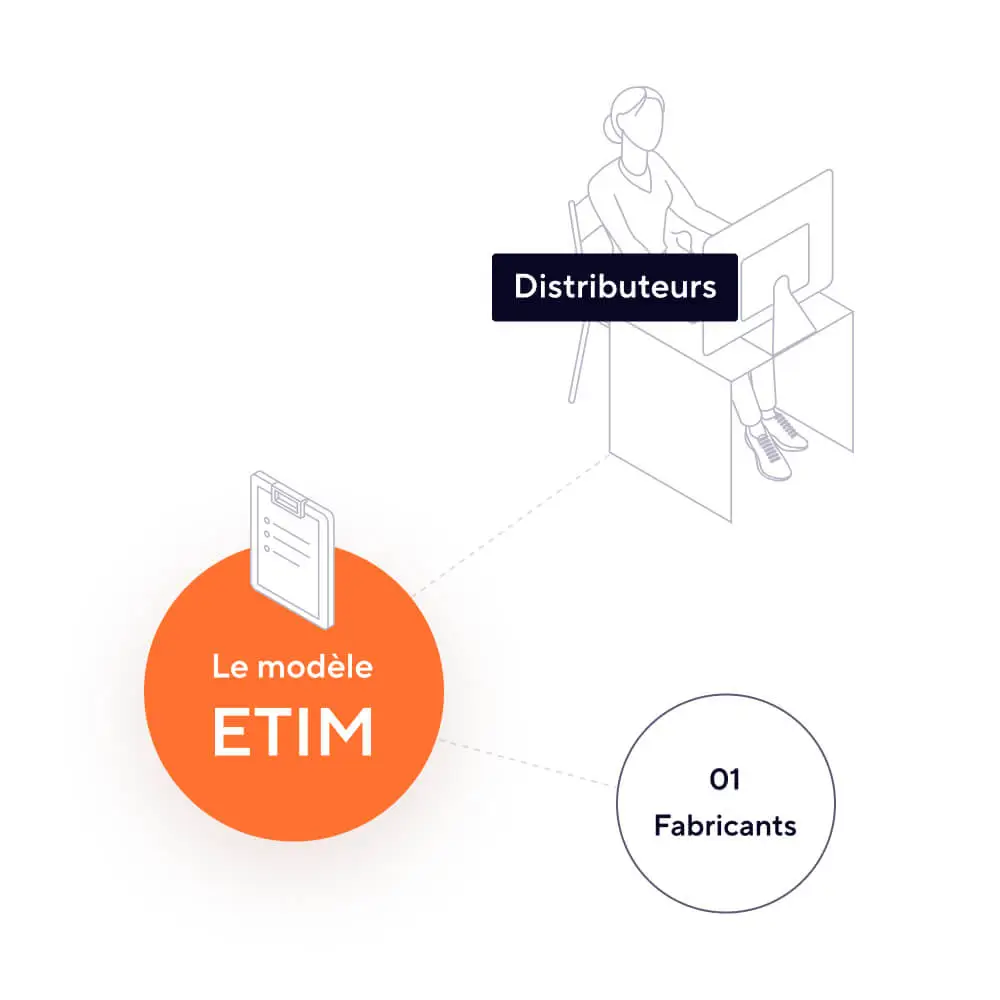
How does the ETIM model work?
The ETIM data model is created by coding a set of technical data. The model is based on various levels of product categories.
The ETIM model has two classification levels:
- Product Group
- Product Class
Each product class is assigned to a unique product group. The group level was created solely to facilitate the management of product classes.
The ETIM model also includes the following entities:
- Feature
- Value
- Unit
- Synonym
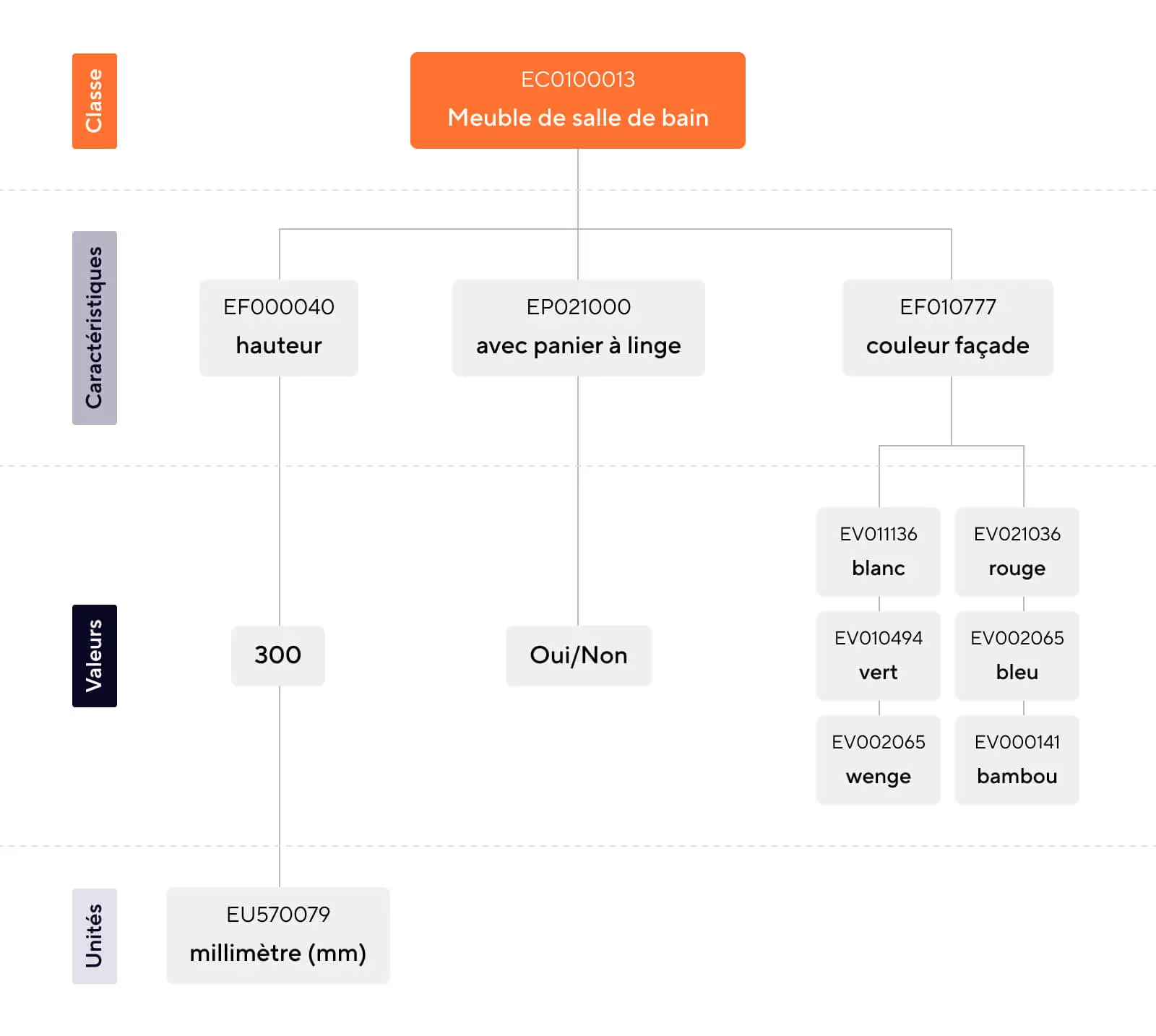
Product Class
In ETIM, a class describes similar products, as well as groups of products from different manufacturers or suppliers. Each product class has various attributes designed to specify the technical characteristics of the products within that class.
The characteristics of each class are organized according to their importance, as well as their essential aspects (dimensions, electrical characteristics, etc.).
ETIM includes nearly 6,000 product classes from sectors as diverse as:
- Electricity
- Plumbing, Heating, and Ventilation
- The building
- Tools
Other sectors may be included in ETIM at the request of members.
Features
A characteristic is clearly defined by a description, a characteristic type, a unit, and/or a value.
Here are the types of characteristics:
- A stands for alphanumeric: list of possible values (e.g., red, green, long, short, etc.)
- L for logic: closed-ended questions, that is, questions that can be answered with a yes or no (also known as Boolean logic, true or false)
- N for numeric: single numeric value
- R for interval (or " range " in English): two numerical values defining a range of values
Value
Each attribute of a class corresponds to a specific alphabetical list of possible values.
Unit
A "unit" refers to the unit of measurement that defines the expected value for numerical and interval characteristics.
Synonym
A synonym (or keyword) provides an alternative description of a product class. A synonym can refer to multiple product classes, and a product class can have multiple synonyms.
The Benefits of ETIM for Industrial Manufacturers
For industrial manufacturers, ETIM evaluates products based on objective and well-defined technical criteria, such as the standard specifications included in sales materials, the specifications commonly requested by installation contractors, and the specifications compatible with the major French and European certifications.
ETIM’s Benefits for Distributors
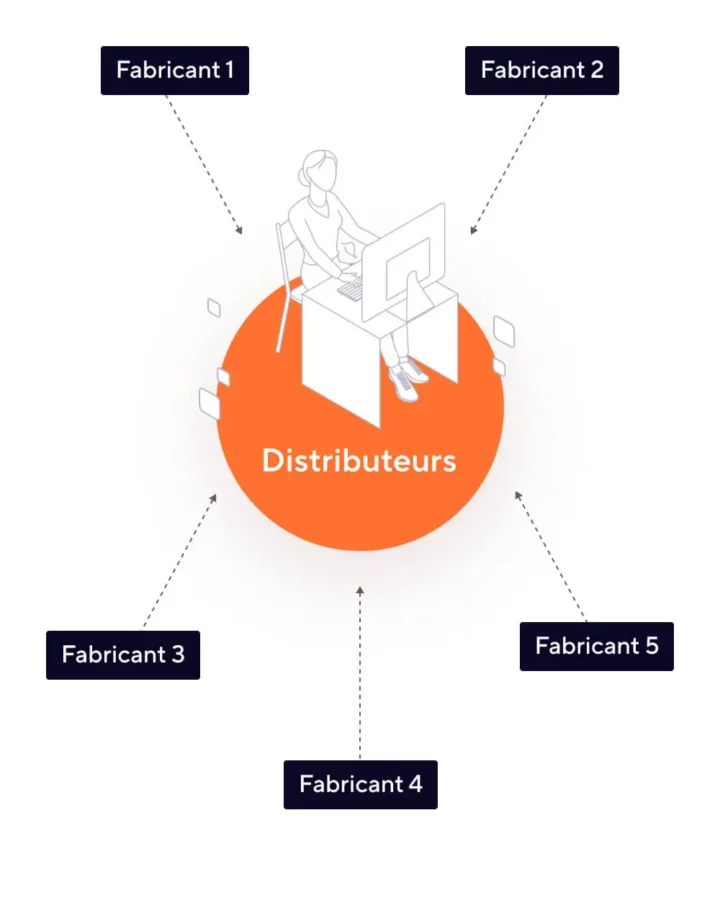
For distributors, the ETIM model makes it possible to populate media with data and automate processes such as internal classification, content management, or MDM (Master Data Management); the production of print and digital communication materials; and filters and search fields in applications and e-commerce sites.
ETIM Model: Which Industries Does It Apply To?
The ETIM classification model is used in various building product sectors.
In the coming years, other industry sectors and product groups are expected to be incorporated into the ETIM model.
The model was designed for use by professionals (installers, integrators, distributors, and manufacturers) who offer products aimed at a B2B (Business-to-Business) audience.
- Electrical Engineering
- Plumbing and Heating
- Ventilation and Air Conditioning
- Plumbing
- Building Materials
- Tools
Unlike a database, the ETIM model itself does not manage a manufacturer’s brand or product code. There is a mandatory association between the product code and the ETIM class, which allows the characteristics and values included in the classes to be linked.
The manufacturer is responsible for establishing this association/mapping before providing the information to its distributor. This association must be established in order to create a link via FABDIS or in another format.
The business reference is the key piece of information for linking to other data in the FABDIS database.
What are
What are the advantages and benefits of ETIM?
-
#01
Products that are more easily visible in catalogs and marketplaces
-
#02
Providing Communication Materials with Structured Data for Distributors
-
#03
Improved effectiveness of communication and interaction with all trade stakeholders
-
#04
Advanced features, such as Easy-Check GOLD by FAB-DIS (a solution designed to simplify the creation of manufacturer files and verify their compliance for distributors)
-
#05
Process optimization, resulting in savings in time and resources
-
#06
Better product listings on retailers’ e-commerce sites because the product descriptions are more detailed
-
#07
Greater satisfaction among end customers, who can easily find the products they need
-
#08
Achieving significant cost savings by streamlining procurement, inventory management, and distribution—by consolidating large orders and optimizing the portfolio
-
#09
Reduced Risk of Error Through a Common Language
-
#10
Comprehensive, accurate, and up-to-date product data throughout the supply chain
-
#11
Improving the reliability of transactions and optimizing online sales through e-commerce sites
-
#12
Improved strategic decision-making through the use of harmonized data that is processed in a meaningful way and shared with customers and partners
ETIM by the Numbers
- Model release date: 1991
- Model introduced in France: 2013
- A new version of the model is released approximately every 3 years
- Version 8.0
- 5,415 classes or product families
- 22,698 ETIM characteristics
- 25,000 ETIM values
- Available in 18 countries and 22 languages
- 90 members of ETIM France, including 69 manufacturers, 14 distributors, and 7 partner members (PIM software vendors)
Related articles
Visit the blog
Content management on Magento: how to give marketing teams back control with Hyvä CMS
17/08/2026

How Hyvä Checkout cuts load times and boosts conversions
11/08/2026

RAISE Summit Paris: 3 lessons on AI in the enterprise, from data to execution
23/07/2026

DATASOLUTION continues its external growth with the acquisition of Altimax
23/07/2026
Shopify POS: Sync Your Brick-and-Mortar Stores and Your E-Commerce Site—Once and for All
17/07/2026