5 August 2026
What is a reference value?
 Product information, customer information, supplier data, financial data, digital resources… Companies collect and store various types of data—and thus information—that are essential to their successful growth.
But then, why is good data management so important? How can we make the most of all this reference data?
Definition of Reference Data
Master data is the strategic data held by a company. It is distributed throughout the information system and is used in the company’s line-of-business software. It can include all types of marketing data:
Today, the quality of all types of data is central to the process. Approximately 82% of business decision-makers cite improving data quality as an area for improvement within their companies (*The Economist). Master data creates value and thus enriches transactional data.
Got a project?
Request your personalized audit
Why is master data management important for businesses?
The most commonly used data management systems are silo architectures and Master Data Management.
The problem with a silo structure is that it segments data by department. As a result, the data is not unified, and the different data sets do not communicate with one another.
While silos were once widely used by large companies, they now lead employees to make poor strategic decisions. Indeed, with silos, it is difficult to determine which version of the information is correct, particularly due to duplicates and outdated data.
As a result, employees have difficulty accessing the information they need. Consequently, data silos lead to a real waste of time and a loss of productivity. Similarly, the quality of customer relationships declines, and marketing campaigns become less effective.
Thus, effective master data management ensures a company’s growth and long-term sustainability. That is why the best solution for addressing the new challenges of multichannel operations is to adopt a centralized master data management process.
There are many reasons why companies choose to implement a single data repository. And very often, this idea arises when a company embarks on its digital transformation. Data is, in fact, an extremely important element in any organization, regardless of its size.
How can we ensure effective master data management?
To ensure effective management of the company’s master data, a Master Data Management (MDM) solution is the most suitable option. With MDM, the days of a data-silo architecture—and thus scattered information that makes it difficult to find what you need—are over.
More specifically, MDM helps establish a common language for the entire organization. Master Data Management centralizes information, eliminates duplicates, and updates reference data.
Rather than storing the same data in different systems, MDM maintains it in a single master file, which simplifies the company’s organizational structure. The values are standardized so they can be used by all applications in the information system.
Company stakeholders have access to data on customers, products, suppliers, and more. This ensures that employees can quickly access reliable, up-to-date information. As a result, this process improves team productivity.
The role of Master Data Management is to simplify the management of the company’s strategic data and to ensure the quality and governance of master data. Particular attention is paid to data traceability and security.
Implementing a single data repository using an MDM solution is a large-scale project. Do you have a master data management project? Are you looking to implement an MDM project in your company? We offer tools to simplify the management and storage of your master data. Schedule a personalized demo to get a comprehensive overview! 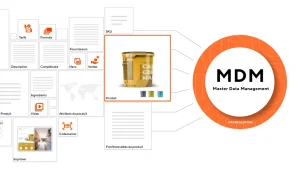
Do you need help defining the scope of your MDM project? Let our experts help!
Related articles
Visit the blog
Content management on Magento: how to give marketing teams back control with Hyvä CMS
17/08/2026

How Hyvä Checkout cuts load times and boosts conversions
11/08/2026

RAISE Summit Paris: 3 lessons on AI in the enterprise, from data to execution
23/07/2026
DATASOLUTION continues its external growth with the acquisition of Altimax
23/07/2026
Shopify POS: Sync Your Brick-and-Mortar Stores and Your E-Commerce Site—Once and for All
17/07/2026