10 March 2026
Product Governance: Why a PIM Is Essential Given the Limitations of the e‑commerce Back Office
 In an increasingly complex and omnichannel business environment, product data management is becoming a strategic imperative for companies. Yet, many still rely on their e-commerce back office to manage their entire catalog. While this approach may seem practical, it quickly reveals its limitations when faced with the diversity of sales channels, regulations, and customer expectations.
At DATASOLUTION, we see every day the challenges brands and retailers face in maintaining effective product governance. Here’s why entrusting this task to an e-commerce back office is a misuse of resources, and how a PIM (Product Information Management) can transform the way you manage product information.
5 Key Takeaways
- The back office e-commerce is not a product repository : designed for online sales, it suffers from rigid modeling and weak governance, making it unsuitable for comprehensive product information management.
- Product complexity has skyrocketed : beyond just the name and price, products now include dozens of attributes (regulations, allergens, materials, traceability, etc.) that only a PIM can organize using flexible templates by product family.
- True omnichannel capability relies on a PIM : Unlike web-based back-office systems, a PIM powers all channels—physical stores, marketplaces, partners, and print—from a single source of truth.
- PIM enhances data governance and reliability : Thanks to structured workflows, defined roles, and validation processes, each contributor (marketing, quality, legal, etc.) operates in a traceable and controlled manner.
- The PIM has established itself as the core of the information system : by separating product management from sales channels, it reduces duplication, improves maintainability, and offers greater agility in response to market changes.
The e-commerce back office: an operational tool, not a product database
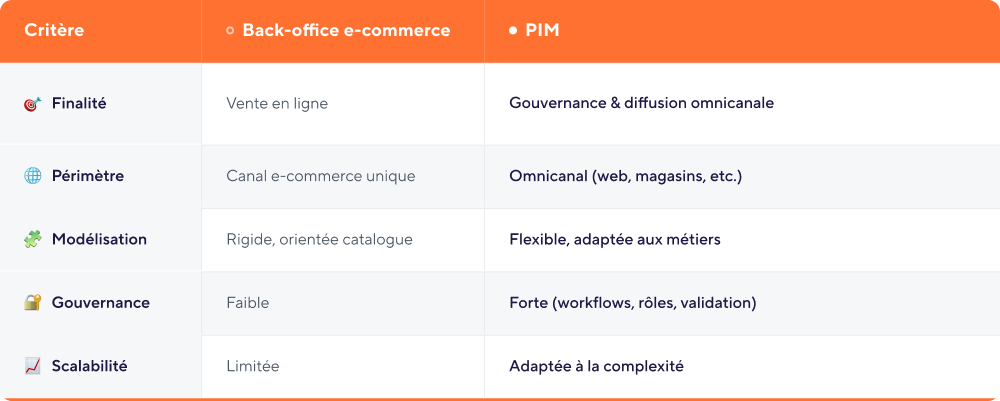
The e-commerce back office was designed for a specific purpose: to sell online. Its scope is limited to the digital channel, its structure is rigid, and its governance remains weak. It excels at managing products for the purpose of a transaction, but it is not suited to becoming the single source of truth for your products.
Conversely, a PIM is designed to manage and distribute product information across all channels (web, stores, marketplaces, partners). Its flexible modeling, robust governance, and scalability make it the ideal tool for meeting the demands of a constantly evolving market.
Product Governance: Why a PIM Is Essential Given the Limitations of E-Commerce Back-Office Systems
The complexity of the product goes beyond the scope of e-commerce
Today’s products are no longer limited to a name, a description, and a price. They include sizes, colors, materials, regulatory requirements, traceability, allergens, and many other specific attributes depending on the product category. An e-commerce back-office system designed for a single sales channel cannot handle all this complexity.
A PIM, on the other hand, allows you to:
- Separate models for each product category (fashion, food, cosmetics, etc.)
- Conditional attributes based on product type
- Business rules specific to each sector or market
With a PIM, every stakeholder in the company (product managers, quality assurance, marketing, legal) operates within a structured workflow, ensuring data reliability, traceability of changes, and validation tailored to each context.
Omnichannel: A Promise That’s Often Just Talk
Many e-commerce solutions claim to be omnichannel, but in reality, they remain focused on the web and its variations (such as mobile apps). A PIM, on the other hand, acts as a single source of truth and feeds all your sales channels:
- Brick-and-mortar stores: point-of-sale (POS) terminals, sales associate tablets, digital displays, and even electronic price tags
- Marketplaces and External Feeds
- External partners: directories, resellers, distributors, etc.
- Print: flyers, posters, catalogs …
Scalability and IT Architecture: PIM at the Heart of Your Ecosystem
Integrating a PIM into your IT architecture means decoupling product management from your sales channels. The result:
- Reducing Data Duplication
- Greater agility in responding to changes
- Optimized Maintainability of Your Information System
The PIM becomes the core of your product governance, while the e-commerce back office becomes just one consumer among many.
What now?
Managing your product data no longer has to be a barrier to your growth. With a PIM, you’ll gain efficiency, consistency, and responsiveness, while reducing the risk of errors and maintenance costs.
At DATASOLUTION, we help companies implement PIM solutions tailored to their specific challenges, such as ETAM, Lactalis, Ekosport, and Supergroup.
Would you like to learn more?
Contact us to discuss your needs and learn how a PIM can transform your product governance.
Related articles
Visit the blog
ChatGPT Ads on Shopify and HubSpot: What This Means for E-commerce Businesses and Marketing Teams in France
02/10/2026
Fine-tuning LLMs in the Enterprise: Better Than a Frontier Model?
28/09/2026

OroMomentum: AI for B2B efficiency
22/09/2026

AI: The 5 Top Stories of Summer 2026
17/09/2026

Content management on Magento: how to give marketing teams back control with Hyvä CMS
17/08/2026