4 January 2025
Digital Asset Management (DAM): A Critical Link in the Content Value Chain
 In an era where digitalization is ubiquitous, it seems obvious that it greatly improves a company’s performance. However, managing all of a company’s data is often complex.
Let’s take the example of graphic data specifically: the appearance of different versions of the same asset within a company’s storage systems—or simply the inherent risk of data loss—can pose real challenges on a daily basis. This is due in particular to the existence of different versions of the same asset within a company’s storage systems or simply to inherent data loss, for example. Using a marketing data management tool is therefore essential for managing and organizing production. This is where MDM, which itself consists of the PIM for product information management and DAM (Digital Asset Management) for graphic data.
In fact, storing thousands of digital resources isn’t something you can wing—it must be done carefully; otherwise, you run the risk of not being able to find your way around. At this point, the first priority is to help users sort and organize all their content very easily using configurable search tools, for example. These tools are available in MDM, DAM, and PIM systems alike, enabling the use and optimization of marketing and communications data.
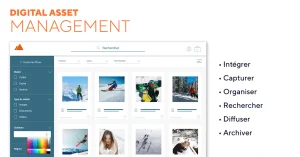 Focus: What Is DAM?
DAM stands for Digital Asset Management. As you’ve probably guessed, it’s a technological tool that allows you to store, organize, and share a company’s digital assets. With its innovative and intuitive design, DAM serves as a truly centralized and secure repository for your data. DAM is particularly useful for quickly and easily sharing all digital assets within a company, whether they are images, text documents, or videos…
More than just a storage repository, a DAM lets you explore and leverage your digital assets through a truly collaborative platform, benefiting every department in a company—from the marketing and sales teams (sales, IT…), as well as the design teams (creative, brand management…). A high-performance solution for both B2B and B2C companies.
For example, Digital Asset Management allows users from all over the world to download resources once they have been granted permission to do so. This makes communication faster and easier, and allows content to be shared on a webpage or on social media in the blink of an eye.
Why Implement a DAM Solution?
Today, DAM is a major player in the content value chain, which is currently structured as follows:
Production → Storage & Organization → Localization & Customization → Distribution
It is important to understand that the DAM will cover this entire chain. It will play a crucial role in everything related to the storage, organization, and also the discovery and distribution of content.
To cope with the increasing volume and diversity of marketing content, it has become essential for companies to effectively manage content centralization and create a single repository for the entire organization. In other words, DAM solutions make it possible to pool all files relevant to the company, thereby facilitating their use. In addition to strengthening the company’s brand image, this also ensures the consistency and relevance of resources throughout the content value chain.
The goal is to embark on its own digital transformation, leading to an even broader multichannel approach and the use of a single marketing production platform. Gradually, so-called “outbound” strategies are being replaced by “inbound” strategies. DAM helps save resources and reduce what is typically a significant investment by enabling personalized, targeted campaigns with greater precision. This approach improves communication among all of a company’s departments and also boosts productivity.
DAM & PIM: Are We Heading Toward a Mandatory Partnership?
PIM, or Product Information Management (also known as GIP in French, short for Gestion de l’Information Produit), is a technology similar to DAM, but one that enables the centralization and standardization of marketing and technical information for a product or product catalog. In a sense, the two complement each other, especially in projects aimed at digitizing the product offering. However, the management processes for DAM and PIM are fundamentally different.
In practical terms, a DAM enables the management of digital files. However, to ensure optimal communication among marketing, graphic design, and sales teams, we approach the DAM through the lens of MDM: a broader framework that provides greater precision.
MDM: Breaking Down Traditional Data Silos
We do not view DAM or PIM as isolated information silos. On the contrary, our experience working with digital companies over the past few years has shown us that they must interact in a complementary manner within a broader environment: MDM. Indeed, the idea of using DAM on its own makes little sense. That is why, in our role as digital transformation consultants, we believe that so-called “best-of-breed” solutions are the most appropriate. In other words, we deploy platforms tailored to our clients’ needs to perfectly address the specific requirements of their businesses.
To achieve this, we integrate several software solutions (both open-source and proprietary), always with the goal of optimizing marketing and communications data. More specifically, we build a Master Data Management (MDM) system capable of integrating content management, digital asset management (DAM), and product information management (PIM) tools. As a result, information is centralized in a single location, providing greater convenience and enhanced security. A single repository for centralizing corporate data.
Forget about problems with lost information or poor organization, which force each department to waste hours trying to find the right versions…
An ideal solution for organizing and consolidating your data
As we mentioned earlier, a system like this benefits not only content storage and organization but also content distribution. This allows you to optimize the flow of content across the various channels used by the brand: print, web, social media, e-commerce, catalogs, and more. Each of our modules specifically addresses one stage of a piece of content’s lifecycle, from production and packaging to any other output channel.
When communication channels multiply and diversify—as is often the case with brochures, email campaigns, offline marketing, and social media—there are effective solutions available to ensure the consistency and relevance of all your projects.
Got a project?
Related articles
Visit the blog
ChatGPT Ads on Shopify and HubSpot: What This Means for E-commerce Businesses and Marketing Teams in France
02/10/2026
Fine-tuning LLMs in the Enterprise: Better Than a Frontier Model?
28/09/2026

OroMomentum: AI for B2B efficiency
22/09/2026

AI: The 5 Top Stories of Summer 2026
17/09/2026

Content management on Magento: how to give marketing teams back control with Hyvä CMS
17/08/2026