10 January 2025
What is a data model?
 A data model is a way to structure and organize a company’s data, as well as the relationships between them. The data model is the cornerstone of an information system, particularly MDM (Master Data Management) solutions deployed to manage a company’s strategic data.
Defining a Data Model
A data model defines and structures all of a company's data and the connections between them within the context of specific business processes. These data models are presented visually. They then help build an effective information system.
In fact, information systems require that data be properly defined, formatted, and organized beforehand. Data models help identify which data is required, structure it correctly, and build a common foundation for storing, accessing, sharing, updating, and utilizing data for all of a company’s teams, as well as for its partners, customers, and suppliers.
A data model is essential for building a reliable information system that supports all of the company’s business processes. The advantage of structuring data in a data model is that it supports a wide variety of use cases, including database modeling, information system design, and process development. 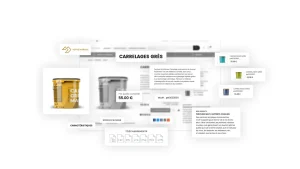
Got a project?
Request your personalized audit
The conceptual data model
Also known as a domain model, the conceptualdata model maps out the company’s major business processes. The conceptual data model clarifies the key initial concepts. It is most often used at the start of a new project and prior to the development of the logical data model.
The Data Model
The logical data model refines and elaborates on the conceptual data model. This logical model clarifies and describes the various logical entities (data classes), specifies the data attributes that define these entities, and characterizes the relationships between them.
The data logic model provides context for the conceptual data model. This allows data from different systems to be normalized.
The Physical Data Model
The physical data model is the final step in data modeling—or, to put it another way, the most complete and accurate model. In fact, the physical data model constitutes the internal schema of a database:
- the tables
- the columns in these tables
- relationships between tables
The physical data model is used directly in database design. It generally allows for the design of three types of databases:
- relational databases (traditional operational databases)
- document databases (NoSQL and JSON)
- Dimensional databases for aggregation and business intelligence data stores, such as data warehouses and data marts
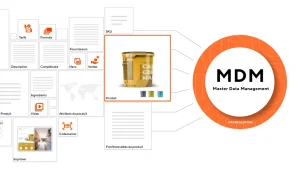
Building a data model will be the first step in structuring the data before implementing it in the MDM (Master Data Management) system.
Master Data Management will enable the management of all the company’s “master” data, just as a PIM (Product Information Management) system does specifically for product data and a DAM (Digital Asset Management) system does for graphic data.
Data models will be specific to each company. They may be very similar, or they may differ slightly or completely from one organization to another. For example, two companies in the same industry, such as the electricity sector, will have similar data models because they share the same characteristics and required data fields. On the other hand, a company in the IT sector and a company in the printing industry, for example—which face very different production and order management challenges—will have very different data models.
The data model must be designed early on so that a suitable MDM can subsequently be developed to properly manage a company’s data. The company can then distribute this data across its various communication channels, such as an e-commerce site or other platforms.
 Master data
Reference data, also known as master data, constitutes a company’s strategic data —that is, the data on which its entire business is based. It is used throughout the company’s information system, particularly in line-of-business software.
The different types of reference data are as follows.
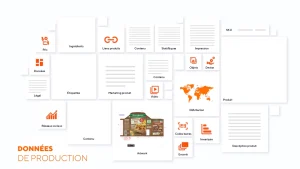
- Product data: product description, model, color, size, retail price, unit of measure, diagram, instructions…
- Customer data: name, mailing address, email address, order history, etc.
- Supplier data: orders, shipments, inventory, invoices…
- Geographic data or location data: information that enables the analysis of data by geographic area or by the locations of stores, branches, etc.
- Digital assets: all digital files (images, videos, infographics, etc.) needed for the company’s communications
- Legal information: standards, regulations, legal notices, etc.
- Translations: texts in various languages…
 The Role of Master Data Management
 Why choose DATASOLUTION to deploy your centralized data repository?
DATASOLUTION advises and supports companies in their Martech digital transformation, enabling them to manage all their marketing data (products, customers, suppliers, location) and address the challenges of multichannel marketing by centralizing and organizing their data within a single data repository.
DATASOLUTION’s industry experts are available to help you define your requirements and propose a solution tailored to your specific needs.
Our team conducts an assessment of your IT marketing maturity to identify an architecture and an action plan to strengthen your IT, marketing, and sales ecosystem in line with your strategic priorities.
Related articles
Visit the blog
ChatGPT Ads on Shopify and HubSpot: What This Means for E-commerce Businesses and Marketing Teams in France
02/10/2026
Fine-tuning LLMs in the Enterprise: Better Than a Frontier Model?
28/09/2026

OroMomentum: AI for B2B efficiency
22/09/2026

AI: The 5 Top Stories of Summer 2026
17/09/2026

Content management on Magento: how to give marketing teams back control with Hyvä CMS
17/08/2026