3 February 2023
The 7 Key Issues in Data for 2023
 “Data”… or 18,100 monthly Google searches in France, according to the Keyword Planner. In recent months, more than ever, this term has been everywhere. Many keywords associated with data are trending right now, including ChatGPT, #jenesuispasunedata, data privacy…At the heart of our digital world every day—but also, and above all, at the heart of business strategies—data enables us to make informed and well-considered decisions.
To take a brief look back, in 2022, the key issues surrounding data included topics such as artificial intelligence, flexible governance, ethics, and even data equity. In a world where innovation is flourishing, driven by the use of data, here’s a brief overview of the seven trends to consider as you ramp up your data strategy this year.
This isn’t a spoiler. This new year will be profoundly marked by the end of third-party cookies. Originally announced for late 2022, Google has ultimately pushed the date back to the second half of 2023. We are entering a new turning point for the data economy.
#1: Web Analytics—Which One Should You Choose?
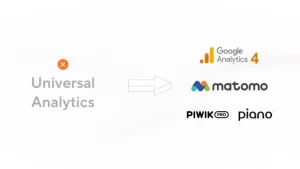 July 2023 marks the end of Universal Analytics, Google’s flagship tool, which the CNIL has deemed illegal since February 2022. Google has just announced to its users that UA properties will be automatically migrated to Google Analytics 4. You will still be able to access previously collected data for at least six months.
It would be wise to export your historical data, and it will still be necessary to follow the CNIL’s instructions published in July 2022 to remain compliant with the GDPR—in particular, by using proxification to pseudonymize the data. This may also be an opportunity to choose another tool from among the 18 solutions offered by the CNIL that allow for an exemption from the consent requirement. Among the contenders to succeed UA are AT-Internet, Eulerian, Matomo, and Piwik Pro.
With Analytics 4, Google is completely shifting its approach by offering a data model based solely on events. Artificial intelligence is now at the heart of the platform, enabling it to automatically generate accurate and useful insights based on effective predictive metrics.
At a time when the management and protection of personal data are major challenges for the American company—which has been repeatedly called to order by European regulatory authorities—Google has announced that it is prioritizing privacy: anonymizing IP addresses and removing third-party cookies.
If you haven’t done so yet, it’s absolutely urgent that you consider switching to another web analytics tool so you don’t get caught off guard by the automatic transition to GA4.
Contact our experts for assistance!
#2: Server-Side Tracking
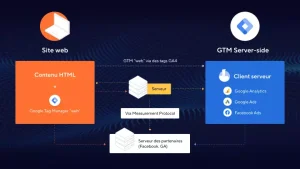 A recent innovation that has already become indispensable, server-side tracking refers to the process of collecting data generated by a user while viewing a web page, routing that data through a web server, and then transmitting it to a destination server or system (such as analytics, personalization tools, CRM, etc.).
This type of tracking offers three main advantages: improved website performance, particularly through reduced page load times; data security and privacy protection; control over the data generated by website users; and a reduced risk of data leaks; and, finally, improved quality of the data collected.
As you can see, with the end of third-party cookies, blocking by browsers, ad blockers, and the use of the conversion API… it’s necessary to switch to a server-side approach this year. The volume, confidentiality, and—above all—the quality of the data collected will only improve as a result.
#3: Visualizing and Analyzing Your Data
Is your data centralized?
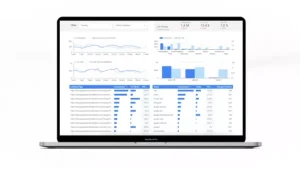
Stop wasting time accessing your data to build your valuable KPIs by connecting to various tools and creating static reports that will be outdated by the next day. Choose data visualization and invest in a custom, dynamic dashboard!
This is one of the best ways to enable you to make data-driven decisions by analyzing the overall context of your business based on well-defined KPIs.
There are many tools available depending on your company’s needs and your data sources; these include Looker Studio (formerly Data Studio), Tableau, and Power BI.
#4: Pay Attention to Your Tracking
One of the first things to pay attention to when editing a website: tracking! It’s essential to clean it up and update it regularly. To remain effective and function properly over time, tracking must adapt to changes in your website and your various marketing and analytics tools. Unnecessary tracking should be removed so as not to compromise the website’s performance; a qualified web analyst can help you by conducting regular audits of your tracking.
So don’t make the mistake of neglecting it. Bring it back to life! Also, if your most recent update was more than 9 months ago, it’s absolutely essential to conduct an audit.
#5: We need to promote
Collecting data is good, but making the most of it (or even monetizing it) is even better!
PwC recently published a study highlighting the rise of chief data officers (CDOs).
While the value of data is widely recognized today, companies still struggle to quantify its economic impact in greater detail. It is no easy task to roll out new data initiatives—which come with rising costs—to an audience that expects rapid, tangible results.
It should be noted, however, that the various approaches to data valuation and/or monetization go hand in hand with the idea of managing data as a product.
#6: We love minimalism
Data minimization is a concept that emerged alongside the principles of personal data management, particularly in the context of what is known as “privacy by design” (protection by default).
This principle subsequently spread to many companies through the GDPR, which stipulates that personal data must be “adequate, relevant, and limited to what is necessary for the purposes for which it is processed.”
Although it may seem like a constraint at first glance, more and more companies are recognizing the benefits of an approach that aims to identify, early on, the data most likely to create greater value and then assess its operational uses.
In 2023, it is high time to adopt the principles of data minimization—beyond just personal data—as best practices. Focusing on “only what is necessary” helps combat information overload and allows you to devote all your energy, budget, and processing capacity to the categories of data that matter most—those that deliver value to your business.
Against the backdrop of a climate emergency that is more severe than ever, this practice also helps make a more positive contribution to environmental protection.
#7: Data Democratization
, and DATA Mesh
In closing, one final major change to watch for in 2023 will take place in the area of data democratization.
We agree—this isn’t a new trend. However, we are seeing a noticeable acceleration, driven by technological advances and a strategic shift within various organizations.
We’re seeing that companies are becoming more aware of the importance of “opening up” their data and providing free access to tools and innovations. (Hello, ChatGPT—which needs no introduction—or even Dall-E, which lets you create AI-generated art.)
DATA Mesh?
Coined in 2019 by Zamak Dehghani, the term refers to a decentralized architecture that assigns data ownership to the individual or team with the most knowledge on the subject. It is considered a key tool for the democratization of data. Those running on the public cloud will benefit from the four principles of the data mesh: 
What we have in mind here is a collaborative approach to leveraging data within the ecosystem. The challenge? Putting it into practice! In 2023, the movement toward data democratization will gain even more momentum.
So you’ll definitely be hearing more about data in 2023!
Let our team of experts guide you through your web analytics projects.
Related articles
Visit the blog
ChatGPT Ads on Shopify and HubSpot: What This Means for E-commerce Businesses and Marketing Teams in France
02/10/2026
Fine-tuning LLMs in the Enterprise: Better Than a Frontier Model?
28/09/2026

OroMomentum: AI for B2B efficiency
22/09/2026

AI: The 5 Top Stories of Summer 2026
17/09/2026

Content management on Magento: how to give marketing teams back control with Hyvä CMS
17/08/2026