9 April 2024
Spotlight on e‑commerce Trends in 2024!
 Adapting to rapidly evolving trends and technologies, changes in consumer behavior, and market trends is quite a challenge.
To help you with this topic, we asked our experts and consultants to break down the key trends regarding’e-e-commerce in 2024.
Headless and PWA
The ” Headless Commerce” technically separates the interface presented to the customer from the various systems and tools that power the business. This makes it possible to offer customers a fully personalized experience by providing the most suitable tools to improve conversion on your site. Switch to hheadlessgives you the agility needed to keep up with evolvingine-commerce in 2024.
Although the overall architecture remains more complex in practice, many e-commerce platforms are now embracing headless architecture and enabling a gradual transition from a “monolithic” model to a decoupled one.
PWAs (Progressive Web Apps) will continue to gain ground, offering experiences on par with native apps—but on the web.
PWAs combine the best features of websites and mobile apps, offering users a seamless and responsive experience, even without a stable internet connection. With the rise in smartphone use for online shopping, PWAs are becoming a crucial element for businesses seeking to remain competitive in the e-commerce market.
In addition to the trends mentioned above, e-commerce in 2024 faces new challenges and opportunities. The rise of voice commerce, for example, offers new ways to interact with customers and simplify the purchasing process. Similarly, augmented reality (AR) and virtual reality (VR) are transforming the online shopping experience, allowing customers to interact with products in an immersive way before making a purchase.
At the same time, companies must prepare to deal with increasingly strict regulations regarding data protection and consumer privacy. Compliance with standards such as the General Data Protection Regulation (GDPR) is essential for maintaining customer trust and avoiding potentially costly fines.
Contact our e-commerce experts
AI eeverywhere
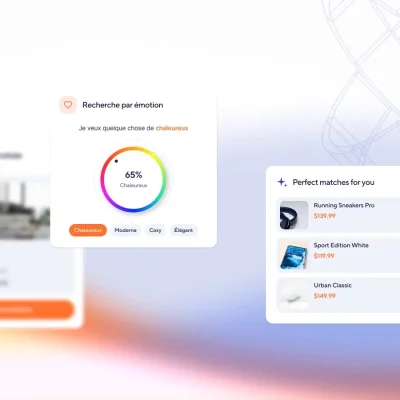
AI-based technologies will increasingly play a major role in the development process (code reviews, optimization, etc.), as well as in the opportunities offered to your customers. The use of AI, already common for enriching and translating product information, is increasingly focused on collecting and analyzing customer data. The ability to process all this data in real time will make it possible to identify individual preferences , predict behavior, and offer targeted recommendations, making the shopping experience more interactive and efficient.
Customer service will also benefit. AI-powered chatbots and virtual assistants will be able to answer questions from your visitors and customers quickly and efficiently, offering relevant suggestions and assistance—all in a proactive manner.
Today, companies are increasingly relying on AI to generate valuable insights into the products and services most likely to appeal to consumers. This predictive capability enables companies to stay ahead of the competition by offering relevant deals and promotions and adjusting their marketing strategy in response to emerging trends.
In addition, AI is also used to improve inventory management and price optimization. By analyzing real-time sales data and forecasting future demand, AI-based systems can help businesses optimize their inventory, avoid stockouts, and maximize revenue. Similarly, AI algorithms can dynamically adjust prices based on demand and competition, ensuring competitive pricing and maximizing profit margins.
Checkout & Payment
Web performance and page load times remain key metrics to monitor and optimize. Quick checkout or “1-click” options, for their part, reduce the number of steps and improve conversion rates. The frictionless payment experience continues to evolve, particularly through new, distinctive payment options at checkout, such as instant bank transfers and BNPL (Buy Now, Pay Later). Not to mention mobile-specific solutions like Apple Pay and Google Pay.
Open Banking payment services will also continue to grow. And amid the widespread digitization of transactions—especially in B2B—it is becoming essential to invest in anti-fraud payment methods and fraud detection technologies. Leveraging AI makes it possible to analyze sales patterns and detect potential anomalies in real time. In fact, AI is now also used to detect and prevent fraud in online transactions. Machine learning algorithms can identify suspicious behavior patterns in real time, enabling companies to take preventive measures to protect their customers and their businesses.
B2B e-commerce
It’s important to remember thata B2B buyer is also a B2C buyer, and that they now expect their suppliers to provide a shopping experience similar to the one they have in their personal lives. Recommendations, personalization, and the optimization of the ordering and payment processes are among the key areas of focus for B2B e-commerce in 2024.
More broadly, we are seeing the decline of “procurement” sites (dedicated to placing orders) in favor of“self-service” portals. These “self-service” portals provide customers with a comprehensive view of their business operations, going beyond simply placing orders. In addition to making purchases, customers can also generate customized reports to analyze their spending, order spare parts or complementary products, and access additional services such as equipment maintenance tracking.
In addition, these portals often include configuration tools that allow customers to customize products to meet their specific needs.
In addition, “Self-Service” portals provide simplified access to after-sales service. Customers can report issues, request repairs or replacements, and track the status of their service requests directly from the online platform.
In summary, the shift toward “self-service” portals represents a major development in the field of B2B e-commerce, offering customers a more intuitive, efficient, and self-directed experience for managing all of their business activities.
Companies must constantly adjust their strategies and adopt new technologies and innovations to remain competitive. To do so, focus on continuous improvement and quick wins, and consistently measure your changes to quantify their success. The choice isn’t easy, and DATASOLUTION’s experts are here to help you find the best possible solution to meet your needs. With expertise in more than 10 e-commerce platforms , along with our network of partners, we’re confident we can meet your expectations.
Our teams can assist you with project planning, implementation, and maintenance!
Related articles
Visit the blog
ChatGPT Ads on Shopify and HubSpot: What This Means for E-commerce Businesses and Marketing Teams in France
02/10/2026
Fine-tuning LLMs in the Enterprise: Better Than a Frontier Model?
28/09/2026

OroMomentum: AI for B2B efficiency
22/09/2026

AI: The 5 Top Stories of Summer 2026
17/09/2026

Content management on Magento: how to give marketing teams back control with Hyvä CMS
17/08/2026