5 February 2026
Migrating Salesforce Commerce Cloud to Shopify: Technical Guide and Case Study
 As the first long-standing Shopify Plus partner in France, DATASOLUTION has completed several migrations from Salesforce Commerce Cloud (SFCC). This guide details the real challenges, the pitfalls to avoid, and our methodology for successfully completing this transition.
Key points to remember:
- Migrating from SFCC to Shopify isn’t just a simple change of tools—it’s a complete overhaul of thee-commerce architecture, business processes, and team workflows.
- Shopify prioritizes standardization and agility, whereas SFCC allows for extensive customization, but this is costly and slow to implement.
- The SEO is a critical factor in the project: without redirects and a well-managed transition, traffic loss can reach 30 to 40 percent.
- The main risks are identified early on: a complex product catalog, an advanced promotions engine, a highly customized checkout process, and integrations ERP integrations.
- Success depends on proper planning: a rigorous gap analysis and technical proof-of-concepts prevent unpleasant surprises and ensure a solid ROI.
Why migrate from SFCC to Shopify?
This question comes up frequently: TCO deemed too high, maintenance complexity, time-to-market for updates is too long, or a desire to benefit from a more agile ecosystem. However, SFCC and Shopify are based on different architectural philosophies. What appears to be a simple migration actually involves a profound transformation of business and technical processes.
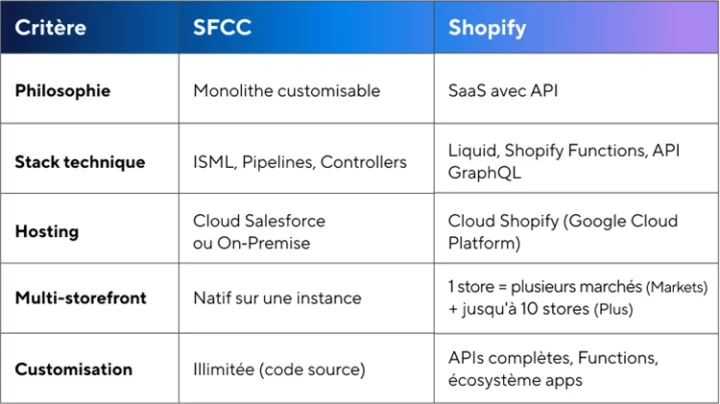
What are the architectural differences between Salesforce and Shopify?
This difference in philosophy has concrete implications for how the project is managed. However, the Shopify ecosystem more than makes up for this with the richness of its APIs and the maturity of its app marketplace.
What are the major technical challenges involved in migrating from SFCC to Shopify?
1. Product Data Structure
SFCC supports complex attribute structures: dynamic attributes, custom groups, and fine-grained localization. Shopify imposes certain constraints: a maximum of 3 options per product, a limit of 2,048 variants, and the use of metafields for additional attributes. A technical B2B catalog will require a redesign of the product modeling, or even the use of specialized applications such as Infinite Options.
2. SEO Migration
SFCC allows custom URLs, while Shopify requires prefixes (/products/, /collections/). This involves comprehensive URL mapping, large-scale 301 redirects, and post-migration monitoring. A poorly prepared migration can result in a 30–40% loss of organic traffic. Conversely, a thorough migration allows you to recover that traffic within 3 to 6 months.
3. Promotional Engine
SFCC’s promotions engine is very comprehensive: stackable promotions, complex exclusions, and tiered pricing. Shopify Scripts and Functions offer interesting possibilities, but certain logic requires third-party apps. Conduct an audit of your promotional rules and classify them: those that can be replicated natively, via Scripts/Functions, via an app, or those that need to be rethought.
4. Multi-market management
SFCC natively supports multiple sites on a single instance. Shopify addresses this need with Shopify Markets: local currencies, languages, dedicated domains, and differentiated pricing—all managed from a centralized interface. For more advanced needs, Shopify Plus supports up to 10 expansion stores. Markets Pro handles customs duties and tax compliance for international operations.
5. ERP Integrations
SFCC customers often have complex integrations (SAP, Oracle). SFCC integrates seamlessly with these systems. Shopify generally requires middleware. Use an iPaaS (Celigo, Boomi, Make.com) to orchestrate workflows; this abstraction layer facilitates future changes.
6. The Checkout Process
This is often the main point of friction for SFCC customers who are used to complete freedom. On SFCC, the checkout process is fully customizable: a one-page checkout flow, complex validation logic, and integration of third-party services at any stage.
On Shopify, the checkout process is locked by default. Shopify Plus provides access to Checkout Extensibility, which allows you to add custom fields, validations, upsells, and integrations via apps or custom code. However, you’re still working within a framework defined by Shopify—it’s impossible to rebuild the checkout process from scratch.
Key Point: If your current SFCC checkout includes highly specific business logic (proprietary installment payments, identity verification, complex B2B workflows), carefully assess what can be replicated using Checkout Extensibility before committing. In most standard B2C scenarios, the Shopify checkout—which is optimized for conversion—outperforms custom SFCC checkouts.
What is underestimated?
Change Management: Teams accustomed to SFCC’s Business Manager will need to adapt to the Shopify admin. Plan for dedicated training sessions.
Migrating historical data: Importing orders and customers is more complex than expected (API rate limits, data with no matches). Define the scope upfront: complete historical data or active customers only?
Application Costs: On average, expect to spend $200 to $400 per month on third-party applications. This cost must be factored into the initial business case.
Which rFeedback following the migration of an international fashion brand ?
We helped a premium fashion brand migrate to Shopify. The background: the brand had a long-standing presence in three European markets (France, the UK, and Germany), wanted to accelerate its international expansion, and was frustrated by the slow pace of development on its existing platform.
Deployed architecture: A single Shopify store using Shopify Markets to serve the three main markets (languages, currencies, and local pricing). For international expansion, we integrated the Global-E solution, which allows us to quickly enable 120 additional countries with automated management of taxes, customs duties, and local payment methods.
Results: A 40% increase in online revenue generated by these new markets in the first year, without any major integration challenges. The e-commerce team now manages 123 markets from a single interface, compared to 3 SFCC storefronts previously. Time-to-market for new collections has been reduced from 3 weeks to 5 days.
When should you consider a migration?
Positive indicators:
- Less than 50% of SFCC’s advanced features are being used
- Need for a fast time-to-market
- Reduced technical staff
- Experience with modern marketing platforms (Klaviyo, Splio, etc.) is preferred
Warning signs:
- More than 15 custom integrations on SFCC: each connector will need to be redesigned or replaced
- Promotion engine with more than 50 active rules: an in-depth audit is required; plan for an app budget
- Highly customized checkout (one-page, specific business logic): see the dedicated section below
- Highly technical B2B catalog with complex configurators
- Deep integrations with non-standard legacy ERP systems (custom SAP, AS400)
- In-house teams with more than 5 SFCC developers: conversion costs to be factored in
What is therecommended methodology for a successful migration from SFCC to Shopify ?
Phase 1, Gap Analysis (4–6 weeks): Functional audit, mapping to Shopify, detailed cost estimate.
Phase 2, Architecture and POC (4–8 weeks): Definition of the target architecture; proof of concept for complex issues.
Phase 3, Development (8–16 weeks): Theme, integrations, migration scripts, acceptance testing.
Phase 4, Go-Live (2–4 weeks): Final migration, SEO redirects, DNS switch, monitoring.
Phase 5, Stabilization (4–8 weeks): Corrections, optimization, SEO monitoring, training.
The migration from SFCC to Shopify is not just a change in platforms; it is a transformation that affects processes, teams, and the operational model.
When properly planned, it reduces the TCO and accelerates time-to-market.
The key: a rigorous scoping phase that includes an honest gap analysis and ensures that stakeholders are aligned on the compromises that have been agreed upon.
Get in touch with our Shopify experts
FAQ on Migrating from SFCC to Shopify
Yes, for most B2C and international projects. However, highly technical catalogs, complex promotions, or highly customized checkout processes require a preliminary feasibility study.
On average, 4 to 8 months, depending on the volume of data, the number of integrations, and the level of existing customization.
A poorly planned migration can result in a 30 to 40 percent loss of traffic. With thorough URL mapping and 301 redirects, traffic is typically recovered within 3 to 6 months.
Not always, but it is strongly recommended for projects that span multiple markets, involve high volumes, or require checkout customizations.
Related articles
Visit the blog
ChatGPT Ads on Shopify and HubSpot: What This Means for E-commerce Businesses and Marketing Teams in France
02/10/2026
Fine-tuning LLMs in the Enterprise: Better Than a Frontier Model?
28/09/2026

OroMomentum: AI for B2B efficiency
22/09/2026

AI: The 5 Top Stories of Summer 2026
17/09/2026

Content management on Magento: how to give marketing teams back control with Hyvä CMS
17/08/2026