4 January 2023
KNOW – FEEL – DO, or How to Structure Your Communications for Maximum Impact
 Can we communicate anything to anyone?
Used in both internal and external communications, the model has proven its effectiveness, particularly due to its ease of use. Applying it is a sure way to quickly become an expert. In fact, the method helps you better understand your target audience so you can deliver a message that aligns with their values and captures their attention.
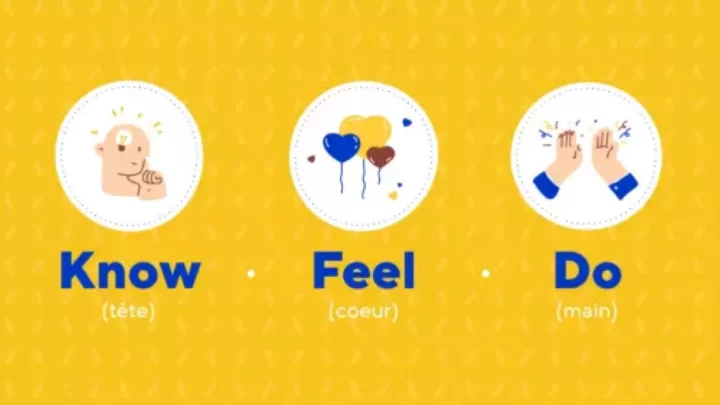
The KNOW–FEEL–DO model is based on three questions:
- KNOW (the head): What does my audience know, and what do we want them to know?
- FEEL (the heart): What does my audience feel, and what do we want them to feel?
- DO (hands): How do we want the audience to act?
Most of the time, it’s the “KNOW” approach that’s used—creating content based on what the company wants to convey, without really considering the audience’s interests. Understanding your audience and engaging them takes time. The goal is to use a method that saves time so you can optimize your communication campaigns.
In short, the model helps convey a clear and powerful message that will prompt a response and lead to action (conversion) on the part of the audience, whether internal or external.
A simple exercise? Internal application
The tool also helps managers communicate more effectively with their employees. This approach makes it possible to be more persuasive and effective. In practical terms?
Example 1
Let’s say you want to share charts showing the increase in negative reviews about customer service with the customer service department itself.
Don’t hesitate to take the time to ensure that your team understands the methodology and interprets these results correctly. You want to motivate them to take action without offending anyone. Remember that you’ve had time to review and analyze these figures, so give your team time to familiarize themselves with them so they can implement the necessary changes.
Example 2
Know: I want to email the first draft of the new visual identity guidelines to my teams
Feel: I want them to feel involved in this new project
Do: I need a quick response to this email with feedback and suggestions:
. Now that you’ve clarified your project in a few lines, you can write your email with its objective clearly in mind.
Now the question is: how? How can I encourage my colleagues to respond to this email in a constructive way? The best way is to put yourself in their shoes: Why change the code of conduct? What values and emotions should it convey?…
Initially, the method can be used as a catalyst—to resolve or clarify a situation, or to regain your employees’ attention during a meeting, for example. Later on, it can be applied in a more thoughtful and structured way for larger projects.
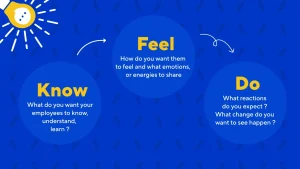
With its customers
To guide your communication with prospects and customers, you can structure your thinking around these three questions. They will help you define a clear message.
Know: Start with what you want your audience to know above all else. Don’t beat around the bush—get straight to the point. You should be able to do this in one sentence; if you can’t come up with a clear message, keep working on it until you do.
Feel: You can’t control how the audience feels, but you can consider the emotional impact you’re aiming for. Will it be a rational, pragmatic, or emotionally charged message? You’ll be able to strike a balance between the head and the heart.
Do: You should define the objective of the campaign in a few words, being as clear and concise as possible, and ask yourself: What do you want your audience to do?
Example
Know: I want to create an Instagram Story ad for the launch of my new line of roasted coffee.
Feel: It should spark curiosity and desire —to the point where they can almost smell the coffee through their screens
Do: First, I want to generate views to raise awareness of my product and brand and convert clicks into purchases
This exercise helps explore thoughts and behaviors and can be applied to each persona. It may seem excessive to do this for each profile, but the goal is to determine priorities—for example, to set a campaign budget.
Whether you’re writing a landing page, an Instagram post, or a newsletter, you want to increase the chances that your message will be read and lead to action. With compelling content, you can create an emotional connection that will result in a conversion.
Any advice?
To take it a step further, you can incorporate the Know-Feel-Do model into the empathy map; the model will fit naturally into the framework. You will then be able to create a very detailed profile of your customers or employees.
What’s next?
Now it’s your turn! Why not give it a try right now? You have nothing to lose.
As you prepare your next post, ask yourself these three questions.
Need help?
Discover Business Performance with our experts, who will help you develop your communication strategy!
Related articles
Visit the blog
ChatGPT Ads on Shopify and HubSpot: What This Means for E-commerce Businesses and Marketing Teams in France
02/10/2026
Fine-tuning LLMs in the Enterprise: Better Than a Frontier Model?
28/09/2026

OroMomentum: AI for B2B efficiency
22/09/2026

AI: The 5 Top Stories of Summer 2026
17/09/2026

Content management on Magento: how to give marketing teams back control with Hyvä CMS
17/08/2026