11 January 2024
Is Shopify a secure solution?
 Considered one of the leading B2C e-commerce CMS platforms, the Canadian solution Shopify is extremely simple to use
Shopify is used in nearly 175 countries around the world, mostly in English-speaking countries. In 2020, the company powered more than 2,000,000 merchants.
It is therefore very important that the platform be secure, always available, high-performing, and impervious to data theft or various types of intrusions.
In this article, we’ll look at the following points:
- The Overall Architecture of Shopify
- Shopify’s Technical Commitments to Ensuring Security
- Shopify Security Certifications
- Our Key Considerations for Ensuring Complete Safety
General Architecture of Shopify
Accommodations
Shopify is a SaaS system, developed in Ruby on Rails and hosted in the cloud, with no way for developers to modify the core of the system. This ensures quality compared to open-source platforms, where the core can be modified—a practice that can lead to future complexity in terms of maintenance.
It also provides a very important security guarantee, since no vulnerabilities are possible at the application level, as the application is completely sealed off.
The cloud system is extremely powerful because it is based on Google Platform, with data centers in the United States, Europe, and Australia.
Cloud regions currently available on the Google Platform:

This system ensures robust performance during peak periods such as Black Friday or the holiday season, thanks to its elastic cloud architecture: the more people who enter the store, the larger the store becomes.
This is a major difference from “on-premises” hosted systems, which require performance enhancements or optimizations before going live to prevent performance degradation or service outages.
Asa Shopify Plus-certified agency that has implemented more than 30 Shopify Plus projects, we have never encountered any performance issues, regardless of our clients’ peak sales periods.
Content Distribution
Hosting is managed across three major geographic regions, and media (photos and videos) are replicated across CDNs managed by Cloudflare, across the globe at nearly 300 points of presence, ensuringexcellent load times for visitors worldwide.
For example, if your website is hosted in Europe and you have a visitor from Japan, that visitor will download the media via the Tokyo CDN rather than the European one.
Check out the Cloudflare case study
Here are the details of all the replication points around the world:
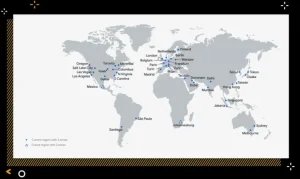
The CDN is built-in and included with all Shopify licenses; no action is required on your part or on the part of your agency.
Key Technical Security Measures on Shopify
SSL (Secure Sockets Layer) Certificate
Shopify uses SSL certificates to ensure a secure connection between the customer’s browser and Shopify’s servers. This ensures that data is encrypted during transmission. There’s no need to purchase or configure external certificates—it’s included with Shopify.
Protection Against Brute-Force Attacks
Shopify is implementing measures to prevent brute-force attacks, in which an attacker tries to guess a password by trying different combinations.
Security Updates
Shopify proactively manages security updates to ensure that the platform is protected against known vulnerabilities. The agency does not need to manage any updates, except for certain very rare API changes that may become deprecated—which only affect you if you have developed custom apps.
Protection Against DDoS (Distributed Denial of Service) Attacks
Shopify uses strategies to minimize the impact of DDoS attacks, which aim to take a website offline by overwhelming its servers with excessive traffic. To do this, Shopify relies on Cloudflare, which filters traffic and protects your services.
Data Encryption
TAll sensitive information, such as payment data, is encrypted to ensure its confidentiality.
PCI DSS Compliance
Shopify complies with the Payment Card Industry Data Security Standard ( PCI DSS ), which means it meets the security standards for credit card transactions.
Fraud Protection
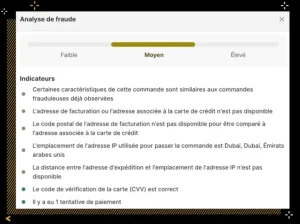
Shopify uses fraud detection systems to identify and prevent suspicious transactions. Here is an example of a fraud report, which allows the online merchant to form an opinion and helps them decide whether or not to accept the sale.
Two-Factor Authentication (2FA)
Shopify offers two-factor authentication to enhance the security of merchant accounts. At DATASOLUTION, we strongly encourage our customers to enable 2FA on their accounts.
Third-Party Application Security
Shopify has established security standards for third-party apps to ensure that they do not compromise the security of the platform.
In fact, third-party apps have access only to the APIs, so they can only read, modify, or delete the data to which you grant access. This allows you to isolate changes made by a third-party app.
Privacy and Compliance Policies
Shopify has strict privacy policies and complies with data protection regulations.
Shopify’s Security Certifications
PCI Certification
The Payment Card Industry Data Security Standard (PCI DSS) is a security standard for organizations that store, process, or transmit credit card information. The standard was created to strengthen controls over payment data in order to reduce fraud.
PCI reports providean assessment of an organization’s compliance with the PCI DSS requirements established by the PCI Security Standards Council.
SOC Reports
Service Organization Control (SOC) audit reports evaluate an organization’s controls related to confidentiality,processing integrity, security, and availability.
Our Key Considerations for Ensuring Complete Safety
As you can see, security is at the heart of Shopify’s philosophy. Shopify is a SaaS platform that powers more than 2 million different websites and must therefore be foolproof. However, we would like to draw your attention to two external factors.
Third-Party Apps
Once you authorize a third-party application to interact with your site’s APIs, you should be aware that this data may be transferred outside of Europe, which is not compliant with the GDPR. Furthermore, you are granting not only read access but also write access in some cases, which means that your customer or product database could be modified by a malicious developer. Third-party applications should therefore be used with great caution, by choosing reputable providers and ensuring that your developers or agency systematically validate them.

Humans
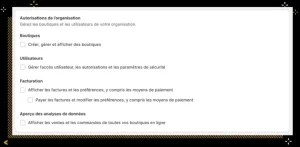
This advice applies to all IT systems: You must be extremely careful with your access permissions, and strong authentication is therefore not just recommended but mandatory—you must log in using a password supplemented by an SMS or an access key. Shopify allows for granular management of employee access through role assignments, so the administrator must be vigilant about the permissions granted to different team members. It’s good to know that Shopify can connect to your businessdirectory directory or LDAP via native connectors, which enables the automatic creation and deletion of employee accounts based on changes to your team.
We hope this brief guide has been helpful in introducing you to security-related aspects of the Shopify platform!
Related articles
Visit the blog
ChatGPT Ads on Shopify and HubSpot: What This Means for E-commerce Businesses and Marketing Teams in France
02/10/2026
Fine-tuning LLMs in the Enterprise: Better Than a Frontier Model?
28/09/2026

OroMomentum: AI for B2B efficiency
22/09/2026

AI: The 5 Top Stories of Summer 2026
17/09/2026

Content management on Magento: how to give marketing teams back control with Hyvä CMS
17/08/2026