11 August 2026
How Hyvä Checkout cuts load times and boosts conversions
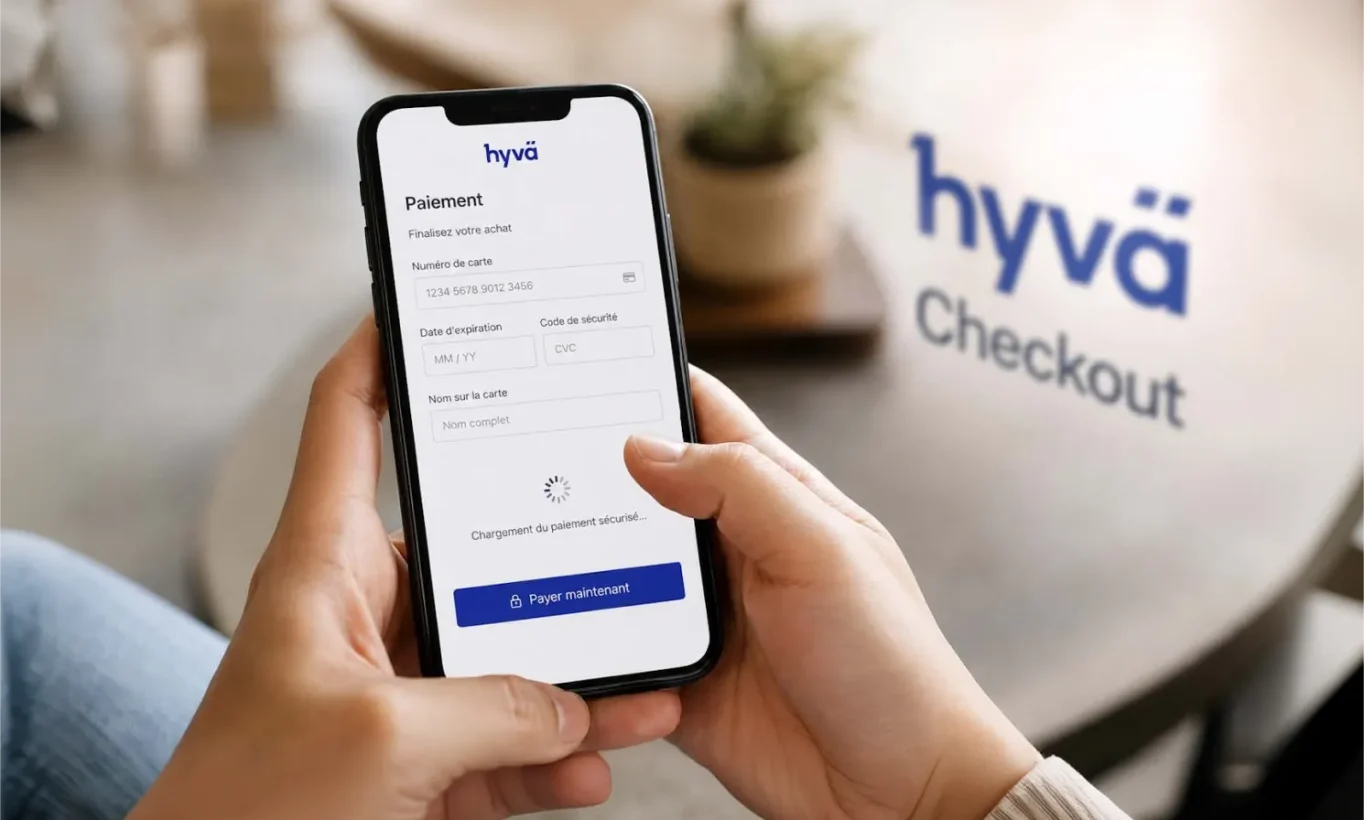
 Your visitor has compared, hesitated, picked their size, added to cart. They’ve taken out their bank card. And then they wait. Checkout is the point on the site where the customer is closest to paying — and often the one where you keep them waiting the longest. The question is where that wait comes from, and what a solution like Hyvä Checkout changes.
The last step is the most costly
Not every second on your site is worth the same. A visitor who finds a category page slow hasn’t decided anything yet: they’re browsing, comparing, and may well leave regardless. The one waiting on your payment page, on the other hand, has already made their decision. You paid to attract them, and your price passed their filter. All that stands between their intent and your revenue is a form.
That’s what makes the checkout funnel different from the rest of the site. Slowness on a product page costs you one visitor among many. Slowness at checkout costs you a sale you had already won, along with the acquisition cost that came with it.
This wait comes at the worst possible psychological moment. The customer is about to hand over their details and their card number. A button that doesn’t respond on the first click, or a total that takes several seconds to recalculate after the carrier is selected, plants a doubt about how serious the site is — right before payment. Yet this slowness has a specific cause, and it rarely lies on your server side.
Why checkout keeps your customers waiting
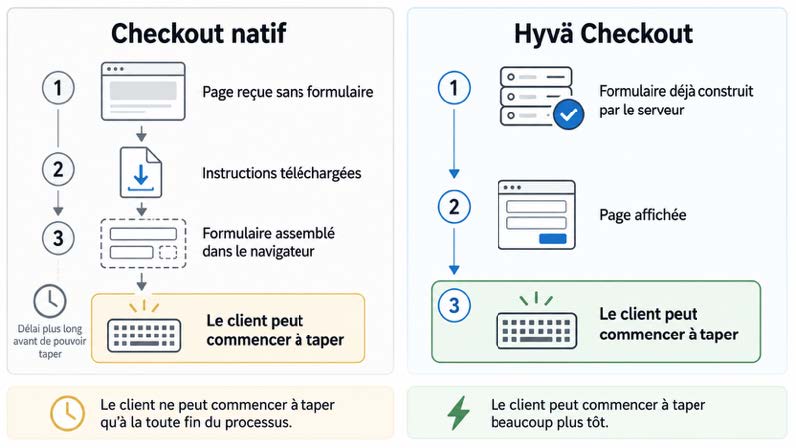
On a Magento site running the native funnel, checkout doesn’t arrive “ready to use”. The server sends the customer’s browser a page whose form is still missing, along with a large bundle of instructions, and it’s the browser that has to build that form. The address fields and payment methods are assembled client-side, using their machine and their connection. It’s a bit like the difference between receiving a piece of furniture already assembled and receiving the parts with the instructions. In the second case, the wait depends entirely on whoever is doing the assembling.
On a recent computer with a fiber connection, that work is done quickly. On a three-year-old phone with a poor 4G signal, on the train or in a parking garage, the wait becomes noticeable. And a share of your traffic arrives in exactly those conditions; your mobile statistics prove it.
On top of this basic mechanism, there’s everything you’ve plugged into the funnel over the years. The payment module, the carrier module, the marketing tracking tool.
Each was installed for a good reason, and each adds its share to the load time.
None is to blame on its own, but their cumulative effect explains why a checkout degrades as a site ages, without anyone having broken anything.
This is also why the usual optimizations quickly reach their limit here. You can compress, cache, move to more powerful hosting: caching is of little use on pages that are personalized by nature, and the assembly work still has to be done in the customer’s browser. There are gains to be had, but they soon hit that ceiling.
What Hyvä Checkout changes
Hyvä Checkout reverses the order of operations. Rather than sending the parts of the form and letting the browser assemble them, the server sends a form that is already built. The customer receives a page they can start typing into straight away. The work is done upstream, on a machine whose power you control, instead of being delegated to a phone you know nothing about.
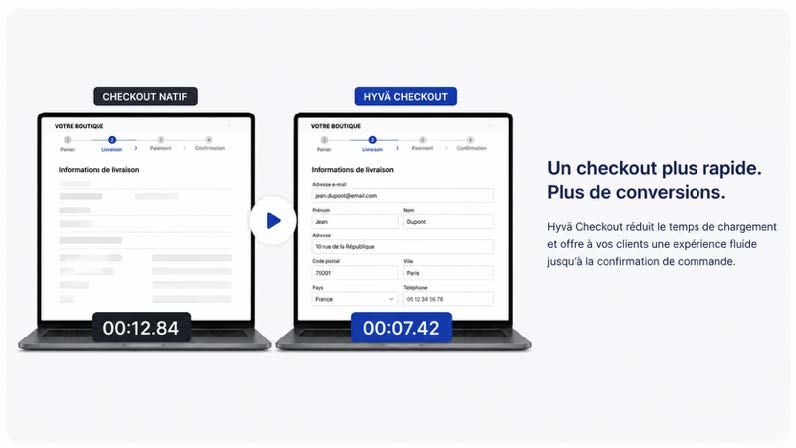
Based on our own measurements, the switch saved us up to 40% of the time on the journey from clicking “add to cart” on the product page to the order confirmation page appearing.
Hyvä Checkout is a product in its own right, separate from the Hyvä theme and sold under its own license. Above all, it doesn’t speed up your current checkout: it replaces it.
Your modules, in practice
This replacement has a direct consequence: everything plugged into your funnel has to work with the new one.
Most extensions on the market are now compatible, as their vendors have followed suit. That leaves the edge cases: a more niche module, a feature developed for you alone. Those require some adaptation — nothing insurmountable — and it’s work we’ve already carried out many times.
Prerequisite: Hyvä Checkout assumes the Hyvä theme. If your site is still running on a classic theme, checkout isn’t your first step.
Measure your funnel
Compare your stats — on mobile, then on desktop — for your cart-to-completed-order conversion rate. Then time your funnel pages. And go through the journey yourself, on your phone, off the office wifi, counting the seconds when the funnel opens, when the carrier is selected, when the totals are recalculated.
These checks can be done in a few hours. They give you a figure taken from your own site, with your own customers.
And they leave you with a benchmark for afterwards.
If you’d like to find out what your current checkout is costing you,
let’s talk.
Related articles
Visit the blog
ChatGPT Ads on Shopify and HubSpot: What This Means for E-commerce Businesses and Marketing Teams in France
02/10/2026
Fine-tuning LLMs in the Enterprise: Better Than a Frontier Model?
28/09/2026

OroMomentum: AI for B2B efficiency
22/09/2026

AI: The 5 Top Stories of Summer 2026
17/09/2026
Content management on Magento: how to give marketing teams back control with Hyvä CMS
17/08/2026