20 August 2025
How can you transition from an “Information”-oriented approach (PIM) to an “Experience”-oriented approach (PXM)?
 With consumers becoming increasingly connected and demanding, simply managing product information (PIM) is no longer enough. Brands must now go beyond raw data to offer an enriched, contextualized, and omnichannel product experience.
That is precisely what Product Experience Management (PXM) promises. Building on a robust PIM foundation, PXM transforms this data into a powerful driver of conversion and customer loyalty. It’s no longer just about providing the right product information, but about delivering the right experience, at the right time, on the right channel.
This paradigm shift involves a transformation that is at once technological, organizational, and cultural. It is becoming essential to rethink how data is collected, enriched, disseminated… and used to strengthen customer relationships.
What you’ll learn in this article:
- Why PIM Is No Longer Enough to Meet the Expectations of Consumers and Digital Channels.
- What PXM Really Is and How It Builds on PIM Without Replacing It.
- How PXM Helps Improve the Consistency, Personalization, and Performance of the Product Experience.
- The organizational, technical, and regulatory challenges associated with this transformation.
- The main challenges to anticipate when implementing a PXM.
- Practical tips for effectively structuring your approach in line with your existing systems.
- The role of AI in automating, enriching, and personalizing content.
What is PXM?
According to Gartner, PXM refers to the suite of applications designed to optimize the creation, distribution, execution, and analysis of product data across various sales channels. PXM complements PIM but does not replace it.
See also: What is a PIM?
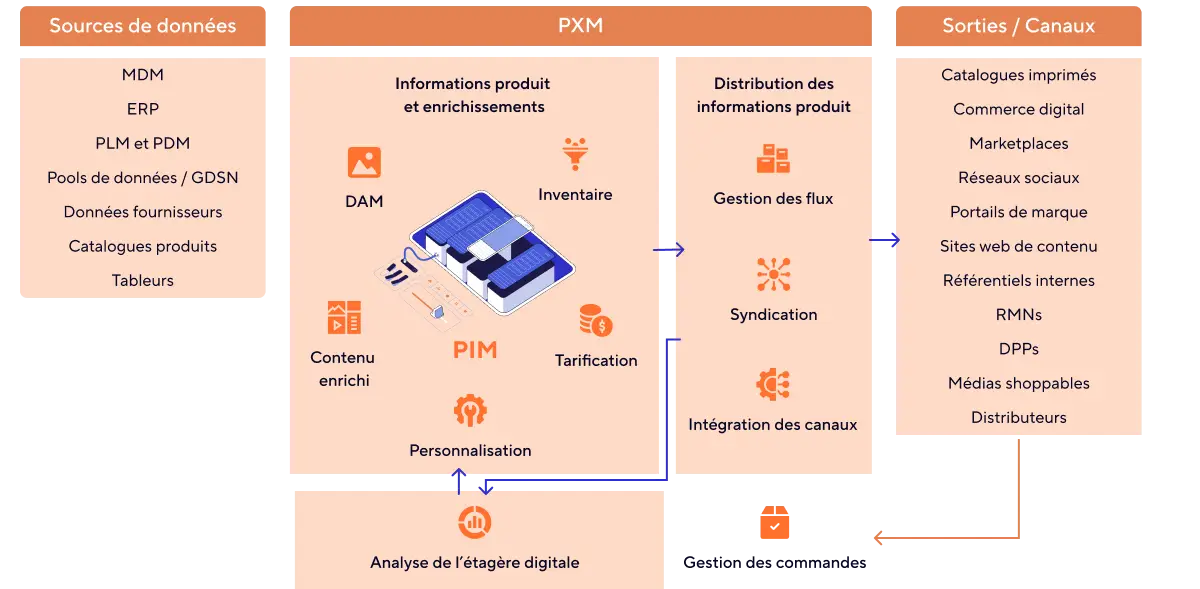
PXM provides timely, accurate, consistent, and enhanced product information—which is essential for brand management, customer engagement, and improving sales conversion across a variety of channels.
PXM encompasses a more comprehensive approach to a brand’s digital presence, one that goes beyond product data by integrating a 360° view of that data across all channels where it is consumed. Its ultimate goal is to drive a brand’s digital sales growth… while enabling its optimization over time.
Why PXM?
This is nothing new: consumers demand personalized and seamless shopping experiences across all the digital channels they use. The number of these channels is growing, and brands must maintain a presence on them.
The complexity of product data, along with its growing volume, requires brands to adopt streamlined management practices while also facing pressure to maintain consistent and accurate product information across these multiple platforms.
And that’s not even counting the increasingly strict regulatory requirements regarding product accuracy, compliance, and sustainability (the AGEC Act, Digital Passport, etc.)
The main goal remains to maintain a consistent presence across all channels… and to take into account the various stakeholders who contribute to product data.
It is therefore essential for companies to:
- Ensure close integration between the systems that manage product data and those that deliver the customer experience
- Ensure the smooth exchange of product data between these different systems
- Use this data to personalize experiences.
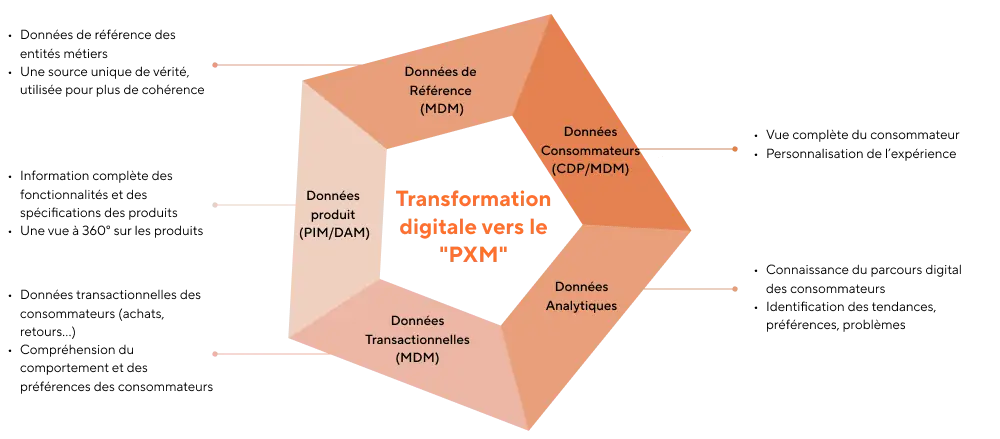
A Few Tips for Getting Started with PXM
The implementation of a PCM sometimes faces the following obstacles:
- The Maturity Level of Companies Regarding Their Product Data and Its Implications
- Integration with “legacy” systems can sometimes be complex
- Management challenges within international organizations, which have separate business units and use different systems
- Role confusion among the various systems PIM, MDM, DAM, ERP, DXP … which may hinder the deployment of PXM
Here are a few tips and best practices for implementing a PXM
- Make integrating your source data into a PIM your top priority
- Involve your marketers and experts in a collaborative process of gathering insights and enriching products
- Identify the channels through which you currently sell your products, and those through which you would like to sell them
- Create personalized content for each channel, and promote your products not only through traditional channels but also through innovative or new ones
- Identify the capabilities offered by various PIM and MDM vendors in terms of PXM functionality, whether natively or through additional modules (such as syndication, etc.)
- Implement processes for collecting sales and analytics data to enrich your product information
And what about AI in PXM?
Generally, AI is already being used in your PIM, MDM, or other systems that make up PXM:
- Optimization: automatic classification, field normalization…
- Enrichment: content creation, adding images
- Translation
On the other hand, chatbots can be integrated into the system to automatically perform tasks and use tools, or to trigger actions based on notifications from various systems.
The shift from PIM to PXM is already underway, largely due to its composable, customer-centric approach, which is increasingly reflected in the models offered by leading vendors (Pimcore, MaPs System, Akeneo). Highly process-oriented, PXM requires striking the right balance between the “simplicity” of an all-in-one solution and the potential power of a “best-of-breed” suite.
This evolution of PXM goes beyond a mere technology platform; it also impacts the way companies operate, serve their customers, and succeed in the era of digital efficiency.
DATASOLUTION’s experts are available to assist you in planning and implementing a PXM solution within your organization.
FAQ – Everything You Need to Know About the Transition from PIM to PXM
PIM (Product Information Management) centralizes, organizes, and distributes product information. PXM (Product Experience Management), on the other hand, goes a step further by enriching and contextualizing this information to deliver a personalized and consistent product experience across all sales channels.
No. PXM does not replace PIM; it builds on it. PIM serves as the reliable database, while PXM uses that data to tailor product content to customer expectations based on channels and usage contexts.
Adopting a PXM strategy allows you to:
- improve conversion rates on your digital channels,
- reduce product returns through clearer and more relevant content,
- strengthen brand consistency,
- and comply with regulatory requirements (AGEC, digital passport, etc.).
Not necessarily. Many PIM solution providers now offer PXM capabilities—either built-in or through add-ons. The key is to choose a system capable of handling content contextualization, personalization, and performance analysis.
Yes, but AI greatly simplifies deployment and scaling. It automates time-consuming tasks (writing, translation, classification) and improves the relevance of content produced at scale.
Absolutely. PXM is just as relevant in B2B as it is in B2C, especially for brands with complex, multilingual, or multi-market catalogs. The product experience plays a key role in the decision-making process of professional buyers.
It all depends on your level of maturity, the quality of your existing data, and the complexity of your digital ecosystem. In general, a phased rollout over 3 to 6 months is recommended, starting with a pilot project.
Related articles
Visit the blog
ChatGPT Ads on Shopify and HubSpot: What This Means for E-commerce Businesses and Marketing Teams in France
02/10/2026
Fine-tuning LLMs in the Enterprise: Better Than a Frontier Model?
28/09/2026

OroMomentum: AI for B2B efficiency
22/09/2026

AI: The 5 Top Stories of Summer 2026
17/09/2026

Content management on Magento: how to give marketing teams back control with Hyvä CMS
17/08/2026