Digital sovereignty and AI: from hosting health data to mastering models
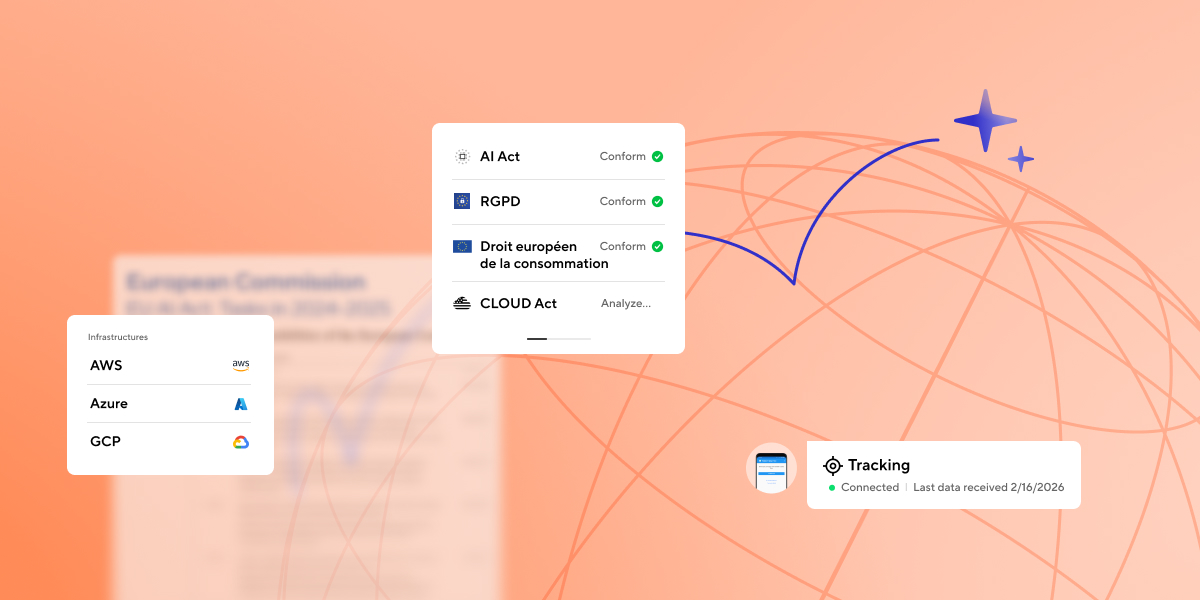
Digital sovereignty is no longer an abstract concept. It has become a political, industrial, and economic reality, as evidenced by recent debates surrounding the Health Data Hub and European initiatives to regulate artificial intelligence.
According to the European Commission, the global AI market is expected to reach $1.8 trillion by 2030, with increasing concentration in the hands of a few American and Chinese players. In this context, Europe, and France in particular, must rethink its technological autonomy to avoid structural dependence.
In 2026, as data becomes the new oil and AI redefines geopolitical power dynamics, the question is no longer whether digital sovereignty is necessary, but how to build it in concrete terms.
Key takeaways
- Digital sovereignty is not limited to data localization: it implies legal, technical, and economic control of the entire value chain.
- The case of the Health Data Hub illustrates the limitations of European hosting subject to extraterritorial laws like the Cloud Act.
- Dependence on American hyperscalers (cloud, collaborative suites, GPUs, AI models) creates a structural vulnerability for states and businesses.
- AI sovereignty rests on four pillars: legal, infrastructural, technological (models), and economic.
- Europe has promising players like Mistral AI, but complete sovereignty requires a coherent industrial ecosystem, local infrastructure, and sustained political will.
Health Data Hub: Sovereignty begins with critical data
The Health Data Hub has crystallized a major tension: can we speak of sovereignty when the health data of French citizens is hosted by an entity subject to the US Cloud Act? Even if the data is physically stored in Europe, the legal question remains unresolved. The extraterritorial reach of US law raises a simple question: who truly controls access to strategic data?
This debate extends far beyond the healthcare sector. It lays the groundwork for a broader discussion: if we do not control the infrastructure that hosts our data, can we claim to be sovereign? The answer is no. Sovereignty is not limited to the location of servers; it implies complete control of the value chain, from hosting to data processing.
Structural dependence on GAFA: beyond the cloud
Our public and private organizations rely heavily on American tools:
- Email (Outlook, Gmail)
- Office tools (Excel,
- Word, PowerPoint)
- Video conferencing (Zoom, Meet, Teams)
- Collaboration suites (Microsoft 365, Google Workspace)
- Cloud infrastructures (AWS, GCP, Azure)
This dependence is not only technical. It is structural: more than 80% of CAC40 companies use Microsoft 365 or Google Workspace, and the majority of government data is transmitted through or hosted by American hyperscalers. Every piece of data produced, every document edited, every meeting recorded feeds into an ecosystem that is not European. In response, the French government has launched alternatives, such as the Digital Suite, to offer open-source tools developed in France. This suite, combined with hosting in France, will help address the issue of dependence on American tools. It’s a step forward, but it’s not enough.
Why? Because the next battle is no longer fought solely over data or collaborative software. It’s fought over intelligence itself.
AI sovereignty: the new strategic frontier
Artificial intelligence is changing the nature of the debate. The question is no longer simply: Where is my data stored? But:
Who trains the models that use my data?
- Where are they hosted?
- Under which jurisdiction?
- With what hardware and software dependencies?
AI sovereignty has several dimensions:
- Legal sovereignty: compliance with the GDPR and the AI Act, as well as protection against extraterritorial laws (notably the Cloud Act).
- Infrastructural sovereignty: control of data centers and GPUs.
- Model sovereignty: development of European LLMs, trained on local data.
- Economic sovereignty: financing and control of key players with European capital.
However, today the global market is dominated by American players, whether in terms of models (OpenAI, Google, Anthropic), GPUs (Nvidia represents 95% of the AI GPU market), or infrastructure (AWS, Azure, GCP). Europe must accelerate its development to avoid becoming a mere consumer of technology.
Mistral AI: European hope, persistent challenges
In Europe, Mistral AI embodies this ambition. The company has demonstrated that it is possible to develop competitive models from France. This is a strong signal, but the industrial reality remains complex:
- GPUs are produced outside Europe (NVIDIA, TSMC)
- Mistral still uses AWS and Azure for some of its training, despite its partnership with OVHcloud
- Capital is international, which raises the question of strategic autonomy.
This does not call into question Mistral’s technological quality, but it shows that AI sovereignty cannot rely on a single player. It must be based on:
- A controlled infrastructure (sovereign data centers, secure networks)
- Local training capacity (access to GPUs, green energy)
- A complete ecosystem (startups, laboratories, public funding)
- A clear strategic commitment (industrial policies, sovereign tenders)
Mistral’s recent announcement of opening a data center in Sweden is a positive step, but its implementation will take years. Sovereignty cannot be decreed; it must be built.

Our position at DATASOLUTION: sovereignty through technical mastery
At DATASOLUTION, as e-commerce experts, our DATA & AI agency has made a clear choice:
- To host our models in France, in certified infrastructures.
- To train our models on French infrastructures, in partnership with local players.
- To control the entire technical chain, from data collection to its use.
- To limit our dependence on non-European infrastructures, even if this entails additional costs.
Why?
Because for our clients, sovereignty is no longer an option. It is a strategic requirement. Sovereignty cannot be partial: it must be total, or it is merely an illusion.
This implies:
- Economic trade-offs (investments in local infrastructure)
- Increased engineering effort (development of customized solutions)
- Consistency between rhetoric and implementation (no “marketing sovereignty”)
In turn, this guarantees:
- Legal control (GDPR and AI Act compliance, protection against extraterritorial laws)
- Operational control (resilience, security, performance)
- Strategic coherence (alignment with national and European priorities)
The debate surrounding the Health Data Hub opened a door, the Digital Suite initiated a response regarding tools, and Mistral AI proved that Europe could compete on models. But AI sovereignty must not be a one-off issue. It must become:
- A European industrial strategy (funding, regulation, cooperation between states)
- A requirement in calls for tenders (mandatory sovereign criteria)
- A structuring criterion for IT departments (technological choices aligned with sovereignty)
- A choice embraced by technology players (transparency, commitment, local innovation)
The question is not about cutting ourselves off from the world. It is about: which critical assets do we want to maintain control over? Today, artificial intelligence is clearly one of them.
Frequently asked questions about digital sovereignty and AI
-
Is the location of data in Europe sufficient to guarantee sovereignty?
No. Sovereignty does not depend solely on the physical location of servers, but also on the applicable jurisdiction. A company subject to extraterritorial law may be compelled to hand over data, even if that data is stored in Europe.
-
Why are GPUs a major strategic issue?
GPUs are the critical infrastructure of AI. Today, the market is dominated by NVIDIA, with production primarily based in Asia. Without independent access to these components, Europe remains technologically dependent for training and operating its models.
-
Does Mistral AI alone guarantee European sovereignty in AI?
No. Mistral represents a significant strategic advance, but sovereignty cannot rest on a single actor. It requires local infrastructure, stable European funding, access to material resources, and a coherent regulatory framework.
-
Why has AI sovereignty become a priority in 2026?
Because AI is no longer simply a technological tool. It influences economic competitiveness, national security, critical data management, and geopolitical balances. Mastering its models and infrastructure is therefore becoming a strategic issue comparable to energy or telecommunications.