Product Governance: Why a PIM is essential given the limitations of the e-commerce back office
In an increasingly complex and omnichannel business environment, product data management is becoming a strategic imperative for companies. Yet, many still rely on their e-commerce back office to manage their entire catalog. While this approach may seem practical, it quickly reveals its limitations when faced with the diversity of sales channels, regulations, and customer expectations.
At DATASOLUTION, we see every day the challenges brands and retailers face in maintaining effective product governance. Here’s why entrusting this task to an e-commerce back office is a misuse of the system, and how a PIM (Product Information Management) system can transform your product information management.
5 Key Takeaways
- The e-commerce back office is not a product repository: designed for online sales, it suffers from rigid modeling and weak governance, making it unsuitable for the overall management of product information.
- Product complexity has exploded: beyond name and price, products now incorporate dozens of attributes (regulations, allergens, materials, traceability, etc.) that only a PIM can structure using flexible models for each product family.
- True omnichannel relies on PIM: unlike web-centric back offices, a PIM feeds all channels—physical stores, marketplaces, partners, print—from a single source of truth.
- PIM strengthens data governance and reliability: thanks to structured workflows, defined roles, and validation processes, each contributor (marketing, quality, legal, etc.) intervenes in a traceable and controlled manner.
- PIM is becoming the heart of the information system: by decoupling product management from sales channels, it reduces duplication, improves maintainability, and offers greater agility in the face of market changes.
The e-commerce back office: an execution tool, not a product repository
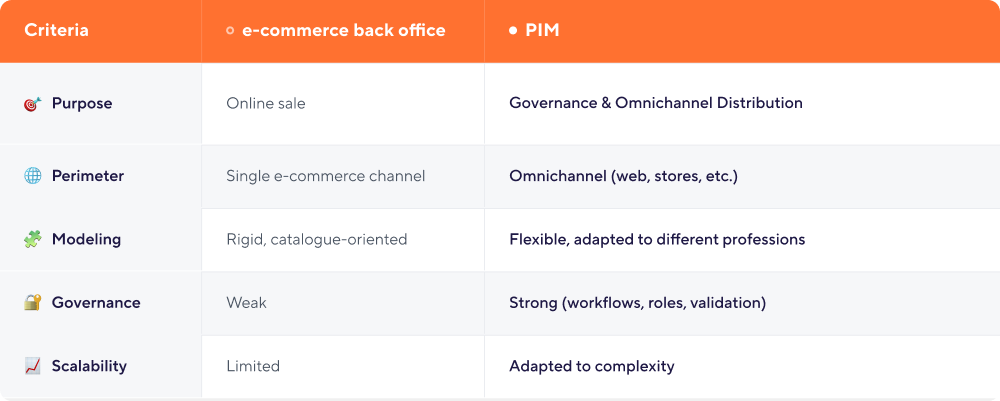
The e-commerce back office was designed for a specific purpose: selling online. Its scope is limited to the digital channel, its modeling is rigid, and its governance remains weak. It excels at managing products for transactions, but it is not suited to becoming the single source of truth about your products.
Conversely, a PIM (Product Information Management) system is designed to govern and distribute product information across all channels (web, stores, marketplaces, partners). Its flexible modeling, enhanced governance, and scalability make it the ideal tool to meet the demands of a constantly evolving market.
Product Governance: Why a PIM is essential given the limitations of the e-commerce back office
Product complexity extends beyond the scope of e-commerce.
Today’s products are no longer just a name, a description, and a price. They incorporate sizes, colors, materials, regulations, traceability, allergens, and many other attributes specific to each product category. An e-commerce back office, designed for a single channel, cannot manage all this complexity.
A PIM, on the other hand, allows for:
- Distinct models for each product category (fashion, food, cosmetics, etc.)
- Conditional attributes based on the product type
- Specific business rules for each industry or market
With a PIM, every stakeholder in the company (product manager, quality assurance, marketing, legal) participates in a structured workflow, guaranteeing data reliability, traceability of changes, and validation tailored to each context.
Omnichannel: an often declarative promise
Many e-commerce solutions claim to be omnichannel, but in reality, they remain focused on the web and its variations (mobile applications, for example). A PIM, on the other hand, acts as a single source of truth and feeds all your sales channels:
- Physical stores: point-of-sale (POS) terminals, sales tablets, digital signage, and even electronic shelf labels
- Marketplaces and external feeds
- External partners: directories, resellers, distributors…
- Print: flyers, posters, catalogs…
Scalability and IT architecture: PIM at the heart of your ecosystem
Integrating a PIM into your IT architecture means decoupling product management from your sales channels. The result:
- Reduced data duplication
- Increased agility in the face of changes
- Optimized maintenance of your information system
The PIM becomes the core of your product governance, while the e-commerce back office becomes simply one consumer among many.
And now?
Managing your product data should no longer be a barrier to your growth. With a PIM, you gain efficiency, consistency, and responsiveness, while reducing the risk of errors and maintenance costs.
At DATASOLUTION, we support companies in implementing PIM solutions tailored to their specific challenges, such as ETAM, Lactalis, Ekosport, and Supergroup.
Want to learn more? Contact us to discuss your needs and discover how a PIM can transform your product governance.
Ready to take the next step? Let’s talk about it…
FAQs about product governance and PIM
-
What is the fundamental difference between a PIM and an e-commerce back office?
The e-commerce back office is an execution tool focused on online sales: it manages products in a transactional context, for a single channel. Product Information Management (PIM) is a governance tool: it structures, enriches, and distributes product information to all distribution channels, both physical and digital. One is a sales channel, the other a central repository.
-
My company only sells online, do I still need a PIM?
Even in a fully digital environment, a PIM (Product Information Management) system delivers real value as your catalog grows in size or complexity. It facilitates the management of specific attributes for each product family, improves data quality, accelerates publishing workflows, and simplifies integrations with marketplaces or external partners.
-
How does PIM integrate into an existing information system?
The PIM integrates as a central governance layer within your IT system: it becomes the single source of truth from which other systems (e-commerce, ERP, marketplaces, print tools, etc.) consume product data. This decoupled architecture reduces silos, limits duplication, and facilitates future evolution.
-
What are the first signs that indicate it’s time to switch to a PIM?
Several concrete signs should raise concern: inconsistent product data across different channels, excessively long online publication times, a proliferation of Excel management files, difficulties complying with regulatory requirements, or problems integrating new sales channels. These points of friction are often direct symptoms of a back office being used beyond its capacity.